| Author |
 Replies: 11 / Views: 1,330 Replies: 11 / Views: 1,330 |
|
|
Pillar Of The Community
United States
1162 Posts |
|
|
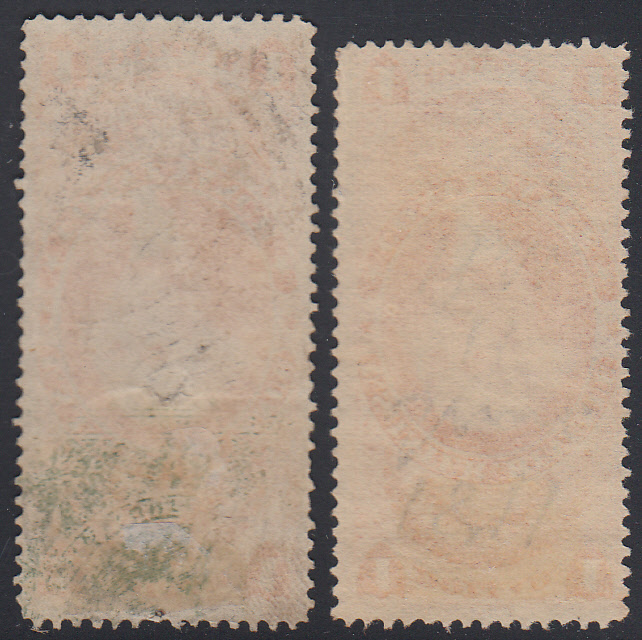
I was working on my revenues today when I noticed this. I've never seen this before. Look at the scan. I have tried to line up the designs of these two R-66c's at the bottom value tablets. Notice how they are VERY different heights. These were both scanned at the same time - no stitching together two scans. They have very different colors, as well, but I've seen all kinds of revenues with very different shades. Can anyone explain this?  |
|
Send note to Staff
|
|
|
|
|
Bedrock Of The Community
United States
10886 Posts |
|
|
Combination of problems with the perforating machines and varying rates of paper shrinkage. These stamps were issued 6 years apart. The 1871 stamp might or might not be a silk paper as well. |
Send note to Staff 
|
|
|
Pillar Of The Community
United States
1162 Posts |
|
|
Valued Member
111 Posts |
|
|
Wow, nice catch, and an amazing difference in size!
Making popcorn while awaiting expert's hot air response proclaiming "Swamp Gas" effect, and the 2 stamps are exactly alike... |
|
Send note to Staff
|
|
|
Pillar Of The Community
3865 Posts |
|
|
The stamp on the left is longer and narrower than the stamp on the right. Most likely due to vertical wove paper.
The stamp on the right is shorter and wider than the stamp on the left. Most likely due to horizontal wove paper.
|
|
Send note to Staff
|
|
|
Bedrock Of The Community
United States
10886 Posts |
|
|
I see the grade school students are posting again. For those who actually care and don't wish to sound childish, I explained the reason for the differences. |
|
Send note to Staff
|
|
|
Bedrock Of The Community
United States
10886 Posts |
|
|
They are also different papers. Not really surprising since the paper used by Butler & Carpenter came from several different mills owned by different companies. The smaller stamp has a much more noticeable mesh. |
|
Send note to Staff
|
|
|
Bedrock Of The Community
12808 Posts |
|
|
Quite a striking design dimension difference. I will be interested to hear what an expert says. Interesting. |
|
Send note to Staff
|
|
|
Moderator

United States
5109 Posts |
|
|
The vertical perforation seems to be the same, if I line up the perforation holes on the side-by-side stamps. So the most plausible cause is probably revcollector's initial statement about varying rates of paper shrinkage. The stamp on the right appears to have been printed, then had considerable vertical shrinkage before perforating. I'm sure the horizontal widths are about the same. Still, a nice item to have on a page by itself, showing the differences. Good catch. |
|
Send note to Staff
|
|
|
Rest in Peace
United States
1738 Posts |
|
|
Bedrock Of The Community
12808 Posts |
|
|
Pillar Of The Community
3865 Posts |
|
|
Agree with above shrinkage. For wet printing, shrinkage occurs upon drying after printing and before gumming across the grain of the paper. Thus, vertical shrinkage occurs on horizontal wove paper. |
|
Send note to Staff
|
|
| |
Replies: 11 / Views: 1,330 |
|




 Posted 03/31/2019 7:32 pm