|
This page may contain links that result in small commissions to keep this free site up and running.

Welcome Guest! Registering and/or logging in will remove the anchor (bottom) ads. It's Free!
To participate in the forum you must log in or register.
| Author |
 Replies: 14 / Views: 2,784 Replies: 14 / Views: 2,784 |
|
|
Valued Member
United States
399 Posts |
|
|
This stamp, Scott 93 or Stanley Gibbons 133/137 (Gibbons gives the white and blue variants different numbers)is one of the most iconic of all British stamps, and, because of its high cost, one of the most desirable. Everything about it is over the top and larger than life. First, consider the face value: five pounds. For centuries up until 1971, under the old currency, there were 240 pennies (or pence) to the pound, so this stamp cost 1200 pence, or, put another way, 1200 times the normal first class letter rate. At the current United States first class postage rate of 55 cents, that would be like the USPS issuing a stamp with a face value of $660. In the UK of the 1880's five pounds was an awful lot of money, about a month's wages for a lot of working class people. Then there was its size: 57 by 33 millimeters, when the ordinary definitives of the day were 20 by 23. It was probably one of the largest stamps of its day from anywhere in the world and is still probably the largest single stamp that Great Britain has produced, I can't think of a larger one. The one pound brown-lilac of 1884, which was reprinted in green in 1891 was slightly wider at 60 mm (that is, three times the width of the normal small size definitives, which is why they had three watermarks per stamp), but not as tall as the 5 pounder, so it was smaller in area. And then, the color was pretty striking. For the previous 40 or so years, British stamps had been printed in fairly sober colors: black, of course for the very first one, then dull reds, browns, greys, greens, so this bright orange must have seemed dazzling when it first appeared. There's a lot of information available on the internet on the origins of the stamp, it actually came into use first of all as a telegraph stamp, and was issued to pay mainly for overseas telegrams which could be prohibitively expensive and to avoid having to use multiple numbers of smaller denomination stamps. Later, telegraph stamps were withdrawn, and postage stamps were then used with the word "Telegraphs" milled out of the printing die, and the word "Postage" put in its place. Very few were actually used for postage, rather a lot were used for internal accounting within the post office, or to pay excise duty at distilleries, or for bulk mailings of advertising circulars. Quite a few were overprinted "Specimen" at the end of their service. There were just under a quarter million printed, and some estimates are that about 8,000 or so survive, so it's not a particularly rare stamp. On any given day you can find 20 or 30 for sale on ebay, with prices ranging from about $1500 at the low end to several thousand at the high end, so it's a highly desirable and sought after stamp, and a frustrating space to try to fill in many an album. An excellent lecture presented to the Royal Philatelic Society by Dr John Horsey, who also wrote the definitive book on the stamp is accessible through the Stanley Gibbons website, under the iconic stamps section. I highly recommend it. 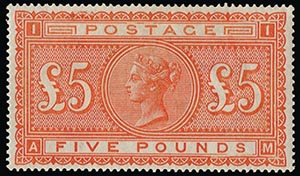  |
|
Send note to Staff
|
|
|
|
|
Pillar Of The Community
United Kingdom
8631 Posts |
|
|
Pillar Of The Community
United States
506 Posts |
|
|
Valued Member
United States
399 Posts |
|
|
Willwood 42, you're absolutely right the 1993 10 pounder is a couple of mm wider and about 7 mm taller than the Victoria 5 pounds, and in looking through the volume of my British collection that includes the 10 pound stamp,I came across something kind of cool I'd never seen before. I bought a 5 volume collection of GB a few years ago, that was virtually complete from about 1935 onwards, (except for the hundreds of Machin varieties)so I never went through some of the QE II volumes page by page, but a few pages after the 10 pound was a set of commems for the centenary of the Sherlock Holmes story, The Final Problem, Stanley Gibbons 1784-1788, and, in addition to the stamps,properly mounted, tucked in there, was a first day cover of the stamps and inset into the envelope is a genuine British penny and a British farthing from the early 1890's. The 1994 Channel Tunnel stamps, SG 1820-1823 are pretty big, too, almost but not quite as big as the 10 pounder. |
Send note to Staff 
|
|
|
Pillar Of The Community
United States
8605 Posts |
|
|
I would like to own one,it is not the price to buy one but the need to buy all those other high price early British high values that makes any collector to sit back and say Whoa !!!! I better look elsewhere ,because to collect early British the collection with one or five high values will always look like it is missing something.Most just move on ,don't even start to put serious money into early British . |
|
Send note to Staff
|
|
|
Bedrock Of The Community
12749 Posts |
|
|
Valued Member

United States
466 Posts |
|
|
It gets extra fun when you collect by plates, or (if you're a touch insane like me) by plates combined with all the Gibbons-listed color shades. Most of the high-denomination stamps have only one plate, but there are exceptions and they are mostly really tough stamps (examples: Scott #42c, Scott #55 with plate 3, #64 with plate 14, #66a with any plate besides 1, etc.) That can rise to thousands of different QV varieties, instead of the hundred or so in a basic collection. Hope your eyes are good -- and use a magnifying glass, or there's no hope!
If you want to exhaust both your patience and your bank account, you can do the above, but only with mint stamps, no used examples. Will be absolutely beautiful if you nearly complete it (you will never absolutely complete it, unless you're Queen Elizabeth with the Royal Collection or something). If you're fine with postally used stamps it's mostly an affordable venture (though of course there are still stamps that you won't get.)
Even the lower denominations can be a challenge, of course. I'm still missing ten plates on the basic Penny Red Scott #33: 77 of course, 225 understandably, and a few others (132, 161, 210, 211, 215, 219, 221, 223) that are mostly low catalog value and supposedly common, they just haven't turned up yet, used or unused, in all the thousands of Penny Reds I have handled. Finally "completing" that (sans 77) will be satisfying though. |
|
Send note to Staff
|
|
|
Valued Member
United Kingdom
439 Posts |
|
|
Slightly off topic but the biggest GB stamp I know of (I collect up to the end of 2000) was issued in April 1980. It is Scott 909 A black and white composite picture of some of Londons' major landmarks. It is about twice the size of the £5.00 orange. |
|
Send note to Staff
|
|
|
Pillar Of The Community
United States
506 Posts |
|
|
Measurements for my copies of 909 & 1483 are as follows: 909 total stamp 42x57=2384, image only 40x55=2200; 1483 total stamp 60x40=2400, image only 60x39=2340. So it is close, but I still think 1483 is larger. |
|
Send note to Staff
|
|
|
Valued Member
United States
399 Posts |
|
|
Reply to Noocassel: I'd forgotten about Scott 909, I suppose because I don't remember seeing one detached from the souvenir sheet.
Reply to codehappy: I must be a touch insane, too because I also have a plate collection: the entire set of Scott 33(SG 43) minus the 77 of course, mind you, I cheated a little by buying the complete set already assembled, including even the elusive 225. It's not a great copy, but not terrible either. I also have a few interesting "extras" in my GB oollection: a few pre-stamp covers, including a Bishop mark, the two authorized bisects, used in Guernsey in 1940-41 (see the footnotes in Scott after GB 248 and 257, if you're not familiar with these), and my "vanity" pages: about 25 of the Queen Victoria stamps with my initials as the corner letters. |
|
Send note to Staff
|
|
|
Pillar Of The Community

United States
1951 Posts |
|
|
Valued Member
United Kingdom
439 Posts |
|
|
I've just measured the stamps in question the orange is 57.5mm by 33mm the 1980 Views of London is 58.5 mm by 33 mm. The orange is bigger than I remembered but looking at the two together, as I am, it is patently obvious which is bigger.
The two times I've been at an auction when a £5.00 has come under the hammer the excitement in the room is almost palpable before the bidding even starts. |
|
Send note to Staff
|
|
|
Valued Member
United States
466 Posts |
|
|
Here's a Penny Red question for UK specialists. I peeked in my Gibbons British Commonwealth catalog, and I see that it gives SG 43 for the rose red variety, and SG 44 for the lake red variety (Scott lists this as a minor number, #33b -- this issue is one of the few in Scott where shade varieties are given. It also gives a "brick red", #33a, which is just a darker shade of the lake red.)
Do the lake/brick red shades occur with all plates (except 77, those all must have been printed with the same batch of ink and maybe even came from a single sheet), or are they only found with certain plates? I'd like to put together most or all of the plates for SG 44 as well, but it does not seem that Gibbons lists which plates exist for #44, at least in the British Commonwealth catalogue, and Scott and Michel certainly don't give that kind of detail for British stamps.
I can figure most of it out myself by simply obtaining a huge number more of penny reds and seeing how they sort out, but if this is already documented somewhere (I'm sure it is) I'd like to know. |
|
Send note to Staff
|
|
|
Valued Member
United States
399 Posts |
|
|
I just realized something in regard to my comment in my original post, and that is the multiple of the first class rate that the 5 pounder represented, and I said that in the US this would mean a stamp with a face value of $660. But in the UK, where this comparison would be more relevant, at the current rate of 67 P (I believe that these days it goes up every year)this would mean a stamp with a face value of 804 pounds! an insanely huge amount of money, and outside of inflation issues the only stamps I know of that come even close are revenue stamps from the government (or "States") of Jersey issued a few years ago that had face values of 50, 100 and even 500 pounds, and these were real, not inflationary pounds. 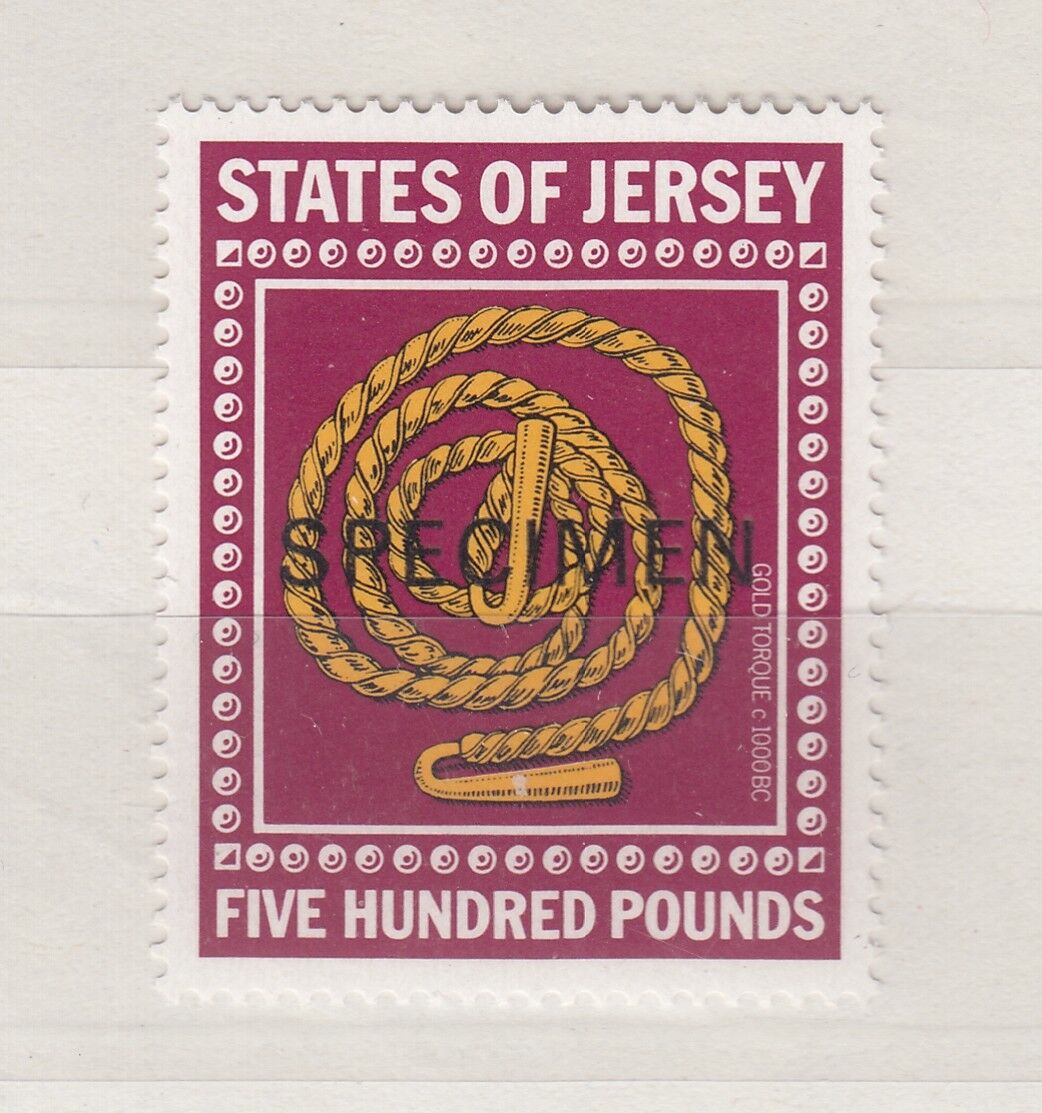 |
|
Send note to Staff
|
| Edited by waddsbadds - 05/08/2019 9:20 pm |
|
|
Valued Member
United Kingdom
439 Posts |
|
|
I have looked in my SG specialised stamp catalogue vol 1 and as far as I can see it doesn't mention which plates used which colour, That doesn't mean the info isn't in this book (especially a more up to date edition, mine is the 5th ed. 1977) because to be quite honest I struggle to even find the right part of the book to look in. The book recommends THE GB JOURNAL between jan '74 and may '77, Published by the GB philatelic society as an extra source of information. Personally I aint no expert.
|
|
Send note to Staff
|
|
| |
Replies: 14 / Views: 2,784 |
|
|
To participate in the forum you must log in or register. | |
Disclaimer: While a tremendous amount of effort goes into ensuring the accuracy of the information contained in this site, Stamp Community assumes no liability for errors. Copyright 2005 - 2026 Stamp Community Family - All rights reserved worldwide. Use of any images or content on this website without prior written permission of Stamp Community or the original lender is strictly prohibited.
Privacy Policy / Terms of Use Advertise Here |
| Stamp Community Forum |
© 2007 - 2026 Stamp Community Forums |
| It took 0.21 seconds to lick this stamp. |
 |
|
|
|


 Posted 05/01/2019 12:44 am


