| Author |
 Replies: 36 / Views: 4,460 Replies: 36 / Views: 4,460 |
|
|
|
Pillar Of The Community
3865 Posts |
|
|
Pillar Of The Community
3865 Posts |
|
|
stamperix: Do the stamps with 200 subject printing plates have vertical or horizontal grain wove paper? Do the stamps with 100 subject printing plates have vertical or horizontal grain wove paper? |
Send note to Staff 
|
|
|
Pillar Of The Community
3865 Posts |
|
|
The following has been found with regards to the above: "In the issues between 1895 and 1903, the paper was fed through the press so that the watermark letters read horizontally on 400-subject sheets and vertically on 200-subject sheets." Reference http://stampsmarter.com/learning/Ma...SStamps.htmlHowever, this refers to the watermarked stamps printed by the BEP from 1895 to 1903 and not to the unwatermarked Columbians from 1893 printed by the ABN. Also, a horizontal watermark would most likely be found in a vertical grain paper and a vertical watermark would most likely be found in a horizontal grain paper. |
|
Send note to Staff
|
| Edited by jogil - 02/17/2020 09:00 am |
|
|
Pillar Of The Community
3865 Posts |
|
|
It may be that all of the 1 cent Columbians and most of the 2 cent Columbians have vertical wove paper and these were printed with 200 subject printing plates.
It may be that some of the 2 cent Columbians and all of the other Columbians up to $5.00 have horizontal wove paper and these were printed with 100 subject printing plates.
Thus, there would be a paper variety between the 2 cents. However, evidence and confirmation of this is needed. |
|
Send note to Staff
|
|
|
Pillar Of The Community
3865 Posts |
|
|
Does anyone have any used copy of any 3 cents or higher denominated U.S. Columbian stamps that they can scan the back of so that the paper grain direction can be examined closer? |
|
Send note to Staff
|
| Edited by jogil - 03/02/2020 09:19 am |
|
|
Valued Member
170 Posts |
|
|
I do have some cancelled Columbians I could scan but I am not sure how you would like them scanned. Just scanned on a flatbed scanner?
I visually checked my cancelled 231s (quantity 20) and found 5 small ones (vertically). Just a random sample probably. So, looks like maybe 25% (or thereabouts) of the extant population are small (horizontal woven correct?) |
|
Send note to Staff
|
|
|
Pillar Of The Community
6366 Posts |
|
|
paper direction ratio?
Thomas Corette's article "The 2-cent Columbian Broken Hat: Accidental or Deliberate" in the 1992 American Philatelic Congress Book notes on page 35 there were produced 90 of the 200-subject plates and 45 of the 100-subject plates. Assuming equal use of all plate and formats (bad science, I know.), it would make a ratio of 80:20, not far off of the 25% from the small sample examined above. |
|
Send note to Staff
|
|
|
Pillar Of The Community
3865 Posts |
|
|
Banknoteguy: A flatbed scanner would be OK. Thanks.
|
|
Send note to Staff
|
| Edited by jogil - 03/02/2020 1:38 pm |
|
|
Valued Member
170 Posts |
|
|
John Becker said, Quote:
paper direction ratio? Yes. I can see the difference in size but I can't tell the direction of the paper weave from the image below. Can others? Shot back lit with digital camera on stand.  |
|
Send note to Staff
|
|
|
Pillar Of The Community
3865 Posts |
|
|
Valued Member
170 Posts |
|
|
After thinking about this awhile, I can't see how whether the paper is woven in one direction or another can make the same plates print a stamp larger or smaller in a flat plate process. My only conclusion is that there are different plates that were used in printing the 100 stamp panes versus the 200 stamp panes and that perhaps different kinds of paper were consistently used for the two different sized plates. But more importantly the two different plates were engraved with different sized designs. Not sure of how this could happen. I decided to do a careful side by side image, to convince myself that there is indeed a difference. Yeah I know, I picked 5 out of 20 visually but I just wanted to be thorough. Image below. And yes, there is a definite difference in height of pretty exactly .25mm. I have other images of 5,6,8,10 but I am not sure they tell me much. I will post some later.  |
|
Send note to Staff
|
|
|
Pillar Of The Community
United States
1414 Posts |
|
|
No. If a size difference exists it is due to paper shrinkage because paper orientation for the 100 subject plates was different from 200 subject plates. Has anyone searched the Classics Society and the United States Stamp Society Bureau Specialist archives or searched the American Philatelic Research Lib Library database? |
|
Send note to Staff
|
|
|
Pillar Of The Community
3865 Posts |
|
|
banknoteguy: For wet printed stamps, paper with a vertical grain tends to shrink horizontally when drying and paper with a horizontal grain tends to shrink vertically when drying. Here is a comparison of both of your stamps regarding their frame design widths. 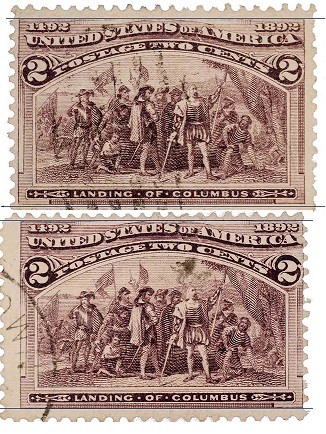  cfrphoto: An email was sent to the USPCS over a week ago asking this but no answer has been received yet. |
|
Send note to Staff
|
| Edited by jogil - 03/03/2020 2:28 pm |
|
|
Valued Member
170 Posts |
|
|
OK, that makes sense.
So, I think I took one over under and I think I did not see a difference in size horizontally but I will go back a check that image and post it if it is as good as the one above or do another one. |
|
Send note to Staff
|
|
|
Valued Member
170 Posts |
|
|
No I either mis remembered or did not look closely enough. There is a similar difference horizontally also. Image below.  |
|
Send note to Staff
|
|
|
Replies: 36 / Views: 4,460 |
|




 Posted 02/12/2020 2:10 pm


