| Author |
 Replies: 7 / Views: 1,130 Replies: 7 / Views: 1,130 |
|
|
Rest in Peace
United States
1738 Posts |
|
|
|
|
Pillar Of The Community

723 Posts |
|
|
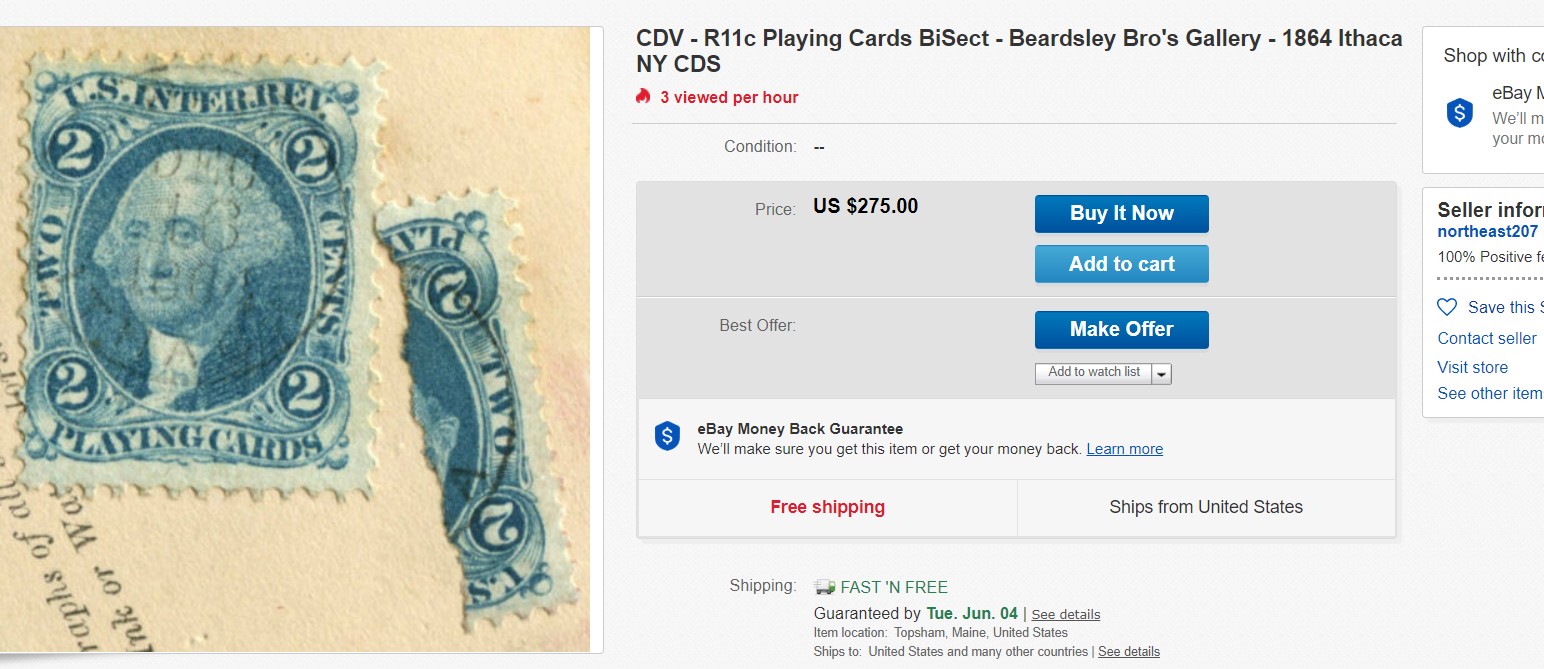
Why is the half stamp not have a cancel extending onto the card. Seems suspect. The other SOTN seems a good candidate for transfer to this. My guess is stamps were damaged and bisect usage is a really good way to manufacture value where there is none.
|
Send note to Staff 
|
|
|
Pillar Of The Community
United States
939 Posts |
|
|
So, I just shuffled through several CDV's on ebay and those that had a hand stamp cancel no ink transfered to the card. Was it the practice to hand stamp cancel tax stamps prior to sticking them on the CDV? Seems suspicious to me. |
|
Send note to Staff
|
|
|
Bedrock Of The Community
United States
10803 Posts |
|
|
It was often the practice to handstamp revenues before use. Prevented theft that way. Remember, the tax was paid when the stamps were purchased. After that it was up to the taxpayer to use them correctly, but pre-canceling them was not a problem. Unless legal action was taken, no one saw them except the people directly involved.
Having said that, I have serious doubts as the validity of this "bisect". The cancels do not appear to match, the bisect portion appears to small, and it sets off alarm bells because of this. |
|
Send note to Staff
|
|
|
Bedrock Of The Community
12683 Posts |
|
|
Bedrock Of The Community
United States
10803 Posts |
|
|
Since there is no such thing aa a two and a half cent rate at the time, there is no reason for a quadrisect. |
|
Send note to Staff
|
|
|
Pillar Of The Community
United States
6459 Posts |
|
|
I agree with Bart's assessment.
Determining legitimacy of bisects on CDVs is very difficult, as:
1. Photographers were so prone to precanceling stamps (CDVs were frequently stored by stacking them, making wet cancel ink likely to offset onto the CDV above or below it, hence the prevalent use of precancels, both handstamped and manuscript).
2. Determining the actual rate due is frequently difficult and nonapparent, unlike with financial instruments. The tax rate would depend on the cost, which isn't explicitly stated, and could include several factors, including type of photo, size of photo, hand tinting services, etc. Also, while nominally illegal, photographers would frequently "gang" revenue stamps paying the tax on a group of CDVs onto one or two CDVs of the group rather than applying the specific tax to each individual CDV. In a vacuum, you don't necessarily know what the revenue stamps were explicitly paying for, and therefore what the tax amount should be. |
|
Send note to Staff
|
|
| Edited by revenuecollector - 05/31/2019 07:25 am |
|
|
Valued Member
United States
13 Posts |
|
|
The hand precancelling was probably not so much as a theft prevention measure for photographers as it was a solution to avoid ink offsets on the face of card photos, which were routinely stacked like baseball cards. No intelligent person would pay more than a few bucks for this cdv and no expertizer would bless it as a bisect. |
|
Send note to Staff
|
|
| |
Replies: 7 / Views: 1,130 |
|




 Posted 05/30/2019 8:01 pm