|
This page may contain links that result in small commissions to keep this free site up and running.

Welcome Guest! Registering and/or logging in will remove the anchor (bottom) ads. It's Free!
To participate in the forum you must log in or register.
| Author |
 Replies: 9 / Views: 3,863 Replies: 9 / Views: 3,863 |
|
|
Valued Member
United States
86 Posts |
|
|
Dad had a group of items that a descendant of Dr. R. W. Hamilton gave him, probably in the 1960s. Dr. Hamilton had served as postmaster at Hillsborough/Whitewater in neighboring Wayne County, Indiana, from 1849 to at least 1852. After his wife died in 1854, he remarried and moved a few miles away to Dad's and my hometown of Lynn in Randolph County. Dr. Hamilton practiced medicine at Lynn and served in the Union Army from 1861 to 1863 as commander of Company C in the 19th Indiana Volunteer Infantry. I inherited the Dr. Hamilton items in 2000. One of those items was this sales letter addressed to a local postmaster. Since this letter came with covers addressed to Dr. Hamilton, including one that identified him as postmaster, we always assumed this sales letter had been addressed to Dr. Hamilton as well. However, we didn't have the cover. One of the interesting, and confusing, things about this letter is the use of the term "postage stamps" when referring to hand canceling devices. I don't know, but assume the use of that terminology for a canceling device was unique to Rippon & Co. A transcription of the letter's text is presented below the letter's image. Tom 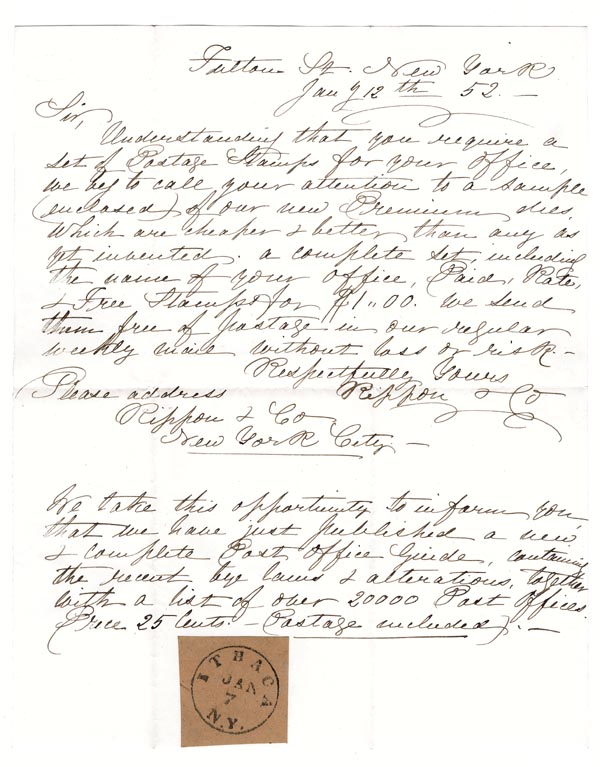 Fulton Street New York Jany 12th 52 __ Sir, Understanding that you require a set of postage stamps for your office, we beg to call your attention to a sample (enclosed) of our new premium dies which are cheaper and better than any as yet invented. a complete set, including the name of your office, Paid, Rate, and Free stamps for $1.00. We send them free of postage in our regular weekly mail without loss or risk. __ Respectfully yours Rippon + Co. Please address Rippon + Co. |
|
Send note to Staff
|
|
|
|
|
Pillar Of The Community
United States
1179 Posts |
|
|
Pillar Of The Community
United States
3521 Posts |
|
|
The hand stamp devices are routinely referred to in ads just as "stamps", at least in manufacturer advertising circulars distributed to postmasters. I definitely acknowledge that I haven't seen the exact use of "Postage Stamps" to describe these. I agree that's pretty misleading.
Frank Mandel authored a nice article on the Development of Handstamped Markings in the United States to 1900 in the PF Seminar Series Textbook #3. In it he illustrates several of these circular ads. I'm sure I've seen some others as well, over time.
I see use of:
"stamps"
"Postmasters Stamps"
"Post Office Stamps"
Honestly, I've always thought all of the above are misleading and without context, do not adequately describe that these are really handstamps. |
Send note to Staff 
|
| Edited by txstamp - 06/26/2019 7:54 pm |
|
|
Pillar Of The Community
United States
3521 Posts |
|
|
I suspect that the point of confusion is because hand stamps pre-date postage stamps, and at this time, at least, the terminology hadn't sufficiently evolved. |
|
Send note to Staff
|
|
|
Pillar Of The Community

United States
943 Posts |
|
|
Frank Mandel also wrote up one vendor of these devices in the Congress Book NO. 53 (1983) in an article "Identification of Postmark Types Produced from Handstamps Made by Edmond S. Zevely, 1850-1861."
For APS/APRL members, this article can be found in their Digital Archives.
I also believe that Robert Dalton Harris did an article or two on the manufacturers of these handstamp devices. I don't have the precise citation, but suspect it was in an issue their "P.S. (Postscripts:), A Quarterly Journal of Postal History", which is also available in the APRL Digital Library. |
|
Send note to Staff
|
|
|
Pillar Of The Community
United States
716 Posts |
|
|
HoosRec, txstamp, and all.
First US postage stamp was issued in 1847 so this add is contemporary with their early use. However, the USPO specifically did not allow the use of a post marking device which your example clearly is to cancel or "obliterate" postage stamps to prevent their reuse. The required method was to give the stamp three strokes of a pen dipped in a good quality ink.
Still, Tom, it's a very nice piece. Just wish you had the accompanying envelope it was mailed in. Any old registered stuff in the good doctor's material?
Best regards, Russ
|
|
Send note to Staff
|
|
|
Valued Member
United States
86 Posts |
|
|
Thanks, all, for the additional information.
Russ, there weren't very many covers in the group and none of them was registered. |
|
Send note to Staff
|
| Edited by HoosRec - 06/28/2019 01:26 am |
|
|
Pillar Of The Community
6360 Posts |
|
|
Regulations on canceling stamps:
Russ, No, not quite.
There is nothing improper with using the townmark to cancel the stamp in the era of Tom's letter. Specifically:
1847: "Section 501. Stamps so affixed are to be immediately cancelled in the office in which the letter or packet may be deposited, with an instrument to be furnished to certain of the post offices for that purpose. In post offices not so furnished, stamps must be cancelled by making a cross X on each with a pen. ..." From "Postal Laws and Regulations of the United States of America, 1847," page 70. Wierenga reprint, 1980.
1851: "All postage stamps affixed to any letter, or packet, or parcel of any description, must be immediately and effectually cancelled in the office in which the letter, packet, or parcel may be deposited for delivery or transmission. At the larger offices they will be cancelled with an instrument to be furnished by the Department. In post-offices not so furnished the stamps must be thoroughly cancelled by making several heavy crosses or parallel lines upon each of them with a pen dipped in good black ink.. The cancelling instrument should be used with black printer's ink, when that material can be obtained." Eli Bowen's "United States Post-Office Guide, 1851", page 351. Arno Press reprint, 1976.
1860: "The use of townmarks to cancel stamps was banned by the U.S. Post Office Department edict after 1860." Richard B. Graham's "Postal History Sampler", p16. Thus the proliferation of duplex postmarks after this date.
1866: "Sec 176. Postage stamps affixed to letters, packets, or parcels of any description, and all stamped envelopes, must be immediately cancelled in the office in which they may be deposited for transmission or delivery. The cancellation should be effected by the use of black printing ink, whenever the material can be obtained; and where it cannot, the operation should be performed by making several heavy crosses or parallel lines upon each stamp, with a pen dipped in good black writing-ink. ... Sec 178. The use of the office rating or post-marking stamp as a cancel instrument is positively prohibited, inasmuch as the post-mark, when impressed on the postage stamp, is usually indistinct, and the cancellation effected thereby is imperfect. The postage stamp must therefore, be effectually cancelled with a separate instrument." From "The Postal Laws and Regulations, compiled by Joseph A. Ware." 1866, sections on regulations, page 27.
|
|
Send note to Staff
|
|
|
Pillar Of The Community
6360 Posts |
|
|
Russ, No wayback machine is needed. The regulations are clear. Re-read and compare those quoted above AND your own experience with pre 1861 covers. Prior to c1/1/1861, the CDS is the primary stamp cancel with the pen stroke as the secondary alternative. After c1/1/1861, the CDS is prohibited, consistent with the "Postmasters Assistant" you cite. It is important to apply the regulations to the period they actually cover. You seem to be applying 1860s regulations to the 1850s.
Reuse: The 1866 regulation is clear, the purpose of the postmark on the envelope is clarity. It does not mention reuse/washing.
Also, please cite your source for "three strokes". The sources I find all say "several". |
|
Send note to Staff
|
|
|
Valued Member
United States
86 Posts |
|
|
Thanks, John, for presenting the regulations for that era. Since I have never collected covers, I have never taken the time to learn about the evolving regulatory environment postmasters and clerks were dealing with. Evolving regulations seems to have become a well-entrenched modus operandi for the POD/USPS. |
|
Send note to Staff
|
|
| |
Replies: 9 / Views: 3,863 |
|
|
To participate in the forum you must log in or register. | |
 Kenmore Stamp Company Joins Mystic Scotts Catalog New Vs Older Questions Cover Calendar For Month And Day -Pics For Today's Dilemma, We Look At A Japanese Cover Postmarks.day By Day Indypex 2026, September 18, 19, And 20, 2026 Last Of My Australian Recent Charity Kiloware Has Happened Modern Art In Outdoor Spaces: Sculptures, Murals, Street Art, Etc. Pushing 330,000 All Different Worldwide Stamps In One Collection . What Did You Do Philatelically: Today Or Recently? Kem Playing Cards Still Sealed, Year? Lets See Jewelry On Stamps! Globes Watches, Clocks, Timekeeping On Stamps The End Of The Chicago Philatelic Powerhouse . The Stamps Of Indo-China. Help With 3 Cent Queen Victoria Stamp Type/Color? Pacific And American Mythologies The Strand Stamp Fair Closes After 57 Years Serbia 2025 - Second Half Of The Year: Bridges, Bridges, Bridges! On Stamps Statues On Stamps Modern Industrial Art And Design Nashville Philatelic Society-Your Invitation To Our Auction Night Meeting Monday, September 28, 2026 Norse Mythologies On Stamps Kenmore Stamp Company Joins Mystic Scotts Catalog New Vs Older Questions Cover Calendar For Month And Day -Pics For Today's Dilemma, We Look At A Japanese Cover Postmarks.day By Day Indypex 2026, September 18, 19, And 20, 2026 Last Of My Australian Recent Charity Kiloware Has Happened Modern Art In Outdoor Spaces: Sculptures, Murals, Street Art, Etc. Pushing 330,000 All Different Worldwide Stamps In One Collection . What Did You Do Philatelically: Today Or Recently? Kem Playing Cards Still Sealed, Year? Lets See Jewelry On Stamps! Globes Watches, Clocks, Timekeeping On Stamps The End Of The Chicago Philatelic Powerhouse . The Stamps Of Indo-China. Help With 3 Cent Queen Victoria Stamp Type/Color? Pacific And American Mythologies The Strand Stamp Fair Closes After 57 Years Serbia 2025 - Second Half Of The Year: Bridges, Bridges, Bridges! On Stamps Statues On Stamps Modern Industrial Art And Design Nashville Philatelic Society-Your Invitation To Our Auction Night Meeting Monday, September 28, 2026 Norse Mythologies On Stamps
Disclaimer: While a tremendous amount of effort goes into ensuring the accuracy of the information contained in this site, Stamp Community assumes no liability for errors. Copyright 2005 - 2026 Stamp Community Family - All rights reserved worldwide. Use of any images or content on this website without prior written permission of Stamp Community or the original lender is strictly prohibited.
Privacy Policy / Terms of Use Advertise Here |
| Stamp Community Forum |
© 2007 - 2026 Stamp Community Forums |
| It took 0.19 seconds to lick this stamp. |
 |
|
|
|


 Posted 06/26/2019 6:28 pm


