This is something I don't recall seeing before, and I almost missed it on this stamp. The stamp is a used copy of Liberia Scott #45. The catalog says the stamp should have watermark 143 and it does. My watermark fluid shows the design similar to the 143 example in the Scott catalog. The exception is that the one horizontal block isn't visible to me. Here is what prompted my post.
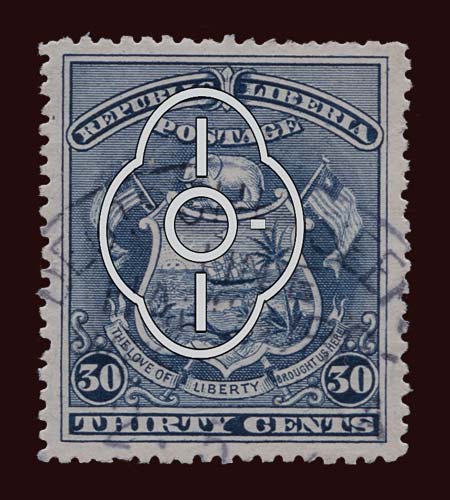
I scanned this stamp to prepare it for sale. When I looked closely at the scanned image, I could see three narrow curved white line segments. When I looked closely at the stamp itself and held it at a sharp angle to a bright light and then rotated the stamp, a double-line impression of the watermark design was revealed on the face of the stamp. Closer inspection revealed these white lines were actually light reflecting off the inner and outer edges of the watermark impression.
I've created a rough diagram of the design and have overlaid it onto an image of the stamp. I didn't do any measuring. I just eye-balled the design components and drew them to approximate sizes and placed the total composite watermark figure in the approximate location where it appears on the stamp. (The left horizontal element is not visible on the face of the stamp). The diagram's black outer edges represent the actual reflective white lines I see with the bright light. The white inner areas are the indented areas of the watermark on the face of the stamp. There is no visible impression on the back of the stamp.
Is this a relatively common characteristic of paper watermarks that I've just never noticed before? I've looked closely at a few thousand stamps over the years and don't recall seeing this. Since I'm preparing to list this stamp for sale, how would you recommend describing this. If this is an unusual situation, is it a fault? Since it's a watermark impression in the paper and maybe more common that I realize, does it warrant any mention at all in the sale description? I appreciate your thoughts!
Tom





 Posted 08/04/2019 2:36 pm


