| Author |
 Replies: 12 / Views: 6,724 Replies: 12 / Views: 6,724 |
|
|
Pillar Of The Community

United States
812 Posts |
|
|
Both Scott and Yvert list variants with "groundwork inverted." Can someone explain what that means? To me, the groundwork here of little diamond-like figures looks the same whether rightside up or upside down. Am I looking at the wrong element? 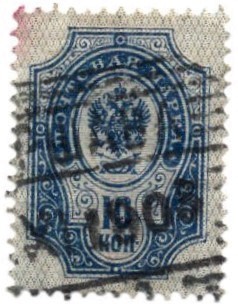 |
|
Send note to Staff
|
|
|
|
|
Valued Member
189 Posts |
|
|
I am brand new to Russian philately (I just started today!). My Zagorsky catalog lists an inverted spandrel variety of the 10k stamp, but I don't see anything about inverted groundwork. My hunch is inverted groundwork and inverted spandrel are actually the same thing. I'm also thinking the groundwork has more intricate detail than merely the diamond-shaped pattern, so it is truly invertible. I don't actually have any of these stamps, so I can't check. Just like EMaxim, I probably need clarification or correction on this subject. |
Send note to Staff 
|
| Edited by rmatossian - 09/25/2019 10:30 pm |
|
|
Pillar Of The Community
United States
3224 Posts |
|
|
You have the groundwork correctly defined. It is not symmetrical. Each diamond shape in the margins is supposed to have two dots in each. Sometimes one or both are missing throughout the overall pattern, but there should be some diamonds with two dots within.
Normal groundwork is where one dot is about centered in the diamond and the other is below it. So inverted groundwork is the other way, one dot about centered and the other above it.
The ones with crowns are easier as the inverted groundwork stamps have an inverted white space in the shape of the crown showing. A fair number but not all of inverted groundwork stamps seem to show some kind of shift in the groundwork, too. That does not mean any shift means there is inverted groundwork.
|
|
Send note to Staff
|
|
|
Pillar Of The Community
United States
7104 Posts |
|
|
There were many threads here with good pictures. I can't say if the photobucket fiasco affected that. Here is one example: https://goscf.com/t/12645If you search for inverted groundwork, you'll find many more. |
|
Send note to Staff
|
|
|
Pillar Of The Community
United States
812 Posts |
|
|
Thanks to everyone, especially to hy-brasil for the immediate solution, but also to Cid for that link to a truly fascinating thread. There we finally get a very clear and precise picture that shows what hy-brasil describes. Great example of the great value of this community forum. Hats off to all involved.
Eric |
|
Send note to Staff
|
|
|
Pillar Of The Community
United Kingdom
3220 Posts |
|
|
Off topic, but it's nice to see a Warsaw postmark in the original post. |
|
Send note to Staff
|
Nigel |
|
|
Pillar Of The Community
United States
812 Posts |
|
|
This gets better and better. Nigelc: I didn't pay any attention to the postmark. Can you explain how to identify it as Warsaw?
Eric |
|
Send note to Staff
|
|
|
Pillar Of The Community
United States
812 Posts |
|
|
And in sum, regarding inverted groundwork: They begin to appear in the designs of 1866-70 and continue to appear right on through the 1909-12 issue. If the design includes a crown, the inverted groundwork is identified by the phantom crown that appears as a white space at the bottom of the stamp. If the design has no crown, we look at the two dots inside the diamond shapes (rhombi) that form the pattern of the groundwork. There will usually be one dot near the center of each diamond and a second dot either above or below the one in the center. If that second dot is below the first, the groundwork is properly positioned. If the second dot is above the first, the groundwork is inverted. If any of this is wrong, please let me know. |
|
Send note to Staff
|
|
|
Pillar Of The Community
United Kingdom
3220 Posts |
|
|
Off topic: reply to an old post from EMaxim about the postmark in the original post. Hi Eric, I was checking this old thread when I noticed I hadn't replied to your question about the postmark. Sorry about that. For a time, various postmarks with patterns of horizontal lines were used in Warsaw and also, I believe, in St Petersburg. The stamp here has the partial city name at the top, "RSHAVA" (in Cyrillic), short for "VARSHAVA" (Warsaw). Here are a few others in different formats from my collection:  |
|
Send note to Staff
|
Nigel |
|
|
Pillar Of The Community
United States
1026 Posts |
|
|
Here is the best picture I could find showing the inverted background. As I said before, looking at the actual background dots doesn't really help, the big area under the crown is too obvious to ignore. :)  |
|
Send note to Staff
|
|
|
Pillar Of The Community
Netherlands
6641 Posts |
|
|
That is spectacular and helps when there is a crown. Neither OP's example, nor the 10 kopeke example Pshann posted have the crown. I think it would be helpful to post it in this thread: https://goscf.com/t/87270 |
|
Send note to Staff
|
| Edited by NSK - 07/12/2024 2:15 pm |
|
|
Pillar Of The Community
United States
1026 Posts |
|
|
Pillar Of The Community
United States
812 Posts |
|
|
Nigel,
Just got around to reading your last post above. Very helpful indeed. Thanks for the follow-up.
Eric |
|
Send note to Staff
|
|
| |
Replies: 12 / Views: 6,724 |
|




 Posted 09/25/2019 9:25 pm


