| Author |
 Replies: 697 / Views: 136,264 Replies: 697 / Views: 136,264 |
|
|
|
Valued Member
United States
106 Posts |
|
|
KGV Collector, Where do you get these lamps. Where I am living there are no stores that carry anything like them, and I have not been sucessful on the web. can you help.
Conn |
Send note to Staff 
|
| Edited by King Conn - 05/21/2010 01:04 am |
|
|
Pillar Of The Community
Australia
4034 Posts |
|
|
Conn I got mine through the Australian distributor for the German company Lighthouse. The German contact I believe is-- www.leuchtturm.com. They are a bit expensive at $45 each. Got mine at $40 each buying bulk. The UK company has them as well and many hobby suppliers.It is very important to get Long wave. A Long wave and Shortwave combo is a very expensive unit.
Full catalogue description!
Ultra-violet lamp
For detecting fluorescence and checking stamps, banknotes and credit cards. A wide spectrum of long wave UV rays. Peak radiation at 366nm. 4watt bulb. Double insulation. Mains operated with 220-230v--50-Hz power supply. Overall size, 180x115x75mm Ref. No R 80.
I said I had 6watt but it is 4watt. Hope it is of some help. KGV
|
|
Send note to Staff
|
| Edited by KGV Collector - 05/22/2010 07:11 am |
|
|
Pillar Of The Community
Australia
4034 Posts |
|
|
The order of progress for myself as a KGV penny red collector was to buy a very good reference book that includes shade printing dates, plate flaws that tie into printing dates, day light shade descriptions, long wave UV reaction shade dates and descriptions.
Collect as many dates on penny reds as possible. Looking for as many shade differences as possible within any given year. The hardest years for dates are 1917, 1918 and 1919. Rough paper penny reds are the hardest to find with dates. It can take many years to collect enough dated stamps to progress to shade detection.
At this point I purchased my long wave UV lights and I am still lacking in rough paper dated examples.
This process has taken me more than 8 years and I am only at the very beginning of understanding smooth paper shades. I have not identified a rough paper shade as yet.
It must be kept in mind that a Mr Blogg identified 422 penny red shades. It gives us an idea on how many dated examples we need to understand penny red shades! |
|
Send note to Staff
|
|
|
Pillar Of The Community
Australia
4034 Posts |
|
|
Daylight shade identification v long wave UV identification.
I believe we need to use both forms to tackle shade naming of penny reds.
UV shows up fade lings and changelings with great ease. Where day light identification will send you crazy because so many stamps are faded for one reason or another.
Two different day light shades maybe very hard to tell apart but under UV the difference is great and it works the other way around as well. A good reference book notes all these little tricky areas. Using both methods to understand penny red shades is the modern day miracle. Just about anybody can understand shades in this day where in the past only a very few mastered this extremely difficult form of collecting KGVs. We just have to take it step by step and will all come clear. Getting the right information and dated stamps is the hardest part the rest is time and not giving up. Happy stamping KGV! |
|
Send note to Staff
|
|
|
Valued Member
United States
106 Posts |
|
|
KGV Collector Your first reply brought me back to reality. I must watch the voltage on what I buy. The United States is sadly behind the rest of the world on voltage distribution systems. Our standard service is 120-240 V 60Hz. The 240v is used only for water heaters range ovens and heavy duty motors for Air Condoning etc. All lighting small appliances computer set all are 120v.
It is one of the limiting factors of the U.S. distribution system. I should know, I worked for Nevada Power Company in Las Vegas for 36 yrs. Retired as V.P. Rates and Regulatory Affairs.
I'm sure I can find some 120v. UV lamps, but I will never get finished with the categorizing of the KGV ONE PENNEY stamps because I'm 85, but it will keep me busy and interested for some time.
Again, thanks for all your help.
Conn
|
|
Send note to Staff
|
|
|
Pillar Of The Community
Australia
1658 Posts |
|
|
Very nice presentation John and very educating mate,have enjoyed this thread from the onset or at least the times I was home and got to read this thread between packing and unpacking suitcases,I noticed you didn't include in your study the 4 penny lemon is that because there aren't that many around or the prohibited costs of these stamps If you don't mind me asking.
regards Harry
|
|
Send note to Staff
|
|
|
Pillar Of The Community
Australia
1658 Posts |
|
|
Also thanks to Rod222 for all you input,this thread did escalate with all the banter and was a great read.
thanks and regards to all
Harry |
|
Send note to Staff
|
|
|
Pillar Of The Community
Australia
4034 Posts |
|
|
Conn! I have been thinking which is always dangerous!
Maybe I have gone far to tecko with the penny reds. Maybe we need to simplify with out being simple.
The great joy of penny red shade collecting is to just see the changes of shade in the collection on the pages, to admire and see the effort of our labours.
If a page per shade type was set out eg,Reds,Pinks,yellows,browns,blues,oranges and sub groups light types, dark types and set out on the page in a progressive shade movements is all we really need to do. This approach is certainly a very good way of collecting shade types and it would look very impressive. It could really be the way to go for you to use day light shade progression. It is no insult and I believe many people use this approach with much contentment!
A battery operated long wave UV light could help a little with this approach! I think we need to think outside the square a bit to suit the situation here. Anyway something to think about. John |
|
Send note to Staff
|
|
|
Pillar Of The Community
Australia
4034 Posts |
|
|
Harry thank you very much for your comments.
Shades is something I have tried to avoid in the image sense as it can be very misleading. It hurts me greatly that on line we can not share and learn from each other about shades. In my isolated position in stamping shades in general I lack very much with. I have taught myself penny red shades and because of this it has taken me a long time to sort them out and I am still very much a learner but onward I go. I simply love my penny red shades! John |
|
Send note to Staff
|
|
|
Valued Member
United States
106 Posts |
|
|
John - I think you are right. I'm getting way ahead of myself. A simpler approach for me right now is the way to go.
And once again many thanks for all the information. Conn |
|
Send note to Staff
|
| Edited by King Conn - 05/27/2010 8:08 pm |
|
|
Pillar Of The Community
Australia
4034 Posts |
|
|
I have not looked at this thread for some time now.
This is one of the best times I have ever had.
It reminds me of how isolated a collector I was.
Have not had a new KGV stamp to add to the collection
since that memorable purchase for me of the N.W. Pacific Island
over prints, posted some pages back.
Yep! I owe SCF heaps! Thanks to everyone!
I am now a better person because of it all! John |
|
Send note to Staff
|
|
|
Pillar Of The Community
United Kingdom
1356 Posts |
|
|
Hi John, Can I thank you 100 times for this thread, it was my chink in the door to SCF, when I began to go through my inherited collection, starting with the KGVs. I must have found it when googling, it was so hugely helpful and informative. It opened my eyes not just to the KGV stamps, but to the Stamp Community Family. For that I will always be grateful to you.    |
|
Send note to Staff
|
| Edited by stampgal - 09/23/2010 2:18 pm |
|
|
Pillar Of The Community
Australia
4034 Posts |
|
|
Valued Member
India
159 Posts |
|
|
Hi I got a small lot of Australian stamps in an auction recently and these three KGV were in it. Request the feedback from veterans out here.  I collect IFS Cochin mainly and had bid for the Australian lot since it was mentioned that old stamps were in it. Regards Thomas 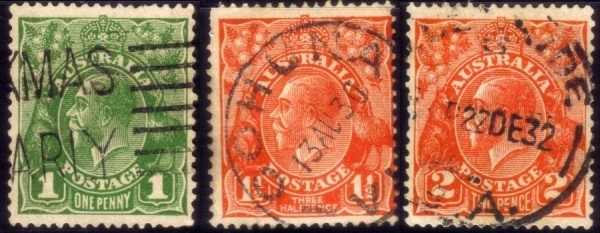 |
|
Send note to Staff
|
|
|
Pillar Of The Community
Australia
4034 Posts |
|
|
Hi! tholath
No matter what the KGVs are, there a great addition to any collection!
Your 3 KGVs are examples of the more common letter rate stamps.
By counting the top row of perforations on all 3 stamps tell us they are perf 13.5.
So watermarks would be SM wmk or C of A wmk. The dates on the stamps also tell us this.
Things to check!
Inverted watermarks..The 2d red booklet stamps were put together with inverted watermark in both the wmks mentioned. If the 1d green is invwmk it is an expensive stamp.
Could not see any printing flaws.
Do not know about the postmarks, somebody else might!
Hope I have been helpful. KGV
|
|
Send note to Staff
|
| Edited by KGV Collector - 11/03/2010 07:59 am |
|
|
Replies: 697 / Views: 136,264 |
|




 Posted 05/21/2010 01:01 am


