| Author |
 Replies: 28 / Views: 3,658 Replies: 28 / Views: 3,658 |
|
Valued Member
United Kingdom
6 Posts |
|
|
|
Does anybody know of a way to measure the miniscule 1/4mm difference yet? I have two such stamps 11 perforation that read 22.25 on a set of calipers, but fear the reading is not as exact as I would like it to be, because it's difficult to get the jaws on the edge of the design. I know the chances of finding two are remote, but never say never. Thanks in advance for any suggestions
|
|
Send note to Staff
|
|
|
|
|
Moderator

United States
12330 Posts |
|
|
Valued Member
United Kingdom
6 Posts |
|
|
Valued Member
189 Posts |
|
|
I use a "Precision US Specialty Multi Gauge" for my measurements. The first 40 mm has markings on the quarter-mm scale, and half-mm thereafter. Even with the half-mm markings you can easily interpolate at the quarter-mm scale. This photo is from Mystic. It may be slightly different from mine. 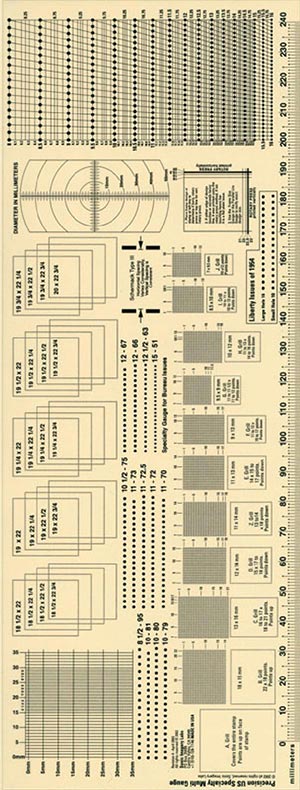 |
Send note to Staff 
|
|
|
Valued Member
189 Posts |
|
|
Quote:
Trying to measure is not a reliable method for identifying a rotary printed stamp. Don, please explain your assertion. Regarding unreliability, there are two reasons I can think of. Either people are just naturally bad at measuring without lots of practice so that repeated measurements of the same distance varies too much for the measurement to be useful. Or, the actual dimensions of flat plate/rotary images vary so much that the distributions overlap too much for them to be distinguished. If it's the first reason, then there's a glimmer of hope. But if it's the second reason, then there's no getting around it. |
|
Send note to Staff
|
|
|
Pillar Of The Community
3860 Posts |
|
|
Scott 613 is a Scott 612 stamp with gauge 11 perfs instead of gauge 10 perfs. |
|
Send note to Staff
|
|
|
Valued Member
189 Posts |
|
|
Quote:
Scott 613 is a Scott 612 stamp with gauge 11 perfs instead of gauge 10 perfs. Yes, there's that, too. Thanks, jogil, for pointing that out. If a flat plate/rotary can be distinguished by their perfs, then do that. But if the primary distinguishing features are inconclusive, then what? That's what I'm on about! edit: changed "perfs are the same" to "primary distinguishing features are inconclusive" for clarity. |
|
Send note to Staff
|
| Edited by rmatossian - 11/23/2019 2:06 pm |
|
|
Moderator
United States
12330 Posts |
|
|
rmatossian, The dimensions and tolerances are far too great to be used reliably. Note that confirmation bias also comes into play, influencing users as they measure. Inexperienced (and some experienced) hobbyists see a rarity in a catalog, see the dimensions, measure a stamp hoping they have a rarity, and become 100% convinced they have a rarity. Then many of us invest untold amounts of time trying to undo their misunderstandings. I think that if catalog publishers had to invest their time on this issue that they would clarify their publications. Don  |
|
Send note to Staff
|
|
|
Pillar Of The Community
3860 Posts |
|
|
rmatossian: Scott 612 is a rotary press printed stamp so that its outer frame dimensions should be the same as those for Scott 613 but not the same as those for flat press Scott 610 (and 611). |
|
Send note to Staff
|
| Edited by jogil - 11/23/2019 10:40 am |
|
|
Valued Member
189 Posts |
|
|
Quote:
Note that confirmation bias also comes into play Boy, Howdy! We are fantastic at motivated reasoning. Quote:
The dimensions and tolerances are far too great to be used reliably. Thanks for this reply, but your reasoning is still not clear to me. It sounds like you're saying that the difference of a half mm is too small to be measured reliably because of poor measuring, whether caused by bias, inappropriate or defective tools/technique, waning eyesight, or whatever. If that's the case, I disagree completely, because all those sources of error can be overcome, say by using a microscope or some kind of automated measuring device. On The Other Hand You might be saying that there are some instances of a rotary that is actually the same size or smaller than a flat-plate counterpart. For example: flat plate = 19.5 with tolerance plus or minus 0.3 and rotary = 20.0 plus or minus 0.3. What if you measure it as 19.75? This is a problem which cannot be remedied, and if this is what you're saying, then I agree with what you said about catalogs. I realize flat plate vs rotary can be distinguished in other ways, but this discussion was originally about measuring small distances generally. |
|
Send note to Staff
|
|
|
Moderator
United States
12330 Posts |
|
|
Valued Member
189 Posts |
|
|
Don, You assumed I have not read the linked article. I have read it, more than once, very carefully. Article says: Quote:
Obviously, since ranges are given, the dimensions are not precise. Therefore, some experts consider the dimensions given in the Scott catalogue are [sic] advisory. Indeed, [one such expert] contends that the Scott Catalogue dimensions should be removed because they commonly mislead collectors. The reason is that measurement with a common ruler or even Vernier calipers is never precise enough for identification [emphasis mine]. To use a "common" ruler is imprecise, and Vernier calipers, if I am not mistaken, are intended to measure thicknesses, not distances. Since the ranges given do not overlap, the reason for not measuring does not apply if an appropriate device is used. Article also says: Quote:
Some collectors...may confuse flat plate booklet pane stamps with rotary stamps because paper grain differences result in stamps slightly wider than normal sheet stamps, but not nearly as wide as wide rotary press coil stamps. Are these paper grain differences (booklet vs sheet vs coil) the source of the ranges? And, if so, do the ranges now overlap? (Since booklet stamps, sheet stamps, and coil stamps all started out as sheets I always assumed that they were made with comparable paper.) I admit I have not read the hundreds of threads, but I have read some. Typically someone tries to use a yardstick or something like that to determine what stamp they have, then this remarkable community responds with mountains of fantastic advice about setoff, perfs, ink smear, and the like. Again, Don, thanks for your patience with my questions. It seems you are always willing to expostulate freely with people, and your posts portray your thoughtfulness. |
|
Send note to Staff
|
|
|
Moderator
United States
12330 Posts |
|
|
The section I was referring to was this one; Quote:
Compared to flat plate stamps, the size of the image of a rotary press stamp is wider or taller. For example, in Figure 5, the flat plate stamp has a design measuring 18.5mm to 19mm by 22mm, the middle stamp is 18.5mm to 19mm by 22.5mm to 23mm, and the right stamp is 19.5mm to 20mm by 22mm. The Scott Specialized catalogue gives these expected dimensions for various rotary press issues, including rarities, but the use of the size of the printed design, in millimeters, is a controversial basis for identifying rotary press stamps. Obviously, since ranges are given, the dimensions are not precise. Therefore, some experts consider the dimensions given in the Scott catalogue are advisory. Indeed, Mr. Frazier contends that the Scott Catalogue dimensions should be removed because they commonly mislead collectors. The reason is that measurement with a common ruler or even Vernier calipers is never precise enough for identification. As Mr. Frazier has written,
"The stamp design measurements listed in the article and the Scott Catalogue are not accurate enough to be useful. Experienced philatelists compare with another stamp with known characteristics. Rotary press stamps are taller or wider than flat plate or booklet pane sheet stamps. Some collectors struggling with incomplete information in the Scott catalog may confuse flat plate booklet pane stamps with rotary stamps because paper grain differences result in stamps slightly wider than normal sheet stamps, but not nearly as wide as wide rotary press coil stamps."
Unfortunately, leading experts as eminent as John Hotchner have recommended measurement, to amateur collectors, as a principal identification tool as recently as January 2019 in an article in Linn's. (See references list at the end of this paper.) The author regards this advice as problematic. Instead, measurement with Vernier calipers, and not a ruler, should be done as a final confirmation after all other attributes are checked: perforation gauge; lack of setoff; plate tone; watermark; and other clues such as postmark date, if available on the stamp or a cover. Clark Frazier has a number of post in this community and is also noted in the article. He is currently the leading expert on Washington/Franklin era stamps and their production; I take his opinion to the bank. The reason that dimensions are favored by some hobbyists is because they appear to be definitive but more importantly they appear to be easy. It is certainly easier than bothering to learn how the flat plate vs. rotary printing processes of the era. To be honest, once a person has enough experience you can typically ID and sort flat plate vs. rotary stamps by look and feel. Lastly, this community gets an average of 2 inquires per week from folks who think they have a rotary rarity based upon dimensional criteria. While many of these threads go on for a number of pages (the original posters sometimes push back and argue for days) I think the average number of replies is about 5 posts per thread. So that's about 500 replies per year on this topic and if each reply takes 5 minutes then that is 40+ hours per year that is spent trying to clear up the misunderstandings. And this is just one community, consider the time that dealers, appraisers, and certification experts have also invested in the same issue each year. And then multiple this efforts over the decades that our hobby has dealt with this issue. I think that it is reasonably conservative to say that literally thousands of man hours have been spent trying to undo the misidentification of rotary press stamps based upon dimensional criteria. By any account, there is extraordinary amounts of time wasted on this topic. So if I have come across as impatient on this topic, please understand. Don |
|
Send note to Staff
|
|
|
Valued Member
189 Posts |
|
|
We all do things that waste man hours.
Sorry to Clark Frazier for removing his name from the quote. |
|
Send note to Staff
|
|
|
Moderator
United States
12330 Posts |
|
|
Quote:
We all do things that waste man hours... True, I waste my own man hours sometimes but I do not waste other people's time unless I am paying them. Donate button is on the left hand side of the page! Don |
|
Send note to Staff
|
|
|
Valued Member
189 Posts |
|
|
Replies: 28 / Views: 3,658 |
|



 Posted 11/23/2019 03:30 am


