| Author |
 Replies: 15 / Views: 2,287 Replies: 15 / Views: 2,287 |
|
|
Rest in Peace
7742 Posts |
|
|
A while ago I used my software gauge shown below, where you scan at 600 DPI...Gauge shown below. 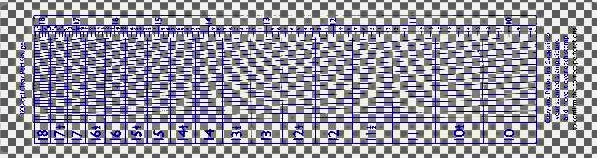 So I took a random selection of 100 Small Queen stamps and used the software perf gauge and put together what I found. Below is what it looks like when the software gauge is applied. 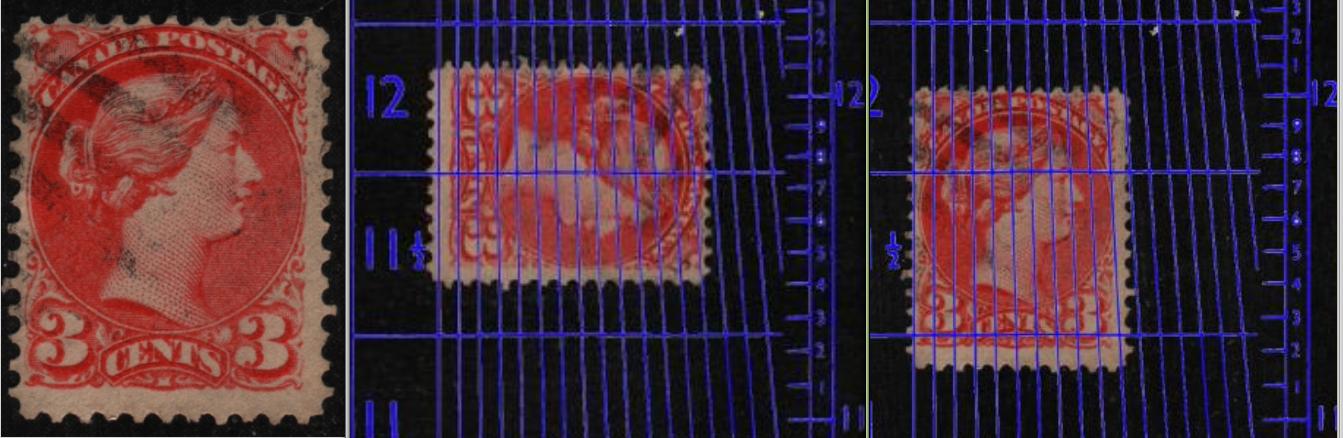 Here is the list I put together to see how accurate the software gauge was. 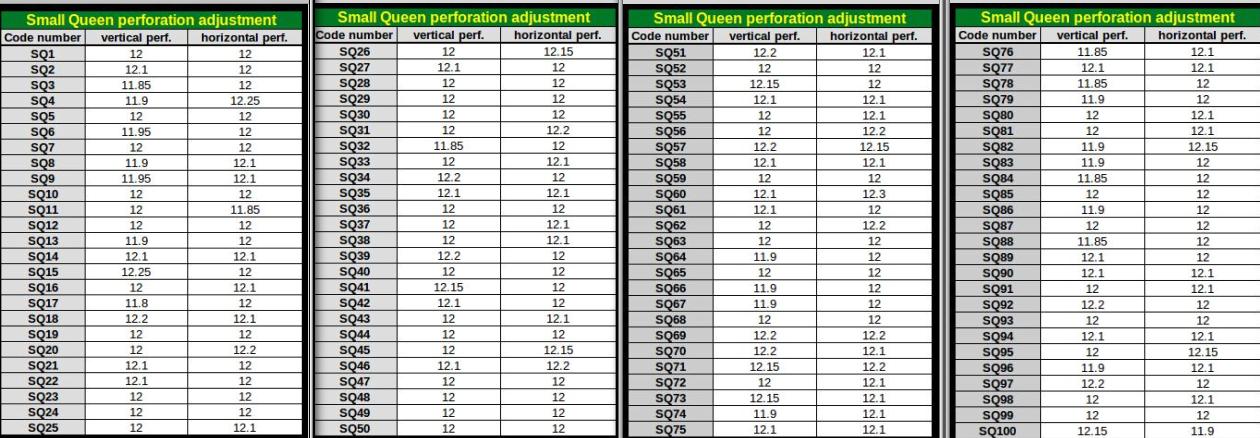 Notice the huge amounts of perforation adjustment varieties...As compared to a hand held gauge... My bet is on a hand held gauge..Any opinions..?? Robert |
|
Send note to Staff
|
|
|
|
|
Pillar Of The Community
United States
3224 Posts |
|
|
I think your research proves that an online gauge is good enough for measuring to the nearest half number and not more. And that's true of the vast majority of handheld gauges, no?
So either is good in most cases. Specialists should use specialist gauges. Your standard computer screen and printer are going to introduce tiny errors anyways. The fundamental problem is that a lot of people do not know how to use a perf gauge or even a ruler properly.
|
Send note to Staff 
|
|
|
Moderator

United States
12330 Posts |
|
|
Hi Robert,
Some observations/opinions…
1. Your overlay software gauge is gauging an image, not the actual stamp. So the assumption is that the images are dimensionally accurate; a hand gauged stamp does not have this assumption (and lower chance of error being introduced).
2. Your overlay image and the orientation of the stamp image both have to be very well aligned and have no skew or 'tilt' to them or the gauge will be off (another chance of error being introduced).
3. I see the value of your overlay approach, or using a transparent hand gauge, as being able to gauge a stamp without removing it from a cover. You approach also translates well to posting images online.
4. Most all stamp catalogs only go out to 'tenths' so what is the point of gauging out to the 'hundredths'? Where does it stop? Do we go out to the 'thousandths', 'ten thousandths', or even more?
5. A software gauge app (not your overlay) can 'average' the perfs over the range of the stamp, this matches what stamp catalogs do. So if you have a stamp with varying distances (i.e. a bent pin or two) the app can simply average the gauge calculation.
Even though I am a total techie I also favor efficiency and speed; sadly software gauge solutions are slower and less efficient than hand gauging. I can hand gauge many stamps in the same amount of time it takes me to digitally gauge one stamp. Risk-wise, the handling of the stamp is about the same with either hand gauging or scanning a stamp. Given the above and speaking for myself, I have little incentive to digitally gauge a stamp.
When stamps were originally produced, they specified a distance between perforations pins. I assume they had a +- tolerance for this distance but apparently no one knows what it was. So now decades later stamp collectors come along with the use of technology can gauge perforations to a very high level of accuracy. Out at 'hundredths' we are probably already beyond the original tolerances that anyone cared about when producing the stamps.
Don
|
|
Send note to Staff
|
|
|
Rest in Peace
7742 Posts |
|
|
Yes guys
gauge in hand is the way to go to obtain accurate perforation measurements...
Robert
|
|
Send note to Staff
|
|
|
Pillar Of The Community
United States
978 Posts |
|
|
Hi I know about plastic see-thru gauges. When I was helping breaking down collections I used the following Lindner item: https://www.philatelicly.com/lindne...7516fd43adaa It was fast and accurate. Checking against a standard gauge, the measurements were the same. Pictures of the item show the stamp face-up. It is better face-down. Jerry B |
|
Send note to Staff
|
|
|
Valued Member
189 Posts |
|
|
Quote:
gauge in hand is the way to go to obtain accurate perforation measurements I don't think the case has been made, and here's why. It looks like you are assuming all actual perfs are 12, and that any variation is due to inaccuracy of the software/device. I think this assumption is unwarranted. A better approach would be to pick one stamp and measure it with your handheld as precisely as you can. Then use your software on that one stamp 100 times. If you get the same kind of variance as you did with the 100 "random" stamps, then it would be safe to say the measurements might not be reliable enough (reliable = small variance). In order to compare reliability of the two methods, you really need to measure the same stamp multiple times using both methods. This might be very difficult to do because, once you have measured a stamp with the hand gauge, you will probably measure it as the same perf every time (confirmation bias!). A way to get around this is to have multiple people do the measuring, but the downside would be that you introduce more variance due to possible differences in technique among the measurers. Also, some commentary on Don's excellent points: 1. The image might indeed not be "dimensionally accurate," but you can informally check the calibration by measuring a stamp (whose gauge is known exactly) several times and computing the average. 2. The orientation matters, but how much of a angle is too much? I doubt the image is ever off by more than 2 or 3 degrees. But if the angle is 5 degrees, a perf 12 stamp might read as 12.05. (secant function) 4. It looks like the software is trying to round to the nearest 20th. Internal computations probably are to the nearest thousandth, at least. |
|
Send note to Staff
|
|
|
Rest in Peace
7742 Posts |
|
|
Quote:
once you have measured a stamp with the hand gauge, you will probably measure it as the same perf every time (confirmation bias! That is correct, I am aware this could happen, so as I remeasured, I took that into consideration and attacked it as if it were the first measurement. Example, it the first measurement was say 12.1...i would place the gauge starting 13.0 and work my way down and or up to get a more accurate measure..Hopefully. Now I know each one of us out there are affected by the eyes looking at the gauge and differences apply. I just trust my eyes and a good hand held gauge. Robert |
|
Send note to Staff
|
|
|
Pillar Of The Community
6362 Posts |
|
|
Quote:
As compared to a hand held gauge... I will agree with the direction taken by rmatossian. What comparison? I see no comparison. You report electronic measurements for 100 different stamps. That is all. There is no proof they were all the "same", nor are they illustrated, nor is any data provided for 100 hand-held gauge measures. Sorry, no valid conclusions can be drawn. |
|
Send note to Staff
|
|
|
Rest in Peace
7742 Posts |
|
|
John..Then maybe I should redo the measurements of each stamp and do a hand held gauge measurement to compare..Would that be the way to go..? Robert as you can see, I have categorized all 100 SQ ""Small Queens""...Now to compare vs hand held gauge...??  |
|
Send note to Staff
|
| Edited by wert - 11/25/2019 11:32 am |
|
|
Pillar Of The Community
6362 Posts |
|
|
Pillar Of The Community
607 Posts |
|
|
Even if the software gauge is dimensionally perfect, I am not sure one gains much by using it. You are still gauging the perfs with all their imperfections, i.e. you are estimating not measuring.
I can see it being of use to align on the perpendicular, and to hold the stamp still. |
|
Send note to Staff
|
|
|
Pillar Of The Community
United States
775 Posts |
|
|
I can't get too hung up on measuring perfs. I am good with going to the nearest 1/2 perf. Here are some reasons:
Stamps change size with ambient moisture.
Soaking a stamp may change its size again.
Perforation pins may not all be spaced exactly identically.
Some German stamps come in two varieties with a 1/4 perf difference. Rather than trying to measure that difference the perforation holes are counted instead (this is noted in the catalog). Maybe something similar can be done for these Canadian stamps? |
|
Send note to Staff
|
|
|
Bedrock Of The Community
Australia
38679 Posts |
|
|
Quote:
Some German stamps come in two varieties with a 1/4 perf difference. Rather than trying to measure that difference the perforation holes are counted instead (this is noted in the catalog). Maybe something similar can be done for these Canadian stamps?
For Australia, I use a "control stamp" It is mounted alongside the Mint of identical perforations. When duplicates arrive at the desk, I remove the "control stamp" and use it to guage the duplicates, a quarter perf is easily segregated. |
|
Send note to Staff
|
|
|
Pillar Of The Community
United States
3224 Posts |
|
|
The German mark values come from a period when the overall stamp sizes were very consistent in that country. This is not true of the Canada Small Queens, where there are extreme jumbos to stamps with designs cut in all around. |
|
Send note to Staff
|
|
|
Pillar Of The Community
New Zealand
731 Posts |
|
|
Great topic Wert!
You're so prolific and a knack for sparking conversation |
|
Send note to Staff
|
|
|
Pillar Of The Community
3860 Posts |
|
|
Out of all Canadian line perforated stamps, the Small Queens have the most variation in perforations gauged. Jack Forbes found many different gauge combinations which he made a chart for. These ranged from around perforation 11.5 to 12.5 Also, the Canada perforation gauge that was put together by Brian Cannon uses two different sets of perforations for this range since two slightly different perforating wheels were being used around this time. One set of wheels had 4 1/32" diameters and another set of wheels had 4 1/16" diameters. This is a must have for Small Queen perforations. |
|
Send note to Staff
|
| Edited by jogil - 11/28/2019 02:31 am |
|
| |
Replies: 15 / Views: 2,287 |
|




 Posted 11/24/2019 2:33 pm


