| Author |
 Replies: 27 / Views: 2,638 Replies: 27 / Views: 2,638 |
|
Valued Member
7 Posts |
|
|
Poll Question:
Are those stamps cancelled? 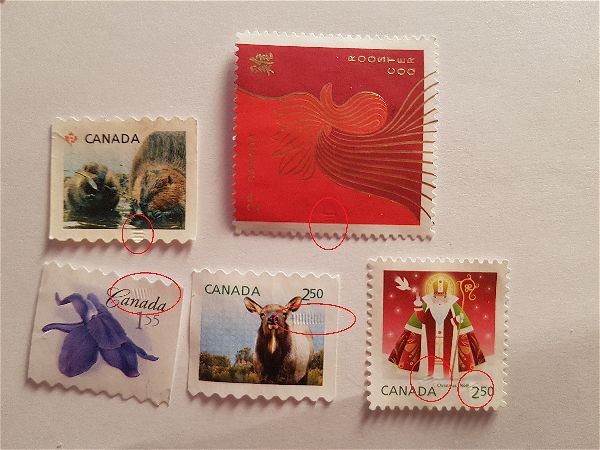 Thanks  |
|
|
Send note to Staff
|
| Edited by emilio911 - 11/28/2019 10:25 pm |
|
|
|
|
Pillar Of The Community
United States
7239 Posts |
|
|
I believe that the person who soaked these stamps used non-philatelic tongs/tweezers, thus leaving the "gripper" serration patterns of the instrument tips on the stamps. |
Send note to Staff 
|
|
|
Bedrock Of The Community
Australia
38679 Posts |
|
|
Quote:
used non-philatelic tongs/tweezers I don't think one could get enough purchase on a pair of tweezers to do that, maybe a pair of electricians pliers. The stamps are self adhesive, he/she may have been holding the stamp in the pliers, whilst scraping off the mucilage. |
|
Send note to Staff
|
| Edited by rod222 - 11/28/2019 10:51 pm |
|
|
Pillar Of The Community
United States
7239 Posts |
|
|
Wow, that brings up quite a mental image, Rod...but I think you are probably correct. Either electrician's pliers or hemostats. Hemostats have the advantage of being lockable. |
|
Send note to Staff
|
| Edited by bookbndrbob - 11/28/2019 11:00 pm |
|
|
Pillar Of The Community
6358 Posts |
|
|
I would vote that the indentations are caused by a piece of mail processing equipment, like a gripping device, thus the stamps have passed through the mail stream are are technically "used" despite having no actual inked cancel. I have very little Canada mail, but I'll bet someone will be able to post an image of such indented stamps still "on cover" |
|
Send note to Staff
|
|
|
Valued Member
7 Posts |
|
|
John Becker's theory is in line with my own theory. I think these marks happened in the mail stream. I was wondering if it was made on purpose to catch stamp recyclers.
Tweezers are an interesting theory too. However, I must explain that these stamps were in a batch of no gum stamps. Basically, the stamps that looked like they went into the mail stream (some had traditional cancellation marks) had these marks, while the ones that didn't have these marks looked like they never went into the mail stream. But it might just be a coincidence... |
|
Send note to Staff
|
| Edited by emilio911 - 11/29/2019 01:54 am |
|
|
Bedrock Of The Community
Australia
38679 Posts |
|
|
Quote:
I'm pretty sure these marks happened in the mail stream. Then state your case. You cannot be "pretty sure" if you have no evidence to back it up. Sure it could be a feed derivative, but my argument, there is no surrounding postal machine cancel ink, the "tractor feed" type marks are not of any great length, and there is no supportive evidence from hundreds, nay thousands of Canadian collectors, whom would have spotted these marks. I have an open mind, but I need convincing either way. |
|
Send note to Staff
|
|
|
Valued Member
7 Posts |
|
|
Quote:
You cannot be "pretty sure" if you have no evidence to back it up. I edited my sentence. Quote:
there is no supportive evidence from hundreds, nay thousands of Canadian collectors, whom would have spotted these marks. Exactly. I'm wondering if someone else has spotted marks like those. |
|
Send note to Staff
|
| Edited by emilio911 - 11/29/2019 01:57 am |
|
|
Pillar Of The Community
6358 Posts |
|
|
My opinion was a "best guess" based on 35+ years of collecting thousands of US machine cancels, studying mail automation, and knowing that high speed machinery often makes marks - some are inked and some are not. My point being that I don't know the definitive answer either, yet I would look in that direction first and give the Canadian collectors a few days to look around and see what they find to post. A few hours of non-answers is not proof of anything. |
|
Send note to Staff
|
|
|
Bedrock Of The Community
Australia
38679 Posts |
|
|
Quote:
A few hours of non-answers is not proof of anything. Lighten up old son, we offer opinions, that's what people do. So every one has to shut up, and only wait for the definitive answered response. Not this koala. |
|
Send note to Staff
|
|
|
Bedrock Of The Community
Australia
38679 Posts |
|
|
Quote:
I edited my sentence.
Thanks Emilio, reads a lot better, what's the source Emilio, can we gather any info from there? Hemostats...learnt a new word today  |
|
Send note to Staff
|
|
|
Pillar Of The Community
6358 Posts |
|
|
rod222, You specifically asked me to "state my case" and then proceed to criticize me for doing as you ask. What gives? You offer very good advice for yourself to lighten up. |
|
Send note to Staff
|
|
|
Moderator

United States
12330 Posts |
|
|
On this US Thanksgiving holiday, I give thanks to fellows like Rod and John who have both made countless contributions to our hobby. They both remain passionate and dedicated to the posting of accurate and helpful information. As 'pillars of our community' they consistently have demonstrated the true spirit of philately.
Don
|
|
Send note to Staff
|
|
|
Pillar Of The Community
6358 Posts |
|
|
Pillar Of The Community

United States
5468 Posts |
|
|
First let me say I do not know. Hemostats generally taper and are long and would not end in this shortened manner. But there are a whole lot of different types of hemostats. Just a late night comment after thinking at first hemostats were the source.  |
|
Send note to Staff
|
|
|
Pillar Of The Community
United States
3224 Posts |
|
|
The marks are always at the edge of a stamp, at several angles and positions relative to the upright stamp design. If you go through kiloware, the vast majority of senders don't angle rectangular stamps on a package or envelope. Upside down or sideways is uncommon, too. The marks are all of different sizes, looking to have been done manually.
I have only got a limited number of pieces of mail from Canada over the last few years (maybe 6-8 a year), but I have never seen this marking on any. If anyone has one, please post.
I think rod's guess is on the mark. I've seen things handled with alligator clips, metal forceps or locking tweezers when put in solvent in ultrasonic cleaners. You can't just put something flat in the basket or tray otherwise the cavitation bubbles don't happen on the down side. Some solvent should work for removing self-adhesive gum and (probably) cancels. In that case, there might be traces of cancels visible under blacklight or perhaps even the tagging will be degraded or missing. emilio911, you might check these out, though there's plenty of Canadian stamps escaping cancelling, just like in the US.
|
|
Send note to Staff
|
| Edited by hy-brasil - 11/29/2019 05:23 am |
|
|
Replies: 27 / Views: 2,638 |
|




 Posted 11/28/2019 4:26 pm


