| Author |
 Replies: 11 / Views: 1,265 Replies: 11 / Views: 1,265 |
|
|
Valued Member
United States
146 Posts |
|
|
I am learning about the 1865 special printings. In reference to the "scissor cut" stamps, are the stamps that have in fact had perfs cut with scissors special print? I believe that the second stamp from the left is a special print. I just wat to make sure I understand what signifies an 1865 special print. 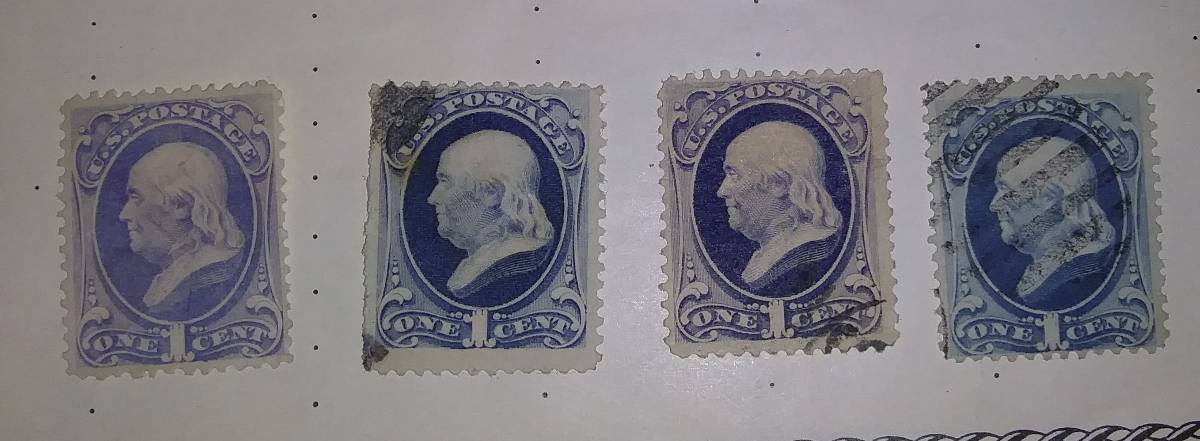 |
|
Send note to Staff
|
|
|
|
|
Bedrock Of The Community
12731 Posts |
|
|
Valued Member
United States
146 Posts |
|
|
Moderator

United States
12330 Posts |
|
|
Pillar Of The Community
United States
1819 Posts |
|
|
stampavalanche, just to clarify and add to what stampsmarter.com will tell you: scissor separation is not a sufficient criterion to define the 1875 special printings. They were often separated by scissors wielded by USPOD clerks in Washington fulfilling orders in order to speed up their work, but the special printings are properly identified by color and by paper type. The stamp in your photo would be Scott #167, but it is not. The perfs at left are not scissor-cut, they are simply blunted, probably from being torn. In addition, Scott #167 is either extremely rare or unknown in used condition (in the past it has been unvalued in the Scott catalog in used condition). |
Send note to Staff 
|
| Edited by dudley - 01/07/2020 1:33 pm |
|
|
Pillar Of The Community
United States
3291 Posts |
|
|
Pillar Of The Community
1375 Posts |
|
|
dudley, from what I learned until now, it's not possible for an average collector to tell a CBN or ABN special printing on its own, as it is mainly based on provencance and color. So if you have additional information about the paper types, it would be interesting for me and perhaps others to read here.
Scissor-cut perforation (for CBN) and rough perforation with fibers inside (for ABN) are both things that can also happen for normal printings. The same is true with good impression (for CBN) and poor impression / worn plates (for ABN). So to me, only provenance and color remains? Maybe the very white paper (for CBN, not for ABN?), but this also happens for normal printins that stamps have very white paper. |
|
Send note to Staff
|
| Edited by stamperix - 01/07/2020 2:19 pm |
|
|
Pillar Of The Community
United States
1819 Posts |
|
|
stamperix, having personally handled only about 3 or 4 examples of the 1875 special printings in my collecting life I have no additional info beyond what the specialized publications offer. |
|
Send note to Staff
|
|
|
Pillar Of The Community
1375 Posts |
|
|
Thank you. I did not find any paper variety in the specialized literature for the special printings, that's why I asked. So I guess you meant the very white paper for the CBN special printing? Ok, this could be at least a first hint (not working for the ABN special printing probably?). |
|
Send note to Staff
|
|
|
Bedrock Of The Community
United States
10839 Posts |
|
|
I have seen several of the 1869 special printings; they were all on a very thin, very hard, very bright white paper that is thinner, harder, and much brighter then the issued stamps when looked at together. They are very sharp impressions. |
|
Send note to Staff
|
|
|
Pillar Of The Community
1375 Posts |
|
|
Yes, this is also mentioned in the literature. But about the Bank Note special printings? The ABN printings are probably not on a distinct paper, the CBN appear to be good impressions on a bright paper which could also happen on normal stamps. So from what I understood now it's only provenance and color to really decide if it's a CBN or ABN special printing? |
|
Send note to Staff
|
|
|
Valued Member
United States
146 Posts |
|
|
Thank you gentlemen for the insight and advice. It's very much appreciated. Jon |
|
Send note to Staff
|
|
| |
Replies: 11 / Views: 1,265 |
|



 Posted 01/07/2020 09:27 am