| Author |
 Replies: 8 / Views: 1,366 Replies: 8 / Views: 1,366 |
|
|
Valued Member
Poland
119 Posts |
|
|
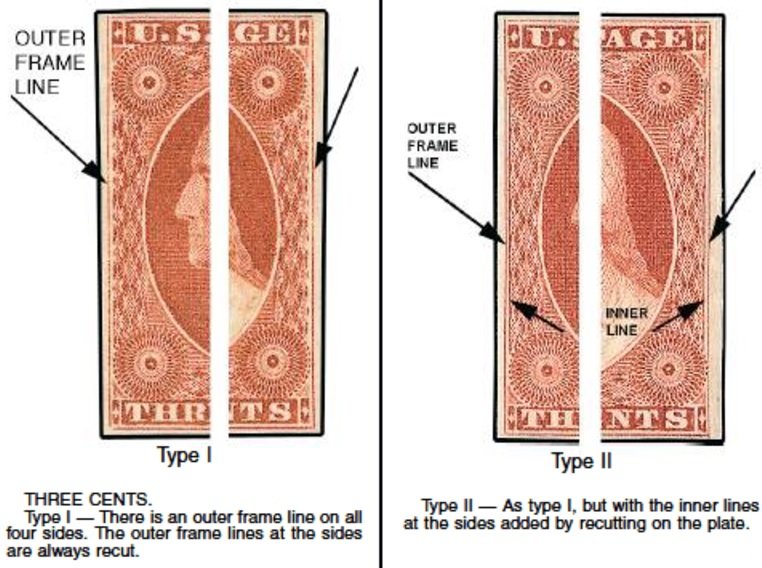
I have a great request to the honorable group of specialists. For me, the Scott 10 and 11 stamps are still a mystery and I still have trouble with the correct identification. Please rate if there is something more interesting among the stamps shown below? I noticed the C stamp where the letter S in the word postage is somewhat similar to 8, and the H stamp where the letter E in the word cents is damaged and CFNTS came out of it. I will be very grateful for all comments and tips. Thank you very much and best regards in the New Year. a.  b  c  d  e  f  g  h  |
|
Send note to Staff
|
|
|
|
|
Pillar Of The Community
United States
2555 Posts |
|
|
Valued Member
United States
363 Posts |
|
|
Valued Member
Poland
119 Posts |
|
|
Pillar Of The Community
United States
3528 Posts |
|
|
Your stamp F is cut in a bit and the cancel obscures some vital areas, so its a bit hard to appreciate it. Here is a similar 3c stamp, from position 70L3. I haven't tried to plate your stamp, but it is similar to this, and I'm showing this to clearly point out to you that there is a right inner line but the left frameline here takes the place of the left inner line. It is a minor variety in its own right, and is certainly an 11A, since it has an inner frameline. http://www.stampsmarter.com/plate/h...ages/993.jpg |
Send note to Staff 
|
|
|
Pillar Of The Community
United States
3528 Posts |
|
|
Well, for what its worth, your stamp F, is in fact position 70L3.
That doesn't change anything - just the plating minutia, if it interests you. It is part of what's called the 3-rows part of plate 3, where there is some very unusual recutting being done, like this. |
|
Send note to Staff
|
|
|
Pillar Of The Community

United States
1835 Posts |
|
|
Pillar Of The Community
United States
2555 Posts |
|
|
It is quite understandable that the F stamp causes confusion. The fact that an inner line is missing on the left side does not preclude it from being called a Type II. There are many other examples from Plates 1E, 1i, 5E, 5L that only have an inner line on one side. Worse still are the stamps from Plates 1E and I that have only a short and faint bit of recutting that force the Type II classification. Due to the ironing out affect of the transfer roll, plates that have been reentered, such as Plates 1i and 5L, can have faint inner lines that are difficult to detect. Lots of fun. Collecting these stamps by catalogue number does not do them any justice. |
|
Send note to Staff
|
| Edited by sinclair2010 - 01/11/2020 12:16 am |
|
|
Valued Member
Poland
119 Posts |
|
|
Thank you very much for all comments and messages. In this way, I know more and more day by day. |
|
Send note to Staff
|
|
| |
Replies: 8 / Views: 1,366 |
|



 Posted 01/08/2020 02:35 am