| Author |
 Replies: 12 / Views: 1,854 Replies: 12 / Views: 1,854 |
|
|
Pillar Of The Community

United States
812 Posts |
|
|
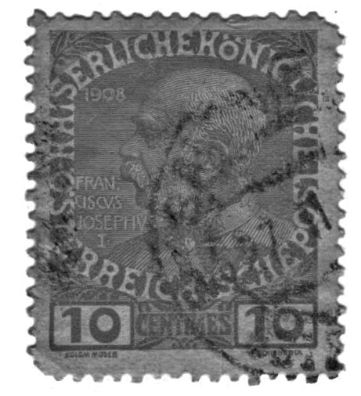
Here are two. Postmark on the 10c: could it be Salonica? If so, was it normal for the office there to use stamps of the offices in Crete, rather than, say, stamps of Lombardy-Venetia?  For this 15c: Postmark seems to be Jerusalem. Scott suggests that stamps of the offices in Crete could be used by Austrian offices anywhere in the Ottoman Empire, hence in Palestine. Is that so?  |
|
Send note to Staff
|
|
|
|
|
Pillar Of The Community
United States
812 Posts |
|
|
Pillar Of The Community
United States
812 Posts |
|
|
Quote:
rather than, say, stamps of Lombardy-Venetia? Or stamps of the offices in Ottoman Empire? |
Send note to Staff 
|
|
|
Pillar Of The Community
United Kingdom
3220 Posts |
|
|
The so-called "Austrian Post Offices in Crete" stamps were really no such thing.
These stamps were simply stamps in French currency that were used along with Turkish currency stamps in many Austro-Hungarian post offices across the Ottoman Empire including the three offices in Crete.
The name is just a tradition that several catalogue publishers adhere to.
I guess the name stuck early on because they first appeared in 1903 at a time when there was huge international interest in the events in Crete and there had recently been issues specially produced for use in Crete by the local British (1898) and Russian (1899) administrations and by the Italian (1900) and French (1902) Post Offices.
However, the Austrian post offices (and earlier Austrian Lloyd Agency offices) had been in operation in Crete since 1858.
|
|
Send note to Staff
|
Nigel |
|
|
Pillar Of The Community
United States
812 Posts |
|
|
Thank you, Nigel. Clears things up quite nicely. And if the 10c is indeed Salonica (Ottoman till 1912) Austrian offices might use stamps either in centimes or in para/piastre?
Eric |
|
Send note to Staff
|
|
|
Pillar Of The Community
United Kingdom
3220 Posts |
|
|
Quote:
Thank you, Nigel. Clears things up quite nicely. And if the 10c is indeed Salonica (Ottoman till 1912) Austrian offices might use stamps either in centimes or in para/piastre?
Eric Yes, absolutely. Not all the Austrian offices used stamps in both currencies but many did. I've just checked my Salonica postmarks and I have four from this set in Turkish currency (1 piastre x2, 2 piastres, 10 piastres) and three in French currency (5 centimes x2, 10 centimes). The office in Salonica stayed open until December 1914. I agree that your stamp has a Salonica postmark. The full postmark would read "SALONICH I" at the top. |
|
Send note to Staff
|
Nigel |
|
|
Bedrock Of The Community
Australia
38679 Posts |
|
|
Quote:
The so-called "Austrian Post Offices in Crete" stamps were really no such thing.
Confirmation.  |
|
Send note to Staff
|
|
|
Pillar Of The Community
United States
812 Posts |
|
|
Greatly appreciate this information from both. Enhances my understanding of offices abroad, whether Austrian, British, or anyone's. Henceforth I'll be paying extra attention to postmarks. My plan is to keep stamps of foreign offices with stamps of the host nation: adds to the picture of political and economic circumstances of the time.
Related question: Why did the Austrians print stamps in French currency? Assuming these offices in the Ottoman Empire were used mainly by expats or commercial agents, who would (I also assume) be holding and using mostly the local currency, I can see why stamps in para/piaster were needed. But why centimes?
|
|
Send note to Staff
|
|
|
Pillar Of The Community
United Kingdom
3220 Posts |
|
|
Quote:
Related question: Why did the Austrians print stamps in French currency? Assuming these offices in the Ottoman Empire were used mainly by expats or commercial agents, who would (I also assume) be holding and using mostly the local currency, I can see why stamps in para/piaster were needed. But why centimes? Hi Eric, I've wondered this too and I don't know the reason. I suspect their customers were dealing and writing contracts in various currencies and I suppose there must have been an advantage to both the post offices and their customers to offer stamps denominated in a currency that was stronger than the Turkish lira. This was the time of the Latin Monetary Union including the French franc and Austro-Hungary was an associate so maybe this choice helped their local accounting as well as increasing profits. However, it may just be that the French franc was in general use amongst merchants and that the Austrian post offices were at risk of losing business to the French offices? I'd really like to learn more about this if anyone can help.  |
|
Send note to Staff
|
Nigel |
|
|
Pillar Of The Community
United States
812 Posts |
|
|
Certainly the French franc was in wide use at the time, acceptable virtually everywhere. The existence of a Latin Monetary Union, however, and with Austro-Hungarian affiliation, is for me a piece of news. Something to look into. Thanks for the tip and for all your other help.
Eric
|
|
Send note to Staff
|
|
|
Pillar Of The Community
United States
775 Posts |
|
|
The monetary situation was fairly complicated, at least it was in Palestine. Here is an excerpt from the book "Handbook of Holy Land Philately Foreign Post Offices in Palestine 1840-1918", Vol I:  |
|
Send note to Staff
|
|
|
Pillar Of The Community
United States
812 Posts |
|
|
Sheds still more light on the matter. Helps explain why Austrian offices in the Ottoman Empire would be provided with stamps in both Ottoman and French currencies. But the pages that Germania has shared lead me to ask a more basic question. If I wanted to send a letter from Jerusalem to, say, Vienna, did I have the option of using either the Ottoman or Austrian post office and its respective stamps? Or was the choice of postal systems restricted in some way, by the sender's nationality for instance? |
|
Send note to Staff
|
|
|
Bedrock Of The Community
Australia
38679 Posts |
|
|
Germania. Applause for your Image naming regime.  Handbook of Holy Land Philately. One can easily link the image to bibliography one may wish to source... A very rare occurrence. |
|
Send note to Staff
|
|
| |
Replies: 12 / Views: 1,854 |
|




 Posted 01/12/2020 8:07 pm