Further Reading:

================================================
RCSD 2005 (Links will probably not work)
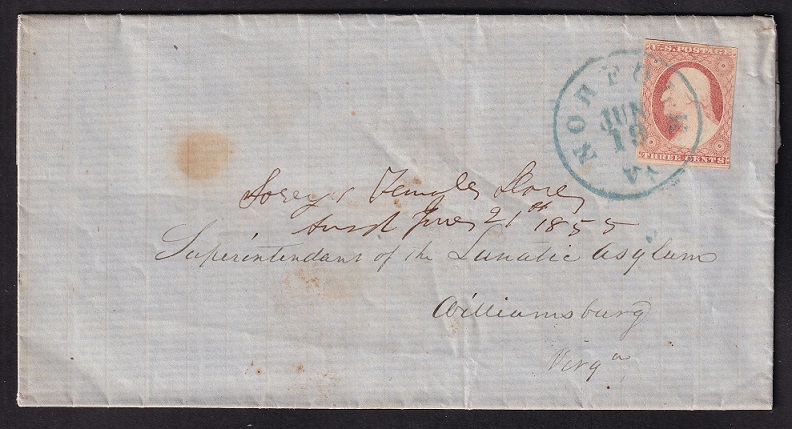
Disinfected Mail
From the fourteenth to the early nineteenth century it was
common practice in many parts of Europe to disinfect mail
which had originated in or passed through an area considered
to be disease-infested, particularly the Middle East.
This was done by fumigating the letter through slits cut in
them, or by splashing or even immersion in vinegar. Each
country had its quarantine stations through which all mail
from abroad had to pass.
The system was in use in Britain from about 1671 to 1850.
Various disinfection markings were applied to mail thus
treated, but these are not postal markings in the true sense
since they were the responsibility of the public health
authorities and not the Post Office.
In the light of modern medical knowledge the practice of
disinfecting mail in this manner is now known to have
been almost completely pointless, but letters which show
signs of disinfection are keenly studied and collected by
postal history enthusiasts.
- R. J. Sutton 6th edition revised by K. W. Anthony
The Stamp Collector's Encyclopaedia
Published 1966
Notes:
GREECE 1847 DISINFECTED MAIL COVER
http://www.sastamps.com/7jl2007.jpgnote the disinfection hole on the back:
http://www.sastamps.com/7jl2007a.jpgAustrian Levant 1900 Disenfected Mail to Egypt:
Picture Postcard of Triestie (Monumento Massimiliano),
bearing Austria Yvert 70, 10 heller red tied by Trieste
Lazzaretto Marittimo Triest Seelazareth double-ring
with Zefta arrival. Very Rare item of mail for the
disinfection specialist.
http://www.world-covers.com/pics/t2347.jpgBibliography of disinfected mail :
Includes books, pamphlets, articles (tear sheets)
that encompass this special interest. A search of
on-line booksellers under "Quarantine" will also
reveal a list of books which may be important
collateral histories of countries fighting the spread
of epidemics.
D'Agostino, Andrea W., Contagio [Italian].
A.I.S.P., Bolli e documenti di Sanita dell'Area Italiano, 1985
[Italian].
Carnevale and Guiges, Les Communicationes en Temps d'Epidemie
[French].
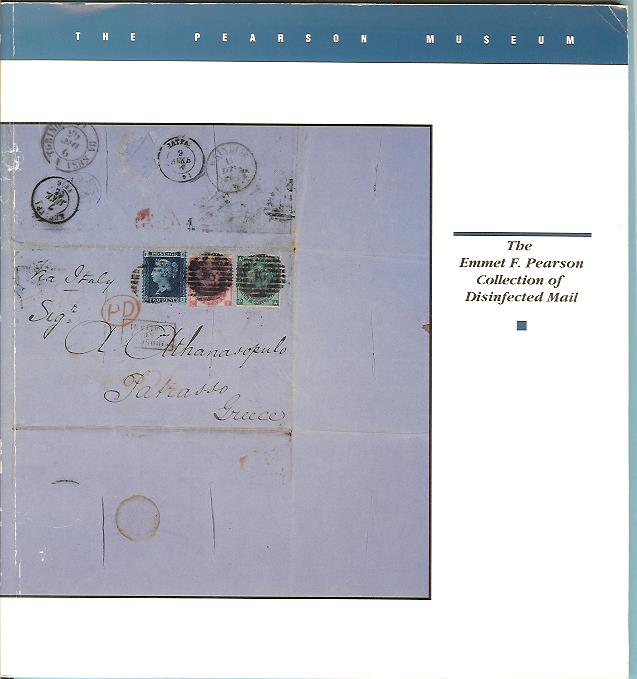
Davidson, Glen W., The Emmet F. Pearson Collection of Disinfected
Mail, 1992.
De Zanche, Luciano, Storia della Disinfezione Postale in Europa e
nell'Area
Mediterranea, 1997 [Italian].
Feuser, Peter, Deutsche Vorphilatelie, 1990 [German].
Galea, The Quarantine Service and Lazaretto of Malta
Green, Irving I., "Holocaust in Hawaii," The Collectors Club
Philatelist, Vol. 32 No. 1.
Guerrant, E. J., "Why are these Covers So Elusive?" WPL Tearsheet
#3922
Lane, Maryette, "Florida's Hellfire and Brimstone Mail,"
Weekly Philatelic Gossip, August 8 and 15, 1953.
Meyer, K. F., Disinfected Mail, 1962.
Meyer, K. F., "Historical Notes on Disinfected Mail," reprint from
Journal of
Nervous and Mental Disorders, Vol 116 No. 6, 1952.
Patton, Donald S., "Disinfected Mail," reprint from American
Philatelist, February 1953.
Sandrik, William A., "Disinfected Mail," American Philatelist, April
1986.
Sandrik, William A., "Plague Disinfection at New York in 1897,"
Postal History Journal, October 1981 and
"Addendum," Postal History Journal, June 1983.
Vandervelde and Garcia, Gibraltar Quarantine and Disinfection of Mail,
1994.
In addition to the above, the Disinfected Mail Study Circle [UK]
publishes
a quarterly journal, Pratique, devoted exclusively to disinfected mail.





 Posted 03/01/2020 11:39 pm