| Author |
 Replies: 18 / Views: 2,851 Replies: 18 / Views: 2,851 |
|
Rest in Peace
7742 Posts |
|
|
I have been working with Canadian perforation measurement adjustment on mint stamps....I have flyspecked B4 + B5 + B6 " Water Sports " stamps B7 + B8 + B9 " Combat Sports " stamps and B10 + B11 + B12 " Team Sports " stamps All these 9 postage stamps have a problem with assigned perforation measurements provided by Catalogues and Library and Archives Canada. I have posted some of these discrepancies. BUT...This one has perforations that I can not explain...The one posted here is the B4 " Water Sports" Swimming stamp....See pictures below. Robert 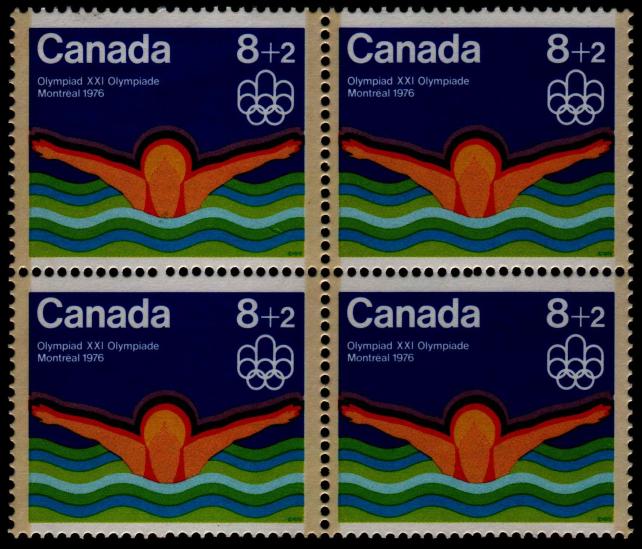 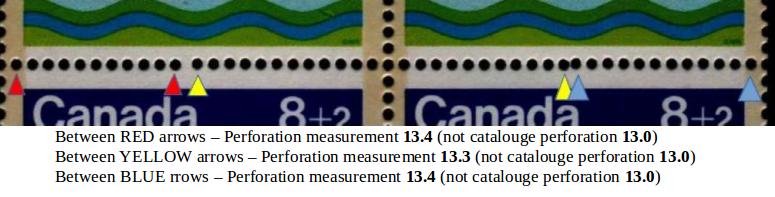 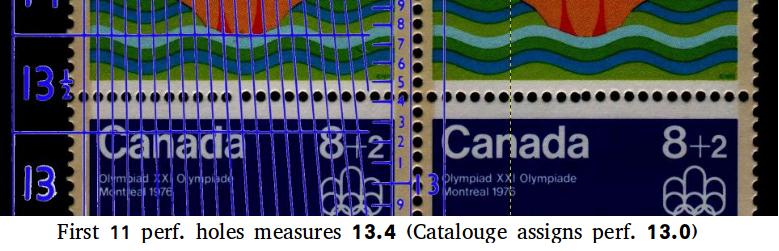 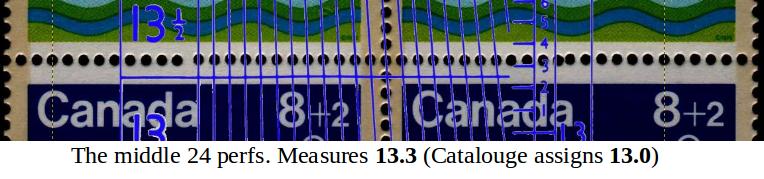 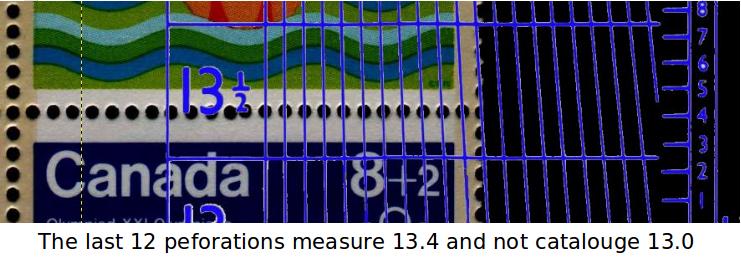 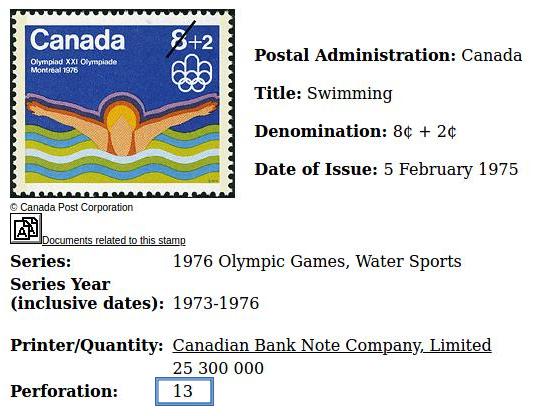 |
|
Send note to Staff
|
|
|
|
|
Bedrock Of The Community
Australia
38679 Posts |
|
|
Suggestion: The stamps are obviously comb perforate. The pins are identical in number, it is just the Punch plate that held the pins have been somehow misaligned, for whatever reason. The perforation is correct at 13, it just doesn't line up with your guage, due to some sort of damage. Example : A Grover comb perforation punch plate with attached pins. Your pins would still guage at 13 over a random 2cm line, excepting where the pins have been misplaced or damaged. If you count your pins, it will be 25 pins wide top and bottom, which will guage at 13, you just have picked up irregular spacing, or a broken pin, has been replaced in the plate, in a differing position. 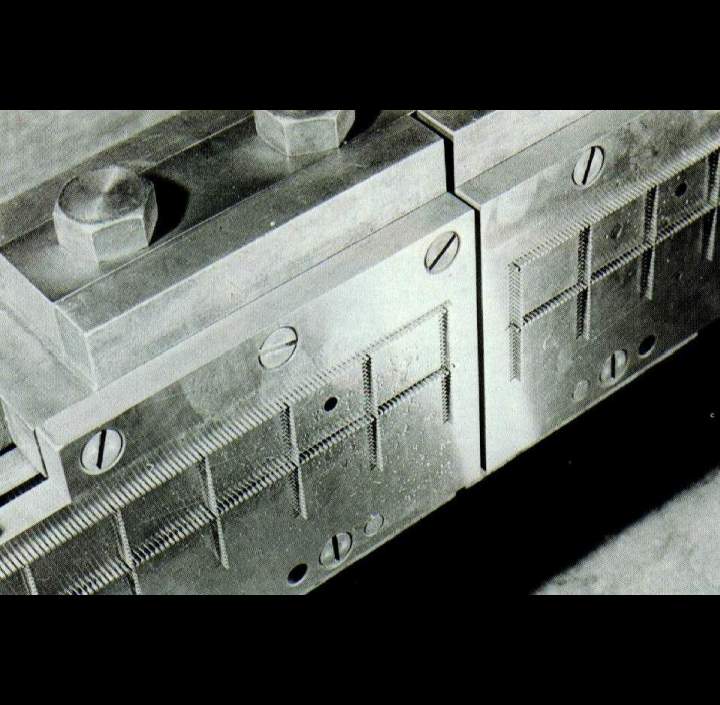 |
Send note to Staff 
|
| Edited by rod222 - 03/18/2020 3:59 pm |
|
|
Pillar Of The Community
United States
2830 Posts |
|
|
Are sheets typically perfed one sheet at a time or a certain number are stacked? Perf pins never seem sharp to me so I am confused about how they actually create the perforation. They don't seem to be hollow at the end (per the picture above as an example), so the perfs aren't being cut out. Yet at the same time uniform dots of paper are created. What is placed underneath the stamps to allow the pins to do their job? |
|
Send note to Staff
|
|
|
Bedrock Of The Community
Australia
38679 Posts |
|
|
Do these stamps exist in a sheet form? that may have been "Harrow" perforate?
|
|
Send note to Staff
|
|
|
Bedrock Of The Community
Australia
38679 Posts |
|
|
Shermae, that is the die. The pins line up with holes in the die plate. 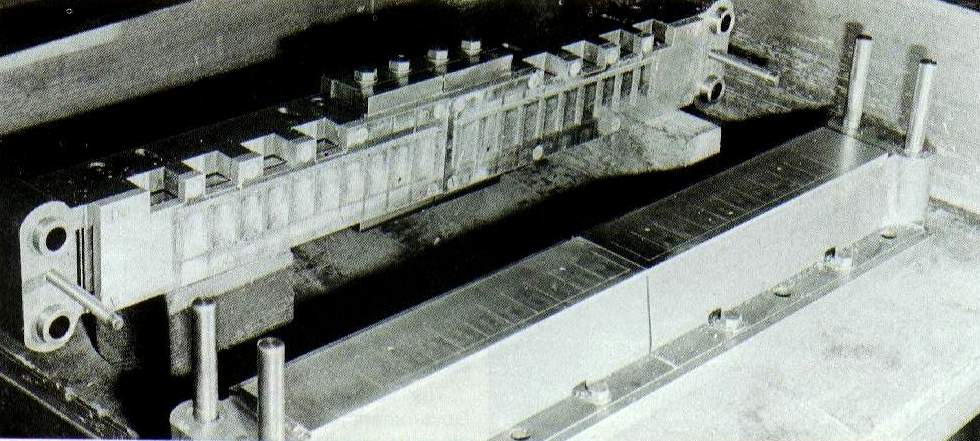 Quote:
Are sheets typically perfed one sheet at a time or a certain number are stacked? This I do not know. With the Grover, the sheet of stamps, are punched, then automatically advanced, by one stamp distance and punched again, till the end of the sheet. The pins are sharpened by, running the punch plate along, and underneath a surface grinder, when the pin edges become dull. |
|
Send note to Staff
|
| Edited by rod222 - 03/18/2020 4:09 pm |
|
|
Valued Member
Canada
395 Posts |
|
|
I just checked my blocks which look similar to Robert's.
What I see is that these were perfed by a comb perforator in the form of an "H", i.e. one stroke made the vertical perforations and half of the perforations on each of the left stamp and the right stamp (more accurately 11 holes on the left and 12 on the right). The weird middle gap is due to slight misalignments in moving the sheet from one stroke to the next.
Secondly, I measured the stamp to stamp distance as 36mm. As there are 24 holes horizontally per stamp this equates to a guage of 24/36x20=13 1/3.
The vertical perforations guage the same (20 holes in 30 mm).
The 13.0 in the catalogues is clearly not exact.
Jan |
|
Send note to Staff
|
|
|
Rest in Peace
7742 Posts |
|
|
Quote:
The 13.0 in the catalogues is clearly not exact. Exactly Jan...I have been trying to bring to the attention of stamp collectors (Especially Canadian Stamps)......Assigned perforations are assigned by experts, catalouges, write ups, books, Library and Archives Canada, etc. I believe that some assigned perforation measurements are being rounded off...Not some thing I am fond of. I have measured another 20 of so stamps that have been assigned say 12.0 x 12.0 perforation...When measured they turn out to be exactly 11.9.....Some collectors call what I do nit picking....I call it a perforation measurement adjustment process. For more accuracy for stamp collectors. If we are worried about every aspect of stamps, then why are we not worried about accurate perforations....I approached a major well known stamp organization and talked to a person for over an hour about studying perforation measurement adjustment....They did not seem interested, and that's ok. I am stumped on what to do, I have talked to the perforation guru with a few emails and he agrees, but also hit dead ends like me, with acceptance of perforation measurement adjustment. Guess it is time to just give up and concentrate on other aspects of stamp collecting. Thanks guys for your replies. Robert |
|
Send note to Staff
|
|
|
Moderator

United States
12330 Posts |
|
|
"Perforation" is defined as "the number of perforation holes or teeth within the space of 2 centimeters". So perforations are not measured, they are counted. I assume this is why they rounded off in many catalogs.
Don |
|
Send note to Staff
|
|
|
Pillar Of The Community
6361 Posts |
|
|
Quote:
When measured they turn out to be exactly 11.9 Wert, Are you sure it wasn't 11.88 or 11.92? Just kidding, but ... Nearly every measurement will be rounded or truncated in the last digit of necessity. How many digits should the catalog report for a collector to correctly ID a stamp? 1? 3? 5? I would agree that the current generous rounding/truncating leads to a lot of threads from newer collectors finding their stamp to be 11.25 and absent from the catalog (and thus rare!), rather than being the listed perf 11 variety. Your posts have clearly demonstrated the Unitrade differences with reality. Don, if I may cut/paste, perhaps out of context... Quote:
So perforations are not measured, they are counted. Unfortunately, this quote may lead a lot of beginners to actually "count" perforation, not learn to use a gauge, and not understand the concept properly. I hope the hobby does not encourage perforation counting ... especially among beginners. Perhaps it is semantics, but why not encourage collectors "to gauge the perforations of their stamps" to determine the rate, etc. |
|
Send note to Staff
|
|
|
Valued Member
Canada
395 Posts |
|
|
Robert,
I'm sure you have noticed that most catalogues only give perforations to the nearest half perforation. The reason perforations were measured in the first place was to help distinguish between otherwise similar stamps. To measure to the nearest half was sufficient for this.
To measure to the nearest tenth you need skill, practice and an accurate gauge. Most people would have difficulty in this. You first asked why you sometimes got 13.3 and sometimes 13.4. Here it is because the actual gauge is between the two.
A more modern use for more accurate perf measurements is to help discover forgeries.
For this stamp there only one variety, and probably no forgeries, so an accurate gauge has little value. Still it should have been rounded to 13.5.
From a scientific viewpoint, Unitrade should not report the gauge as 13.0, as this implies that the measurement is accurate to the nearest tenth. Rather they should report it as 13, which allows for the inaccuracy.
Jan |
|
Send note to Staff
|
|
|
Rest in Peace
7742 Posts |
|
|
Quote:
I'm sure you have noticed that most catalogues only give perforations to the nearest half perforation. The reason perforations were measured in the first place was to help distinguish between otherwise similar stamps. To measure to the nearest half was sufficient for this. Jan...That is not accurate when most catalouges express their books as specialized. That is like a coin collector going to a coin forum and seeing a coin this is say 3.92 cm wide and the coin book rounds it off to say 4.00 cm. As to what John Becker wrote, this would have every new collector contacting every coin forum posting they have a rare new find..Why should it be no difference to stamp collectors...Give them the correct information from the start. Rounding off maybe acceptable to some collectors, but rounding off say my B10 basketball stamp from 13.4 down to a rounded off perforation of 13.0 is not exceptable....maybe I am anal, but it is what I believe the right thing to do. See the B10 perforation measurements below to show you what I mean. And you really believe it is ok to round off..Not arguing with you jan. (my friend), just my belief I guess. 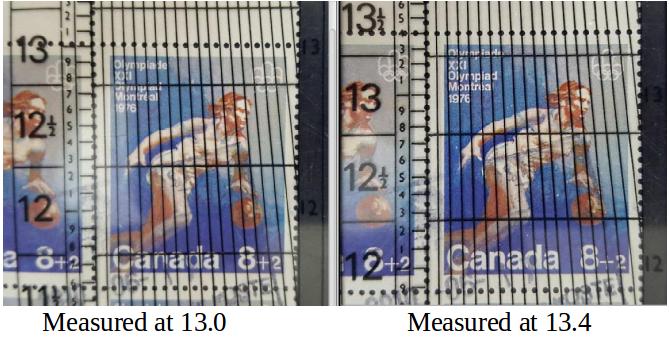 But enough arguing...Time for me to move on...Have a good day guys |
|
Send note to Staff
|
| Edited by wert - 03/19/2020 7:04 pm |
|
|
Bedrock Of The Community
12723 Posts |
|
|
Doesn't it just complicate the living heck out of something simple? I mean we are not talking machined parts for the Space Station here. Washington - Franklins for example come in a few perforation gauges as well as imperf. If we started down the road of instead of sorting/identifying by perf 11 and perf 12 and started listing perf 10.8 and 11.9 what point would it serve. The perforating machines were/are not perfect because they were/are not performing a mission critical function. They made/make holes in the stamp in order to allow the user to separate them easily without damage. The only perforation EFO's that I am aware of are shifted, doubled and so on. And then you have the rare issues that were perforated in one gauge on say three sides and a different gauge on the fourth side.
Lord help us if we start picking apart watermarks. And man, color shades are enough of a headache.
Some of the "double transfers", gashes, scratches and other sundry differences are so miniscule that one needs an electron microscope to see them.
Don't get me wrong, spend time on whatever floats your boat. Lord knows that the classic US issues have more flavors than Baskin Robbins but other than that why should a catalog publisher make any effort to redo everything because a modern stamp gauges differently than what is published. Is the juice worth the squeeze? There are tolerances for a reason. You could possibly, worse case, drive yourself nuts (Filberts to be exact).
|
|
Send note to Staff
|
|
|
Valued Member
Canada
395 Posts |
|
|
Robert, I don't think we are disagreeing. There are times when it is important to measure as accurately as possible. For example, there is a stamp I have been searching for for many years in perf 11x12. According to the specialized catalogue it also occurs in 11.5x12 (which I have). What do I do with an example that measures 11.3x12? Anyway, keep doing what you are doing. You never know when you will find something interesting. Jan Quote:
And you really believe it is ok to round off. Not arguing with you jan. (my friend), just my belief I guess. Please be careful in reading what I said. I said it might be ok to round 13.4 to 13. I did not say it was ok to round 13.4 to 13.0. Similarly I would never round 3.92 to 4.00, but there would be times I would round 3.92 to 4. It depends on the situation. |
|
Send note to Staff
|
|
|
Pillar Of The Community
3860 Posts |
|
|
It would be interesting to group the perforations by different printers like Canadian Bank Note (CBN), British American Bank Note (BABN), Ashton Potter (AP), etc. in order to look for a pattern of similar perforations used. In 1968, BABN had the first Canadian comb perforated stamp as Scott/Unitrade # 482 and the last line perforated BABN-AP stamp was Scott/Unitrade # 601 (plate # 2) in 1978. The last CBN line perforated stamps were Scott/Unitrade # 629-632 in 1974. |
|
Send note to Staff
|
| Edited by jogil - 03/19/2020 10:40 pm |
|
|
Rest in Peace
7742 Posts |
|
|
Quote:
It would be interesting to group the perforations by different printers like Canadian Bank Note (CBN), British American Bank Note (BABN), Ashton Potter (AP), etc. in order to look for a pattern of similar perforations used Interesting thought jogil That would be very intensive for sure. Robert |
|
Send note to Staff
|
|
|
Pillar Of The Community
3860 Posts |
|
|
For Canada line perforated stamps from 1858 to 1978 starting with Scott/Unitrade # 11 and ending with Scott/Unitrade # 601 (plate # 2), there is a booklet and perforation gauge that was put together for them.
However, very little interest has been shown on this by Canada (and U.S.) stamp collectors, stamp societies, study groups, expertising groups, Scott/Unitrade catalogues, etc. even though many complain about the inadequacies of current used gauges.
My study is based on the fact that Canadian Bank Note Companies used U.S. manufactured equipment to line perforate their postage stamps. This takes off from where Kiusalas has left out.
wert: Thus, I do feel your pain about knocking on different doors that ignore (don't open nor answer) you regarding what you are doing by more closely and accurately examining the gauges of stamp perforations. |
|
Send note to Staff
|
| Edited by jogil - 03/21/2020 09:14 am |
|
|
Replies: 18 / Views: 2,851 |
|




 Posted 03/18/2020 1:49 pm


