| Author |
 Replies: 375 / Views: 31,167 Replies: 375 / Views: 31,167 |
|
|
|
Pillar Of The Community
United States
7239 Posts |
|
|
Pillar Of The Community
United States
7239 Posts |
|
|
Pillar Of The Community
Romania
596 Posts |
|
|
This is Mi # 99 (type II) issued in 1948 (Anglo-American occupation of Germany) Plateflaw VI-white line between C and H. I don't understand why MNH has no value in the catalog and field number   |
Send note to Staff 
|
|
|
Pillar Of The Community
Netherlands
799 Posts |
|
|
In reply to cuprams post.
The reason for no catalogue value is most often lack of data.
Catalogues and their catalogue values are based on data of the past and present. This means that if there were no or little sales of this stamp mnh in auction or by stampdealers, a catalogue value will not be mentioned untill sufficient data is available.
Not mentioning the field number can have several reasons. But basicly they do not know or do not know for sure.
This series is on of those series were plate flaws appear and disappear. A certain flaw can be on only a little number of sheets printed and when none of these sheet are available, it is not possible to give the field number.
I give a few reasons, others may have additions. |
|
Send note to Staff
|
|
|
Pillar Of The Community
United States
7239 Posts |
|
|
Good explanation Johan. Here is one on the October 7, 1949 von Stephan issue. It is Mi #116 pf I., "oblique streak on the '0' 0f the value '30' (field 17 for the entire printing, fields 41 and 46 for part of the printing)".   |
|
Send note to Staff
|
|
|
Pillar Of The Community
Romania
596 Posts |
|
|
Thanks Johan for your explanation. At first I was surprised that the field is not mentioned, taking into account the rigor and meticulousness characteristic of Michel's catalog. This series is new to me and is very complicated to identify. The series was printed by 2 companies: Westermann and Bagel who used different methods of mounting the printing plates. I still haven't been able to translate and understand the explanations from Michel's catalog (in German) and I hope that someone will have the English version, the language that is more accessible to me. George  |
|
Send note to Staff
|
|
|
Valued Member
439 Posts |
|
|
Hi, @ cupram, Here is the study group. Have some fun and navigate the site for information. Specialy the plating. The basic stamp 3 DM Type II MNH is a high value. The SM 3 (Secondary Characteristics) is only on type II Westermann. https://www.bautenserie48.de/@ bookbndrbob, Very nice the Von Stefan! Here one example with the circle around the punch hole. Normaly very faint and sometimes very noticeable.  Hornet |
|
Send note to Staff
|
|
|
Pillar Of The Community
United States
7239 Posts |
|
|
Thanks hornet! Here is another one from the 1950's. This one is listed in the Thomas Schantl Verlag Plattenfehler-Katalog BRD/Berlin fifth edition. It is the 1956 Maria Laach stamp, Michel #238 "L" of "LAACH" broken, field 35, part of the printing.   |
|
Send note to Staff
|
|
|
Pillar Of The Community
Romania
596 Posts |
|
|
Valued Member
439 Posts |
|
|
Hi, @ cupram, Once on the site, go on the left column clic on "Bautenserie", "Plattieren", "DM Werte", go down the page clic on "weiter", scroll down to see the SM (secondary Characteristics) you will see the position of the SM 3. Here two pictures: One is my Nr.46 PF I and the second one,the specialized book (one example more exist this one is old). Notice the difference between Michel and some books. Michel PF I is PF 227. Some other will have the grill number and a reference as Michel PF I.   |
|
Send note to Staff
|
|
|
Pillar Of The Community
United States
7239 Posts |
|
|
Hornet, that appears to be from the Collegium Philatelicum reference work on the Crown and Eagle series (1962-8). That is a great piece of work. |
|
Send note to Staff
|
|
|
Pillar Of The Community
United States
7239 Posts |
|
|
This 1997 plate flaw is the result of the correction of a plate flaw on the the 300 pf Idar-Oberstein stamp. The original plate flaw is Michel #1911 PF III, a blue streak in the halftone shading of one of the gem's facets. This plate flaw (not shown here), and the one shown below, occur at field 7, during a portion of the printing. . The plate flaw shown here is Michel #1911 PF IV. It is a retouch done by removing the streak. In doing this, a portion of the halftone in that area (indicated by the red circles) has also been removed.   |
|
Send note to Staff
|
|
|
Valued Member
439 Posts |
|
|
Hi bookbndrbob, In Schantl, the PF IV has a remaining of the blue line and yours doesn't have it. I saw some advertised like yours as PF IV on ebay. So I did ask why and yes, the PLF exist with different characteristics. Michel has the note in brackets but Schantl do not mention it. Thank you showing this one. Below the Schantl example (Picture from ebay) Hornet  |
|
Send note to Staff
|
|
|
Pillar Of The Community
United States
7239 Posts |
|
|
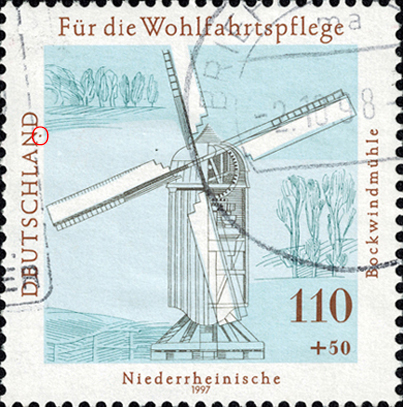
Thanks hornet! The close-up scan on my last one does not show the blue on the little piece of blue line that is there, but I can see it through my 10x loupe. Here is another one from 1997; the Diesel commemorative (Mi #1942). Schantl lists it as "black spot on gear, field 1, part of printing".   |
|
Send note to Staff
|
|
|
Pillar Of The Community
United States
7239 Posts |
|
|
Here is another plate flaw from the 1880 "PFENNIG" series. This one is Michel #44 PF V a, "broken tip at middle of upper ornament (position 91 sheet L). The "a" refers to the color, "(medium) grey-green (olive-grey) (1880-1887)".  |
|
Send note to Staff
|
|
|
Replies: 375 / Views: 31,167 |
|




 Posted 04/08/2021 3:55 pm