| Author |
 Replies: 10 / Views: 828 Replies: 10 / Views: 828 |
|
|
Valued Member
85 Posts |
|
|
I've run into a color variation with the Swift & Courtney private die stamp (RO173) fairly often. But I've not found any description or mention of it. I've included a scan of a "normal" blue RO173b on the right and the variation on the left. 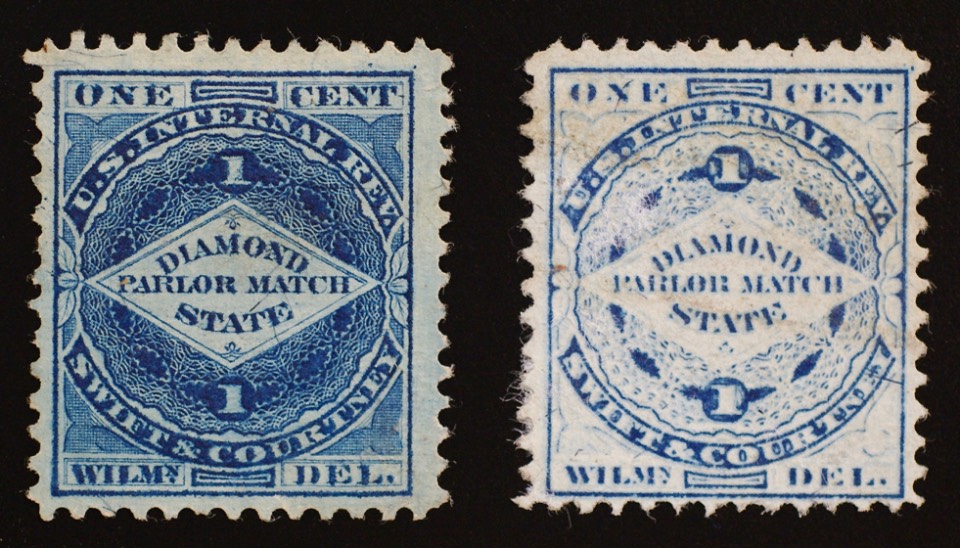 What is the cause of this? The handful I have are all on silk paper. Does this occur on old or exp. silk papers? Thanks in advance, Keith |
|
Send note to Staff
|
|
|
|
|
Bedrock Of The Community
United States
10812 Posts |
|
|
This was a large company which sold a lot of matches, and the plates were expensive to make. So they got VERY worn, at which point they would not accept ink very well and this is what they would look like. That's why so much of the fine detail in engine turning around the central diamond is missing. |
Send note to Staff 
|
|
|
Bedrock Of The Community
United States
10812 Posts |
|
|
Bedrock Of The Community
United States
10812 Posts |
|
|
The left stamp is also one of the double transfer varieties, noticeable in the lettering at the top and bottom of the stamp. |
|
Send note to Staff
|
|
|
Valued Member
85 Posts |
|
|
Thanks. That makes sense.
And you are correct, the normal stamp is on the left! I am very dyslexic. If you are giving me directions, you better just point! |
|
Send note to Staff
|
|
|
Bedrock Of The Community
United States
10812 Posts |
|
|
The worn plates tend to be on silk paper because they were issued later when the plates were older. However the double transfers exist on both, silk being somewhat more common in my experience. |
|
Send note to Staff
|
|
|
Valued Member
United States
271 Posts |
|
|
I thought there was a wet and dry print variety of these. The one on right being the dry. Info came from Aldrich, but cant remember where.
Edit for spelling and more info |
|
Send note to Staff
|
Thanks,
Robert |
| Edited by rwoodennickel - 05/03/2020 07:15 am |
|
|
Pillar Of The Community
United States
796 Posts |
|
|
as was pointed out, there are meany shades and colors of this issue over its life. these shades exist on all of the papers. some resemble ultramarine in artificial light. the more worn the plate the less detail will show up. |
|
Send note to Staff
|
|
|
Pillar Of The Community
United States
796 Posts |
|
|
while the amount of moisture in the ink and paper play a part in getting a good impression, they are not the only factors. specifically issued wet or dry printings play no major role in us issues until the (i believe) the 1960's. I am away from my references so forgive me if the date is off. |
|
Send note to Staff
|
|
|
Valued Member
United States
271 Posts |
|
|
Agreed, there is no mention of different printing methods in West's publications. Revcollector pointed out in his first post about how the engraving was done being responsible for poor prints over time. |
|
Send note to Staff
|
Thanks,
Robert |
|
|
Bedrock Of The Community
United States
10812 Posts |
|
|
Wet and Dry printing methods are a much later production creation. Dry printing as a method began in 1953. Dry when used on issues before that time means that the paper was not moist enough when the stamp was printed. |
|
Send note to Staff
|
|
| |
Replies: 10 / Views: 828 |
|




 Posted 05/02/2020 5:59 pm


