| Author |
 Replies: 3,821 / Views: 253,025 Replies: 3,821 / Views: 253,025 |
|
|
|
Pillar Of The Community
United States
636 Posts |
|
|
Hi RLSNY --
I started to look at your tentative 23L1 stamp -- and the prior owner did not plate it correctly. It is not position 23L1E or 23L1i as the bends in the LFL / LIL aren't even close.
You should give it another go-around -- as with that uniquely positioned GD, it shouldn't be too tough to develop a short list of candidates.
Big Hint -- the blue Philly cds indicates a January 20 usage -- which is getting a little late for 1E / 1i -- not impossible -- just a little late. Plus, that "gouge" in the upper half of the URDB screams plate 1L -- which would make the stamp a #11A -- although might be a scarce Experimental OB color -- (which is impossible to tell from an online scan).
Let us know what you find by way of plating candidates, and we can go from there.
Regards // ioagoa
|
Send note to Staff 
|
|
|
Pillar Of The Community
United States
636 Posts |
|
|
Hi again RLSNY --
When I wrote my last post about your 23L1 stamp -- I was tight on time -- and beyond concluding that it was not from the Early or Inter states of the plate did not have time to go check the Late state of the plate.
I had a little time this afternoon -- so compared your stamp to my reference copies of 23L1L -- and it is a dead on match in all regard.
One interesting thing about 23L1L is that there are what looks like a couple of engraver slips both outside the LFL and in-between the LFL and LIL. The slip that is in-between the LFL and LIL starts at a level roughly opposite the top of GW's forehead -- and runs north stopping just shy of the outer rosette dot at the 8:00 position on the ULR. This can clearly be seen on the Chase copy if you want to compare it to your stamp.
Bottom line -- your stamp is position 23L1L -- an early printing impression from the late state of the plate -- most probably used in January 1852 -- and -- at least on my monitor -- looks more likely than not to be an Experimental Orange Brown variety.
The stamp is an XF 4-margin copy -- and if it is 100% sound (??) -- and if you agree that it is most likely an Exp OB color (??) -- then it might be worth sending in for a certificate.
Regards // ioagoa
|
|
Send note to Staff
|
| Edited by ioagoa - 12/16/2023 7:46 pm |
|
|
Valued Member
United States
342 Posts |
|
|
RLSNY, Sending it in sounds like so much work. Just list it on ebay and I'll buy it and send it in. That way you won't have to worry so much about the color. Thanks! |
|
Send note to Staff
|
Stan Shepp |
|
|
Pillar Of The Community

United States
1831 Posts |
|
|
Thanks - been a very busy weekend - all good stuff, but haven't had a chance to dig into the ExOB possibility. Will report back - probably Monday. Thanks ioa for your detailed analysis. The previous owner did actually have it as Late - but the color is what was making me question it. I will see if I can convince myself it's EXOB or not. |
|
Send note to Staff
|
|
|
Pillar Of The Community
United States
1831 Posts |
|
|
I have never owned an experimental orange brown/ don't have a reference copy. Looking online is surprisingly unhelpful. Certified ExOB stamps vary a lot. What I believe I've gleaned is that the second most likely color for my stamp is brown carmine. In person the stamp is a bit more brown than it appears on the scan. So I can't completely dismiss that possibility. Still I do come down thinking this is an orange brown and really not carmineish. So, I give it a 75% chance of being a ExOB.
So it really does need a cert. It will go out along with some others. I've accumulated enough that I think I'll be sending them in in the next few weeks.
Stan, not sure if you are serious or /sarcasm, but if you want to make an offer, DM me; otherwise it's going in.
|
|
Send note to Staff
|
|
|
Pillar Of The Community
6357 Posts |
|
|
I seldom immerse myself very far into plating, but was intrigued by this one today with traces of adjacent stamps at top and right. I came up with 81L2L Is this correct? If not, help put me on the right path. 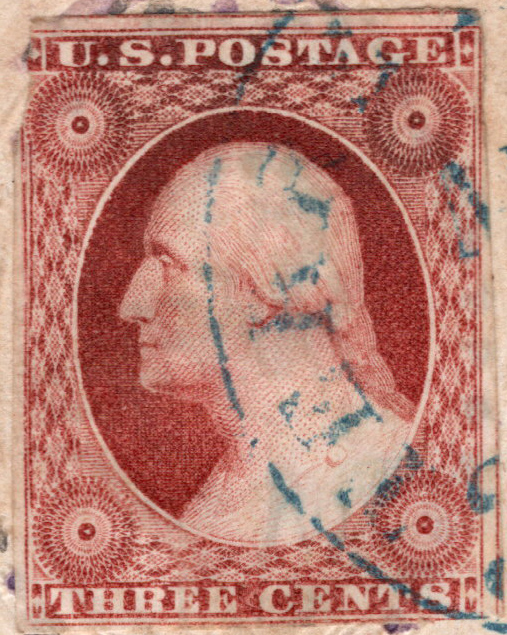  |
|
Send note to Staff
|
|
|
Pillar Of The Community
United States
3520 Posts |
|
|
Hi. I would look at plate 1L.
The heavy gouging in the top half of the upper right diamond block is very characteristic of 1L. Also thick inner line recuts. |
|
Send note to Staff
|
|
|
Pillar Of The Community
United States
636 Posts |
|
|
Hi John —
I am away from my stamps and my computer until after Christmas — working only from an iPhone today.
I agree with txstamp — definitely plate 1L. Also definitely a B relief. Obviously can't be from the 10th vertical column as the LFL of the adjoining stamp at right shows.
Too bad that the lower right corner is cut very close — as the GD (if there is a GD) does not show. Still you can probably use the presence of a GD in the area that does show to eliminate many positions.
Likewise — the relationship between the LFL and LIL is very distinctive — which I would use as the primary characteristic in the hunt.
Wish I could help more — but this is the best I can do until after X-Mas. Maybe Classic Coins or Harper can give this one a go-around for you.
Regards // ioagoa
Edit // hard to tell on an iPhone — but it looks like there may be a GD under the cancel (??) — sitting on top of the BFL — directly below the right edge of the S in CENTS. If that be the case — then the GD should be the primary search characteristic — as there are not many stamps on the plate with a GD that far to the left of the RFL.
Edit #2 — take a look on the prior page of this thread at RLSNY's 23L1L — looks like a possible match — especially if that is a GD under the cancel on your stamp as mentioned above. (Again — hard to be sure when working from an iPhone.)
Edit #3 — Definitely position 23L1L — as the engravers slip that I discussed in my post about RLSNY's stamp is clearly visible on yours!! Again — see RLSNY's post about his 23L1L on the prior page of this thread -- and my replies to him at the top of this page of the thread.
|
|
Send note to Staff
|
| Edited by ioagoa - 12/23/2023 12:57 pm |
|
|
Pillar Of The Community
6357 Posts |
|
|
Mystery solved. Thanks txstamp and ioagoa.
Amazing how obvious it is now. And a coincidence that the same position had just been discussed.
-John |
|
Send note to Staff
|
|
|
Pillar Of The Community
United States
2230 Posts |
|
|
Well done, all. Here's a compressed composite with the Chase 23L1L for visualization:  |
|
Send note to Staff
|
|
|
Pillar Of The Community
United States
2230 Posts |
|
|
Pillar Of The Community
United States
636 Posts |
|
|
Hello All -- In the process of plating some stamps, I stumbled upon what looks like a previously undocumented variety of recutting -- which could be described as follows: "Left frame line extends to stamp below". Likewise -- depending on perspective it could also be described as: "Left frame line extends to stamp above". All a matter of semantics I guess -- but either way -- this is a recut variety that is not yet classified anywhere. The positions involved are 21-31R8. Images are attached below of 2 examples -- and with both examples clearly showing the LFL extension between the two positions -- it is definitely a consistent recut and not a "one-off" inking anomaly. By way of background -- Currently, there are 40 listed varieties of recutting (see USPCS Chronicle #258 / May 2018 / Article titled: Recut Varieties of the Imperforate 3c Stamp of 1851–1857 / Authored by D. Getzin and W. Saadi). One of those 40 -- Recut variety #39 -- is described as follows: "Right frame line extends to stamp below" -- but there is no corresponding recut variety listed for the left frame line extending in the same manner. Link to USPCS article is here: https://chronicle.uspcs.org/PDF/Chr...58/21991.pdfWhen Chase wrote his book on the 3c issues of 1851–1857 he mentioned in his discussion about plate 8 that -- ...the recutting of the FL's often run beyond the corner junction points ..... and in several instances the side FL's continue as far as the next stamp above or below.... -- but for whatever reason Chase did not classify side FL extensions that touched an adjoining stamp as a recutting variety. Over the ensuing years -- recut varieties #35 through #40 were added to Chases original classification listing -- one of those being Recut Variety #39 -- which was announced in the Nov. 2000 issue of the USPCS Chronicle (see USPCS Chronicle #188 / Nov 2000 / Article titled: The Type I 3c 1851–57 Stamps: A Previously Unlisted Recut Variety / Authored by W. McDaniel). Link to USPCS article is here: https://chronicle.uspcs.org/PDF/Chr...88/12115.pdfNone of this is a big deal -- but it is interesting to note -- and, unless I missed it (???), curious that it has never been discussed previously in the literature given the volumes of articles written about this stamp over a period of decades? Regards to All // ioagoa Scan of "discovery copy" of 21R8 is here:  Scan of "confirming copy" of 21R8 and 31R8 is here:  |
|
Send note to Staff
|
|
|
Pillar Of The Community
United States
3520 Posts |
|
|
Interesting. Your discovery copy sure shows it about as well as it can show. Very nice.  It is clearly as good a variety as recut #39. That seems clear - I agree. One thought I had on recut 39, in particular, which also applies to this one, is these actually extend beyond the standard rectangle that normally defines the stamp itself. Maybe that's why Chase didn't include recut 39, or this one - but instead just left them as a side note. I agree that if recut 39 is included, then this one seems as though it should also be included as #41. My only other question (possibly rhetorical) is how far off the rails does one want to go with categorizing recuts? A baseline comparison is the 1c stamp Type Ic, where things just went too far in categorizing, and it created problems in identification. My initial reaction is this is probably a different deal, and is already buried in minutia. To provide some context, it might be worthwhile to scrub plate 8 and just see if this is likely to be the only other such thing "outside the box" so to speak....or is this continuing to open a can of worms that we want opened? |
|
Send note to Staff
|
|
|
Pillar Of The Community
United States
1831 Posts |
|
|
I've made an attempt to plate this but have had zero success. Is it relief C - but no gash? I'm obviously not going to get very far on this one. A very distinctive guide dot, but was not able to locate a match. I'm thinking it's a Scott 10, but would like to do a better job of locating it. Any suggestions? 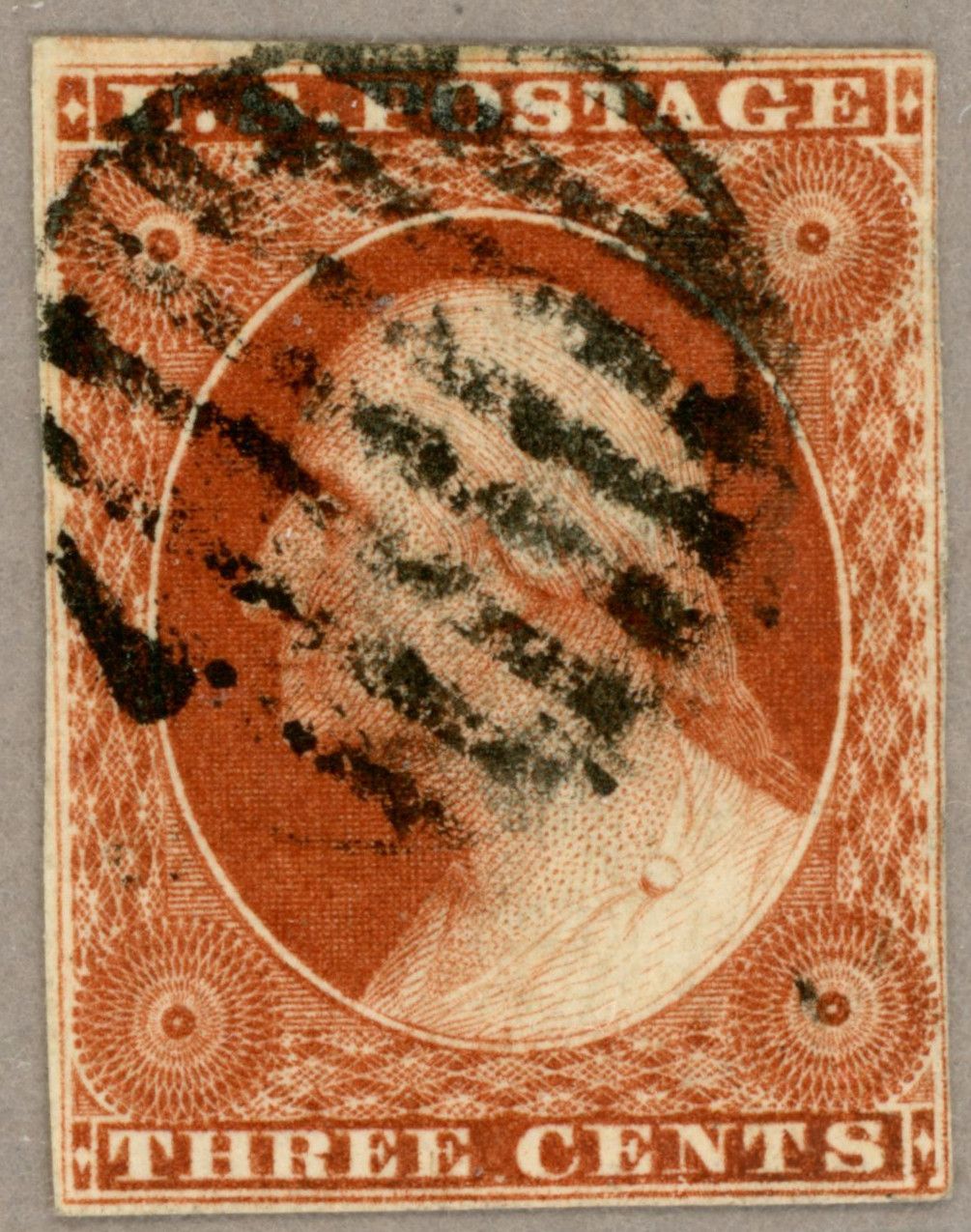 |
|
Send note to Staff
|
|
|
Pillar Of The Community
United States
636 Posts |
|
|
Hi txstamp --
You raise some very valid points about classification of recuts -- and the whole subject is quite debatable -- and as you say -- is essentially a can of worms.
Here is my knee jerk "stream of consciousness" on the whole subject...
At one extreme -- all 2,600 positions are unique -- at the other extreme -- having a single copy of a #10 and #11 for a casual collector filling album spaces will suffice. In the middle might be somebody who wants to put together a showing of an example of each of the "listed" varieties of recutting. The collecting possibilities are endless -- and are really a function of each collector's preferences and areas of interest.
For me personally, I have never been a strong fan of recut classifications -- as my main interest is in figuring the position from which the stamp came -- and in that regard, recuts are a tremendous plating aid.
In some ways, beyond functioning as a plating aid, over time -- some of these various recutting classifications have gotten to be a bit contrived by catalogue publishers, dealers, and others looking to create more spaces for a collector to fill -- in other words -- they are, in part, seemingly driven for financial motives. Even the major changes to the Scott catalogue back in 2008 when the whole #10 / #10A -- and #11 / #11A numbering changes were introduced was fraught with strong differing opinions within the 3c collecting community.
Case in point -- recut #23 -- LIL up too far -- where should the line be drawn as to what constitutes "up too far". Chase listed a handful of these recuts -- whereas McDaniel listed many, many more. If one steps back and looks at the reason why -- it becomes readily apparent that McDaniel drew the line (no pun intended) much differently than Chase did.
Another case in point -- 95L1L -- the 5 line ULT recut -- in actuality is no scarcer than any other position from plate 1L -- which is a fairly common plate -- yet the catalogue makers have assigned a huge premium to the position.
Then there is the whole plate 3 "three rows" recutting variety listings?
I could go rambling on and on here -- but given that my main interest is in figuring the plate position from which the stamp came -- I think that sometimes "less is more" when it comes to trying to slot every little fly-speck variety into a classification listing. On the other hand -- I have many collector friends who would disagree with me -- and who view the classification of recutting varieties (and combinations of recutting varieties) as a strong collecting area of interest. The ongoing debate is where to draw the line on the classifications -- and which one's warrant being assigned a variety # -- or even more extreme -- a separate pricing premium in a catalogue listing.
Great rhetorical question that you asked -- and at the risk of -- as you stated -- opening a can of worms -- like you -- I would be curious to hear what other's think about this whole subject.
Regards // ioagoa
|
|
Send note to Staff
|
|
|
Replies: 3,821 / Views: 253,025 |
|



 Posted 12/16/2023 4:05 pm


