| Author |
 Replies: 3,821 / Views: 253,022 Replies: 3,821 / Views: 253,022 |
|
|
|
Valued Member

United States
327 Posts |
|
|
Rlsny,
The lack of inner frame lines points to right pane of 1E or 1i. Color and impression look like a #10 and it's a B relief.
Regards,
Harper1249 |
Send note to Staff 
|
| Edited by Harper1249 - 01/04/2024 12:41 pm |
|
|
Pillar Of The Community
United States
3520 Posts |
|
|
It kind of looked like it may be 23R1i to me, but that's just a quick swing at it, which may be wrong. |
|
Send note to Staff
|
|
|
Pillar Of The Community
United States
1831 Posts |
|
|
tx, I don't think it is 23R1i. There is a tiny line between the upper right diamond and triangle on my stamp that is missing on that and some other small differences. I think it might be 63R1E. 63R1i is possible, but given the limited images I have available to me, I think it is 63R1E. That position has the huge guide dot of mine and recuts align etc.
And thanks Harper for the hints. |
|
Send note to Staff
|
| Edited by rlsny - 01/04/2024 2:54 pm |
|
|
Pillar Of The Community
United States
3520 Posts |
|
|
Valued Member
United States
327 Posts |
|
|
63R is the position I came up with as well. I'll look at it more when I get home from work to compare 1E and 1i. |
|
Send note to Staff
|
|
|
Valued Member
United States
327 Posts |
|
|
Rlsny,
I looked over your stamp in more detail and realized this position was discussed recently on this thread. If you search for "63R1E" in this thread you'll find it.
When I first looked at your stamp thought it was missing both inner frame lines but after looking at it again there are portions of an inner frame line on the left. There is no inner frame line on the right. On your stamp, the visible portions of the left inner frame line (look at the bottom portion) and the recut in the UL triangle appear fairly strong leading me to say your's is from the 1E but would need additional verified copies to compare it with to be certain.
Harper1249 |
|
Send note to Staff
|
| Edited by Harper1249 - 01/04/2024 8:04 pm |
|
|
Pillar Of The Community
United States
636 Posts |
|
|
Harper --
How coincidental -- I was drafting a post about RLSNY's stamp while you posted your most recent post -- (i.e., mainly to note the prior discussion about StampCrow's 63R1 in this thread -- which I just deleted as you already caught it).
And not to complicate things any further -- but I do want to reiterate that back on page 191 of this thread -- I noted that after revisiting the Lund copy of 63R1E as currently slotted on the StampPlating website -- I am now second guessing if the Lund stamp slotted at 63R1E on StampPlating is actually a very early printing impression from the Intermediate state of the plate.
I was able to finally obtain additional reference material for this position -- both Early and Inter states -- so I need to get back to working on that -- might take a while to sort everything out -- but I will eventually try to post additional thoughts as time permits.
Regards // ioagoa
|
|
Send note to Staff
|
| Edited by ioagoa - 01/04/2024 8:14 pm |
|
|
Pillar Of The Community
United States
2230 Posts |
|
|
Quote:
Hello All --
In the process of plating some stamps, I stumbled upon what looks like a previously undocumented variety of recutting -- which could be described as follows: "Left frame line extends to stamp below". Hi, ioagoa, Thanks for that great post on finding the new recut variety, and sharing your images. I like to see these varieties documented because they tell the story of what workers did by hand with a burin to try to improve the look of printed stamps after the mechanical entry of designs on the plate was determined to be unsatisfactory. They are also a great plating aid, of course. Personally, I wouldn't try to complete a collection of all 41 recut varieties, but I would make an effort to add some of the varieties to my collection if I didn't have an example, like Variety #14 – Five Vertical Lines Recut in Upper Left Triangle. With only two positions showing the five-line recut, supply and demand would naturally result in somewhat higher market prices if many collectors wanted one. However, I agree that the catalog publishers certainly have taken some liberties in assigning higher values than what is reflected in the market. With 374 positions showing Variety #11 – One Vertical Line Recut in Upper Left Triangle, the catalog shows a contrived valuation of $16 versus a value of $15 for a nondescript #11A. |
|
Send note to Staff
|
|
|
Pillar Of The Community
United States
3520 Posts |
|
|
I agree that we don't necessarily need catalog values assigned to every single variety - that seems a bit excessive and maybe a bit onerous. Identifying the different varieties has value, as a plating aid, certainly.
Certain stand-out varieties, especially harder to find ones, can provide some real excitement to the collector when one finds them. I enjoy that part of the hobby very much. I recently bought, essentially, a box of 3c covers - sight unseen. Imagine my excitement when I realized there was a Phantom "E" variety 26A on cover, and (a lot of) other fun stuff in there.
The Scott US Specialized catalog lists so much stuff in depth. On the one hand, its really useful as a reference -- really useful -- to get a high level idea of what's out there to look for. I appreciate it for that very much. On the other hand, I don't think all of the esoteric stuff listed should necessarily be priced higher than garden variety stuff.
In the end, however, the market mostly plays out and sets the real prices, versus the catalog prices. |
|
Send note to Staff
|
| Edited by txstamp - 01/05/2024 10:02 am |
|
|
Moderator

United States
12330 Posts |
|
|
In my opinion catalog values will become obsolete within 10-15 years. It is already possible to get fairly accurate market values from AI.
For example, I just asked Pilot about the current market value for a certified US #315 and it returned
The current market value of a certified US Stamp #315 depends on its condition and whether it is mint or used. According to one source, a mint hinged single is valued at $325, while a used single is valued at $285
1. Another source lists a mint never hinged single at $375 and a mint never hinged pair at $725
2. However, these values are only estimates and may not reflect the actual prices that collectors are willing to pay for this stamp. The best way to determine the market value of a stamp is to consult a reputable dealer or auction house that specializes in stamps. They can provide an expert opinion and appraisal based on the latest trends and demand in the philatelic market. I hope this helps you with your query.
Now hold the phone on pushing back on this AI response. Of course, there are issues with it and anyone can punch holes in the response.
My point is that it took all of about 5 seconds to ask the question and another 5 seconds for AI to come back with a response; AI is already gleaning market value data and over time will get more and more accurate.
Another important thing to note, is that at the end of AI response it also returned several philatelic links. Any catalog publisher who has enough vision to see beyond their nose would already be purchasing this space at the end of 'market value' inquiries. And the same catalog publishers really should be transitioning from the obviously limited (some might say near useless) current 'catalog values' to 'rarity factors' and more importantly, their opinion of the market trends for each stamp.
Or, the catalog publishers can just milk the current remaining but 'aging-out' faithful catalog users and ride it to its gory end in the next decade.
Don |
|
Send note to Staff
|
|
|
Valued Member
United States
327 Posts |
|
|
Quote:
Hello All --
In the process of plating some stamps, I stumbled upon what looks like a previously undocumented variety of recutting -- which could be described as follows: "Left frame line extends to stamp below". I view the recut classifications as a very useful tool for plating but don't really have an interest in collecting the recuts by themselves. Similar to what others have said, there is real value to a plater being able to say, "show me all #11s where the left outer frame line extends to the stamp below." For that reason it seems worth classification. Which brings up the question of who decides when something gets officially added to "the list"? I'm envisioning a tribunal sitting on their high bench and Ioagoa standing before them presenting his case. Of course he would be very convincing and the tribunal would unanimously agree and Recut #41 would be carved into the official list of recuts. But I also see the "can of worms" concerns. Does the line have to touch the frameline of the adjacent stamp of does it just have to be really close. Similar to variations in recut #23 Ioagoa mentioned. Interesting topic. Harper1249 |
|
Send note to Staff
|
|
|
Pillar Of The Community
United States
636 Posts |
|
|
Quote:
Which brings up the question of who decides when something gets officially added to "the list"? By way of background -- all of these recut variety classifications came about as follows: -- Chase listed 34 recut varieties in his book -- assigned numbers to them -- and created a table in his book showing how many of each of the 34 varieties came from each plate and how many existed in total. As an aside -- some, but not all, of the varieties listed by Chase made their way into the Scott catalogue. -- McDaniel published an article in the USPCS Chronicle (Reference Chronicle #155 / August 1992) titled: A compilation of recut and plate varieties. In that article he (McDaniel) wrote: ... "The numbers used to classify each individual recut variety are those assigned by Dr. Chase, with the exception of the last four, #35-38. Dr. Chase made mention of varieties 35, 37, and 38, but did not identify the plate positions where they occurred. Variety 36 was identified and plate positions listed, by this author [i.e., McDaniel],as a result of original research"... -- Varieties #39 and #40 were likewise announced as new discoveries in USPCS Chronicle articles at later dates -- #39 in Chronicles #185 and #188 -- followed by #40 in Chronicle #211 -- all authored by McDaniel. I do not believe that there is any "formal process" for adding recut varieties to the "official list" -- but the established practice to date has been to do so through the publishing of articles in the USPCS Chronicle. By the way -- all of these Chronicle articles are available for free on the USPCS website. The only exception being that anything published within the last 5 years is only accessible by USPCS members. |
|
Send note to Staff
|
|
|
Pillar Of The Community
United States
3520 Posts |
|
|
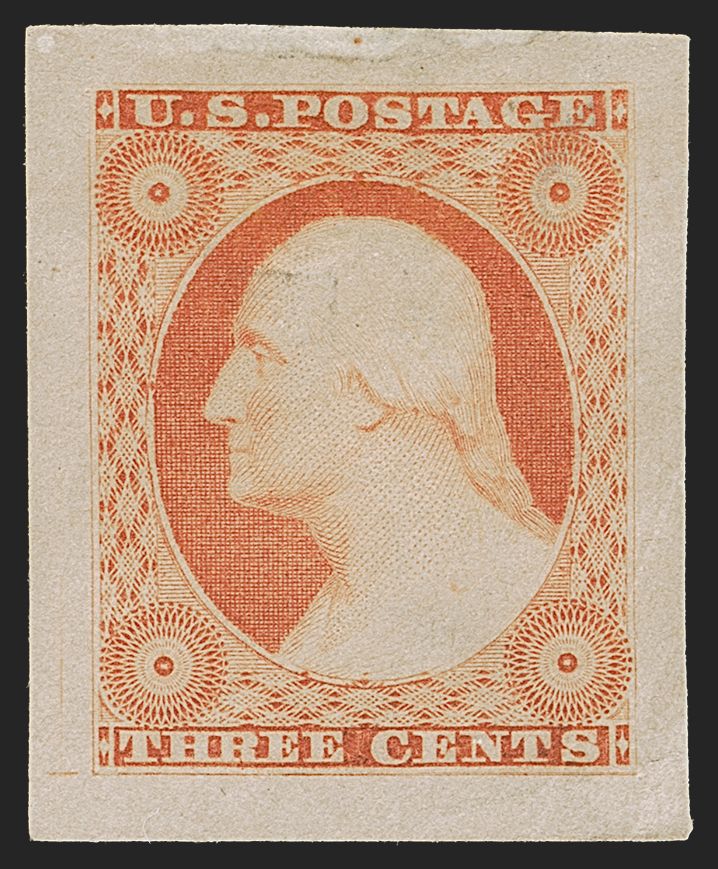 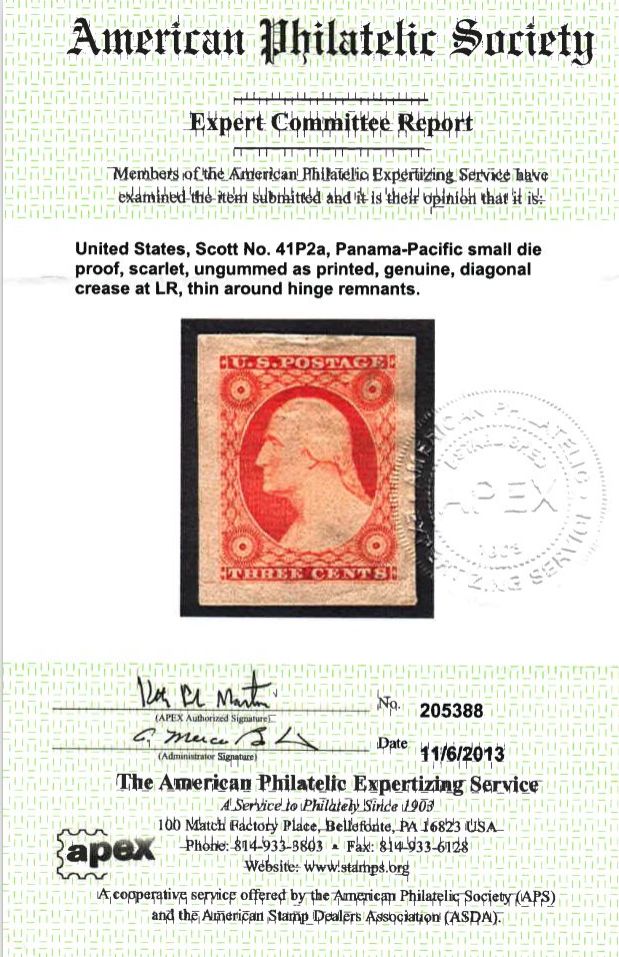 I am the proud owner of the worst known copy of a 3c Pan Pacific Small Die Proof. There are maybe about 5 of these known. I believe a nice one was posted earlier in this thread. The price was right, and I decided to grab it as a reference copy of a Pan Pacific in general. They all appear toned to some degree and have margins about like this. You can see in the colorless oval, where the design impinges into it in various spots. Differences in erasure of these on the different reliefs of the transfer roll help differentiate the reliefs. |
|
Send note to Staff
|
|
|
Pillar Of The Community
United States
1123 Posts |
|
|
Not bad looking for a P2a. And a good deal at 20% of cat. These are often seen with pinholes in the corners, is that a filled pinhole in the upper left? It is not mentioned on the certificate. Is the wrinkling in the top margin part of the thin in hinge area, or is that instead an inking artifact? Can't tell from the scan. Also it looks like a corner crease in the lower right margin, separate from the diagonal crease running through the "S", but the certificate just says "crease" not "creases".
I am not trying to disparage the stamp at all, it is still a lovely copy of a very rare proof. It is more a complaint about the completeness of what the certificate describes and doesn't describe. |
|
Send note to Staff
|
|
|
Pillar Of The Community
United States
3520 Posts |
|
|
Quote:
Is the wrinkling in the top margin part of the thin in hinge area, or is that instead an inking artifact? Part of the hinge removal / thin, etc. I think they just got tired of listing faults and gave up.  edit: I must correct myself - I remember now, when I got it, it does have something going on in the top margin. It may be partially rebacked at top. I knew I was buying a damaged item, so I wasn't obsessed over it in this particular case.  edit2: rebacking explains the filled-pinhole. |
|
Send note to Staff
|
| Edited by txstamp - 01/05/2024 1:47 pm |
|
|
Replies: 3,821 / Views: 253,022 |
|




 Posted 01/04/2024 12:37 pm


