|
This page may contain links that result in small commissions to keep this free site up and running.

Welcome Guest! Registering and/or logging in will remove the anchor (bottom) ads. It's Free!
To participate in the forum you must log in or register.
| Author |
 Replies: 27 / Views: 3,975 Replies: 27 / Views: 3,975 |
|
Pillar Of The Community

United States
814 Posts |
|
|
|
Not only more detailed and inclusive, but better organized and, despite the language, easier to use. That's what surprised me: easier to use.
|
|
Send note to Staff
|
|
|
|
|
Valued Member
United States
424 Posts |
|
|
Would you be able to provide a couple examples where you find the Michel easier to use? I use Scott for my worldwide, but sometimes find their choices a little annoying.
Dale
|
Send note to Staff 
|
|
|
Pillar Of The Community
Spain
518 Posts |
|
|
Hello.
Local catalogs have always been better than general ones.
Regards. |
|
Send note to Staff
|
|
|
Pillar Of The Community
United States
640 Posts |
|
|
EMaxim...
Like Statesman, am interested in learning more re your belief/conclusion Michel's German catalogue is easier to use than Scott. Am not disputing your statement. Simply curious.
Have been a Scott owner/user for more than 50 years. (Also own a bookcase shelf full of country specialty catalogues.) Its been my experience that when voicing criticism of the Scott catalogue the reaction is immediate and strident. Versus perhaps a more objective, balanced presentation (e.g., Here are the five things Scott does really well. And here are five things which I wish Scott would change.)
Oft times Scott defenders will raise the issue of the economics of specialty publishing. An argument I quickly discount given Scott's increasing higher pricing. (When dining out I have little or no interest in the economics of the food supply chain.) The Scott catalogue has been published for 175 years. Other than the introduction of color some years ago, what other significant (recent) advancements have been made?
If the mission is to publish the authoritative, most complete, and easy-to-use postage stamp catalogue, then in this writer's opinion there is ample room for improvement. (IMO, Scott's long-time role as a pricing guide is of marginal value.) One not insignificant aspect is the seemingly arbitrary criteria determining what material is included and what is excluded. There are collecting areas that have become increasing popular across the past decade or so that Scott continues to ignore. On what basis?
The preceding is neither intended to suggest the inherent superiority of specialty catalogues nor to suggest that Scott is not a valuable resource. Rather to serve as catalyst for discussion. And to ask how the Scott catalogue could be improved? And what's precluding doing so? |
|
Send note to Staff
|
|
|
Pillar Of The Community
United States
7239 Posts |
|
|
Scott wastes page space by including very specialized information of little or no value to the generalist/non-specialist collector. The catalog would be much improved if the editors would stop doing this and include better descriptions of stamps that collectors are likely to encounter.
For example, after the North German Confederation rouletted issues of 1868, Scott lists and prices imperforate versions of these stamps. How likely is it that a collector will find any of these un-serrated stamps? More importantly, nowhere does Scott alert the collector to the possibility of postal stationery cutouts...not here, not anywhere in their listings.
For another example, Scott provides little or no descriptive information on early issues, but lists, with some detail the Vineta provisional. Is this useful catalog information for the generalist collector trying to understand differences in stamps?
As the O.P. stated, Michel is better organized and easier to understand, even for a non-native speaker. |
|
Send note to Staff
|
|
|
Pillar Of The Community
United States
2941 Posts |
|
|
I'll be the first to admit that I'm a complete Michel homer. Since I collect only Germany, it's really a no-brainer. That being said, when I started collecting (and I've been an only-Germany collector since day 1 of collecting), I started with a set of Scott catalogs, Scott pages, etc. To this day, even though I do everything by Michel, I do make an effort to list the Scott numbers alongside the Michel numbers on scans of my stamps. It's a constant source of frustration, because Scott is a trainwreck when it comes to organization, at least in its Germany listings. A few of my big complaints with Scott: 1. For many of the collateral areas (occupations, colonies, etc.), there's not a lot of logic to where Scott puts them in their catalogs. This is driven largely by Scott's decision to organize its worldwide catalogs alphabetically. Michel's catalogs are organized geographically, which makes it a lot easier to find related areas without necessarily having to own the entire worldwide set. 2. Scott makes some really random decisions as to what to list. WRT Germany, I would never expect Scott to be as detailed as Michel, as Germany is Michel's home turf. But Scott makes some really odd decisions as to what to list. It's like what bookbndrbob said above — they'll list some ultra rare variety that 99.99% will never see or own, but not list a basic color variety that exists in the millions. They'll often include a note that a major perforation or watermark variety exists, but not give it a catalog number. 3. There are areas, at least within Germany, that can be very confusing in any catalog. Specifically, the inflation issues or the many Germania varieties. Scott doesn't do much to help out collectors who aren't already familiar with the area. Often, they'll just have a header that states "Type of 19XX", and it's up to you to figure out how this listing differs from a previous one of the same type. I specialize in Germany, and it took me hours just to decipher what stamps they were talking about in some of their listings. 4. Scott's method of listing types and watermarks is frustrating. It requires you to constantly be flipping back to prior listings to find out if the current listing has a watermark, or what the basic design looks like. Michel shows the design and lists the watermark above every listing. 5. And perhaps my biggest frustration with Scott - their numbering system is absolute junk. They assign the first known variety a number (ex. 231). For every variety thereafter, they simply append a letter (ex., 231a, 231b, etc). It all seems very disorganized. For example, take a look at this listing: 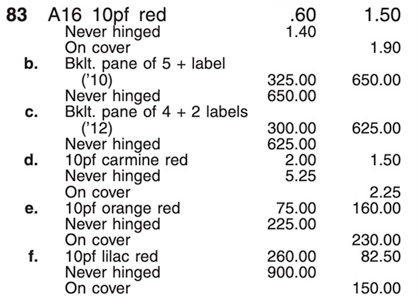 Three suffixes assigned to color varieties, and two to booklet panes. If you just saw a catalog number out of context, you'd have no idea what it was. By comparison, Michel actually uses a numbering system. If you see a Michel catalog number with a lowercase suffix from the beginning of the alphabet (ex. 231 a, 133 b), you know it's a color variety. If it's an uppercase suffix from the end of the alphabet (ex. 205 X, 111 Y), you know it's a watermark variety. Once you've used a system like this, it just makes sense, and you can't imagine why one would ever do it any differently. Here's Michel explanation from its last English-language version of the specialized Germany catalog: Prefixes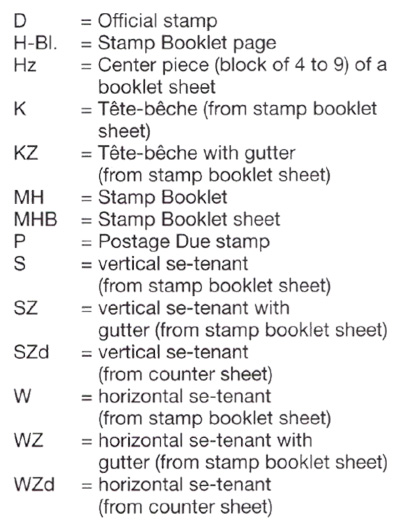 Suffixes Suffixes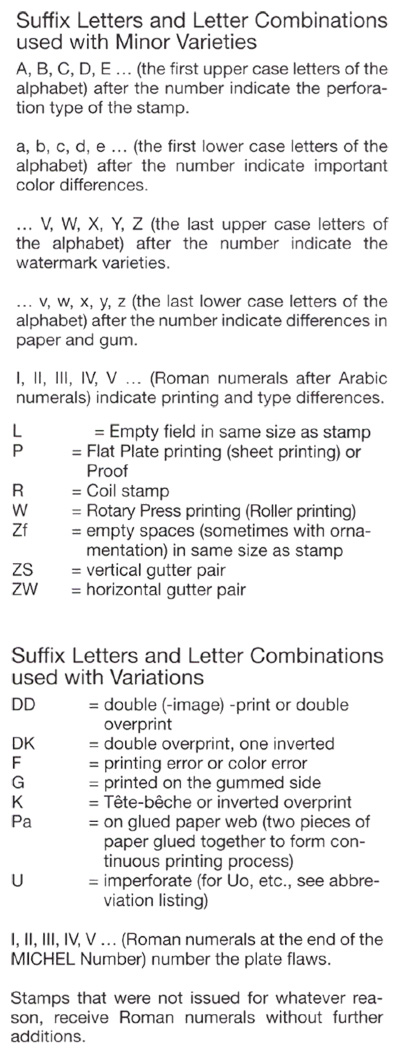 |
|
Send note to Staff
|
|
| Edited by PostmasterGS - 07/16/2020 7:37 pm |
|
|
Pillar Of The Community
United States
814 Posts |
|
|
For me, these are a few of the things that make Michel easier to use:
First, as PostmasterGS noted, for every listed series Michel provides the design, the watermark, the perforation, printing method, paper type. No flipping back to find the last mention of any of these, hoping you haven't missed it along the way.
Second, Michel generally provides pictures and text to explain differences or varieties of design.
Third, and again as noted above, Michel's numbering system is simpler, in part because of the rationale behind the use of suffixes, but also because Michel doesn't relegate nearly so many categories of stamps to back-of-the-book status.
Which leads to my fourth point: Michel is more consistently organized chronologically/historically, rather than by design type. So stamps of the same design but issued at different times are listed separately, rather than being grouped together with odd dates in parentheses. Also, airpost and charity (semi-postal) stamps are included with regular stamps of the same time.
Fifth, I too like Michel's decision to organize countries geographically rather than alphabetically. For example, it's nice to find that all the post-WWI plebiscite areas are listed together.
Sixth, the physical size of the volumes: they're not so large and heavy as to be almost unwieldy.
Finally, and others have mentioned this too, for Germany alone Michel will of course be better than Scott. For US, Scott's specialized will probably be better than Michel. But the organizational and presentational decisions that Michel has made for Germany are also found in its worldwide volumes which, as I have begun to discover so far, are therefore also easier to use.
|
|
Send note to Staff
|
|
|
Valued Member
United States
424 Posts |
|
|
Thank you very much EMaxim and PostmasterGS for outlining reasons why Michel is preferable for Germany (and perhaps other areas as well given the much more logical structure of the numbering system).
I recently purchased a small remainder collection of Berlin that was housed in a Safe hingeless album. I decided to catalog the stamps as I removed them, and based on the information you provided the album follows the same chronological layout.
My Scott-accustomed brain was a bit thrown off by the semi-postals being mixed in, but what really threw me for a loop were the definitive sets separated onto different pages by year of issue. That took some adjustment, but in the end it made no difference in getting the stamps out and ID'd.
In the end, I think perhaps the chronological listing would be one I could easily grow to prefer.
Dale
|
|
Send note to Staff
|
|
|
Pillar Of The Community
United States
4523 Posts |
|
|
In Scott's Pocket Size US catalog, they list errors and other varieties (many with 3 or 4 digit values) few collectors will ever collect yet ignore more common US varieties.
Scott also ties their catalogs and content / layout on album pages such as when they group definitive sets issued over several years into groups. By assigning a minor suffix, it will not be on a printed album page from most US album makers.
I can live with their numbering (SG GB is even more bizarre) but also prefer more common varieties and ignore all those few will own errors.
|
|
Send note to Staff
|
Al |
|
|
Pillar Of The Community
United States
1565 Posts |
|
|
There are as many opinions about Scott as there are serious collectors. So be it. I began my collecting in 1960 at age 10 1/2 with Scott. I moved to Scott Big Blue International albums, from Minkus and H.E. Harris albums, in the early 1980s. Too much hassle to change now. I did have Minkus catalogs, with a different numbering system, in the 1970s. Those were a pain to use since the USA is "Scott country."
Have a couple catalogs from the former Greg Manning Auctions, from the 2000s, as reference guides. It was really irritating to see a US auction house using Stanley Gibbons numbering for many of the British lots and Michel numbers for some of the German lots. I wanted a couple of those lots, but did not bid due to not knowing what I was actually buying. I suppose Manning was trying to appeal to out-of-country buyers.
For me, the Scott catalogs and numbering system are generally fine; not "junk." I don't buy many due to price and not needing to know how much El Salvador or Niger "wallpaper" from the 1990s is valued. My main issue with Scott is the inadequacy of Part I of Big Blue. In my primary specialty areas, I've switched over to either blank quadrille pages; or trimmed down Scott specialty pages, from collections I've bought. To supplement the Scott catalog, I have Follansbee (Mexico), Fischer (Poland), Mundifil (Portugal & colonies), Gibbons (British East Africa) catalogs. |
|
Send note to Staff
|
|
|
Pillar Of The Community
United States
814 Posts |
|
|
I agree with Climber Steve that Scott catalogues are generally fine. And for those whose entire collection has been organized around Scott for decades, any change now would probably be prohibitive. I, however, am still a fairly new collector and therefore have a chance to make changes. For Germany & German area I'm going over to Michel, to Yvert for France & French area. For Britain and colonies I'm organizing around Gibbons, and for Scandinavia with Facit. For the rest of my worldwide material I'll still be using Scott, at least for now. Everyone will of course do whatever he or she feels most comfortable with, but there's also value in pointing out both the strengths and the weaknesses of our available resources. [Michel, for instance, gets into some pretty extreme (i.e., complex and subtle) distinction of color varieties.] |
|
Send note to Staff
|
|
|
Pillar Of The Community
United Kingdom
8637 Posts |
|
|
The catalogue you choose to use depends on your interests and their depth. For France, the basic catalogue is Yvert. In fact, whilst it's attractive, in many cases it has less detail than my Gibbons French area catalogue from the 1990s (which also has the benefit of listing stamps in order of issue, rather than separating air-mail). For me, Maury is a much better catalogue for the French area than Yvert. It shows all of the stamps, not just a representative one, has more detailed listings and integrates air-mail stamps. So should one buy Maury? Not necessarily. We don't all need detail. We may have trouble with the French text. We may need a cheaper option. |
|
Send note to Staff
|
|
|
Pillar Of The Community
United States
1106 Posts |
|
|
I live in the Scott-centric US so I use the Scott catalog for most of my collections. I do have specialized catalogs for the countries I concentrate on where I want more detail. In a perfect world, I would use Michel exclusively for the reasons PostmasterGS laid out above. One of the areas I collect, Soviet Occupied Germany, is a complete mess in Scott! Dan  |
|
Send note to Staff
|
Experienced stamps need a home too. I'd rather have an example that is imperfect than no example.
I collect for enjoyment, not investment.
APS Member #223433
Postmark Collectors Club Member #6333
Meter Stamp Society Member #1409 |
|
|
Pillar Of The Community
United States
814 Posts |
|
|
Actually, because of GeoffHa, I'm still open to Maury for France. The layout looks very good, though I haven't got a copy as yet.
Any thoughts on Scott's organization of China? |
|
Send note to Staff
|
| Edited by EMaxim - 07/17/2020 11:59 am |
|
|
Pillar Of The Community
Spain
518 Posts |
|
|
Hello.
I do not intend to discuss anything, I only assert what my years as a collector have shown me.
Scott is the best catalog for USA.
Michel is the best catalog for Germany
Fischer is the best catalog for Poland
Zumstein is the best catalog for Switzerland
Afinsa is the best catalog for Portugal.
Edifil is the best catalog for Spain
Yvert & T. is the best catalog for France
Stanley Gibbons is the best UK catalog
And it could go on like this all day.
I like world catalogs in this order: Michel, Yvert & T, SG and finally Scott.
It makes me really mad to go round and round the common designs.
Regards. |
|
Send note to Staff
|
|
|
Valued Member
Canada
304 Posts |
|
|
I also want to chime in that it is sometimes not only the country specific catalogue that becomes the pertinent reference. For example Unitrade has become the default catalogue for Canada, but even then it lacks when it comes to specialties such as Booklets or Postal Stationery. McCann used to be the best reference for Canadian Booklet Stamps, but it has not been updated since 1996. Webb has recently released its new Postal Stationery catalogue which greatly expands on what is shown in Unitrade.
Similarly for Michel and Germany. The Michel Germany catalogue has much more information than Scott, but again when it comes to specialty, such as booklets, the Michel "Markenheftchen" catalogue provides far more detail.
So it really depends on what your main interest is that determines which catalogue is appropriate for you. |
|
Send note to Staff
|
|
|
Replies: 27 / Views: 3,975 |
|
|
To participate in the forum you must log in or register. | |
Disclaimer: While a tremendous amount of effort goes into ensuring the accuracy of the information contained in this site, Stamp Community assumes no liability for errors. Copyright 2005 - 2026 Stamp Community Family - All rights reserved worldwide. Use of any images or content on this website without prior written permission of Stamp Community or the original lender is strictly prohibited.
Privacy Policy / Terms of Use Advertise Here |
| Stamp Community Forum |
© 2007 - 2026 Stamp Community Forums |
| It took 0.27 seconds to lick this stamp. |
 |
|
|
|


 Posted 07/16/2020 11:21 am


