| Author |
 Replies: 10 / Views: 1,079 Replies: 10 / Views: 1,079 |
|
|
Valued Member
148 Posts |
|
|
These two stamps are part of an old collection. I believe the stamp on the left is a standard #70. Might the stamp on the right be #70b? (The steel blue shade?) 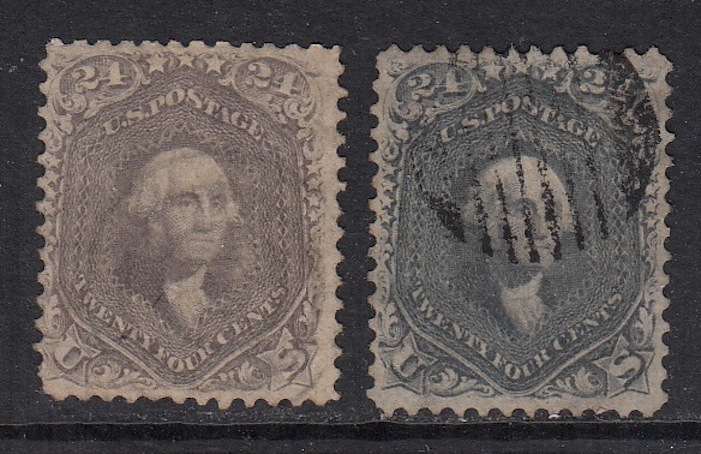 |
|
Send note to Staff
|
|
|
|
|
Valued Member
148 Posts |
|
|
My apologies for the last two image errors. These are the stamps I meant to display: 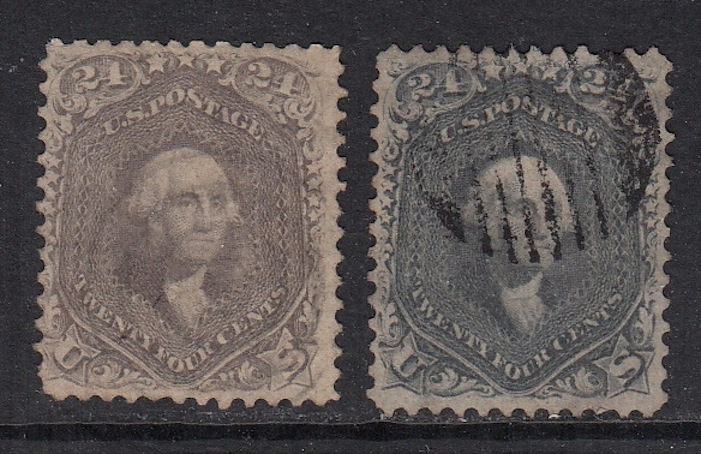 |
Send note to Staff 
|
|
|
Bedrock Of The Community
12781 Posts |
|
|
Pillar Of The Community
United States
1162 Posts |
|
|
I would agree with rogdcam on this. To me, the Steel Blue is a little more 'lively' than the color of your stamp. Sorry I can't put it into better terms than that. Having said that, though, the lighting on your picture is terrible - it is very dark, and that may make the color appear different than it really is. Also, beware that asking for color opinions online is risky - different scanners/cameras have different 'sweet spots' in their spectra, and the lighting used makes a huge difference, too. Also, monitors vary widely with their color reproduction. |
|
Send note to Staff
|
|
|
Bedrock Of The Community
United States
10869 Posts |
|
|
Moderator

United States
12330 Posts |
|
|
<facetious>Since the hobby is quite willing to accept something as subjective as ink/pigment colors, perhaps we should campaign for collecting gum varieties which collectors could differentiate by tasting the gum. Tasting stamp gum is no more or less a subjective sensory perception than seeing a stamp color. Like color, we would not need to worry much about how the gum taste might change over time.
And after all, running production changes in the gum chemistry are certainly as notably as running changes in ink chemistry. I assume that catalog publishers and album producers would support this since it give them new things to sell.</facetious>
Don
|
|
Send note to Staff
|
|
|
Valued Member
148 Posts |
|
|
Pillar Of The Community
United States
1162 Posts |
|
|
Quote:
<facetious>Since the hobby is quite willing to accept something as subjective as ink/pigment colors, perhaps we should campaign for collecting gum varieties which collectors could differentiate by tasting the gum. Tasting stamp gum is no more or less a subjective sensory perception than seeing a stamp color. Like color, we would not need to worry much about how the gum taste might change over time. Mmmmmm.... tastes never hinged!! Well.... it did. |
|
Send note to Staff
|
|
|
Pillar Of The Community
United States
713 Posts |
|
|
When you fixed these photos, I believe you screwed up the photos in the other post. Make sure that you use different names for your photos. The forum will override reused names and replace photos with the current photo. |
|
Send note to Staff
|
|
|
Pillar Of The Community
1368 Posts |
|
|
The "steel blue" varieties I've seen actually do have a bluish tint to the grey color. It's pretty clearly blue which this stamp, the one on the right, does not seem to have. My definitive answer -- since my eyes are the national reference standard for colors -- would be a "pale violet brown" shade on the left, and a darkish grey on the right.
Color varieties are funny because when you actually see the correct color, it's almost always obvious. But before you see that color, a lot of other shades seem like they might be it, but aren't. It's like women . . . |
|
Send note to Staff
|
|
|
Pillar Of The Community
United States
2230 Posts |
|
|
Riley111, if the colors in your image are close to the actual stamp colors, I would say you have a lilac and a steel blue. However, it is impossible to say for sure based on the image. Here are four colors from my collection: Disclaimer: This image is provided to display variations in ink color between different stamps, all of which were scanned together. Because of variations in scanner settings, and because different display screens render colors differently, this image may not be suitable for confirming colors of stamps in hand or in other images.  |
|
Send note to Staff
|
|
| |
Replies: 10 / Views: 1,079 |
|



 Posted 08/24/2020 11:44 pm


