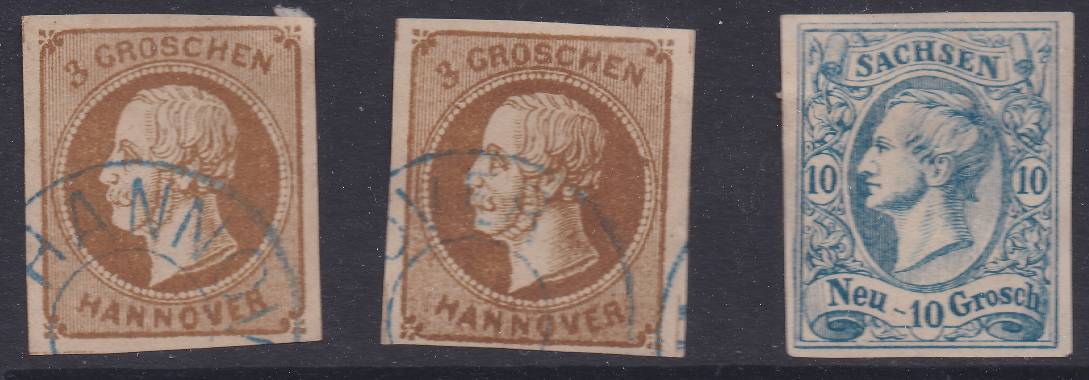
You're right to be suspicious. Old stamps that are somewhat rare and have value often got reproduced to sell to collectors who couldn't afford the real ones. From what I've read, this sometimes was done as a "service" to collectors with both seller and buyer knowing the stamp was not genuine. Such stamps were often too new-looking to be genuine, too well centered, too clean, and so on. But since everyone knew they weren't real, they were kind of like play money and just got used to fill an empty album space maybe with no harm intended. There are a lot of such stamps for countries like Japan where it seems like 90% of the old stamps you see were made as copies to sell to collectors or tourists or anyone else who would buy them.
Unfortunately, a lot of such stamps weren't marked clearly as "fake," "copy," or any other warning. Then, through the sale of a collection or otherwise, they eventually got into the stamp collecting mainstream where we now wonder if they're real. Often these stamps are clearly fake due to being too perfect or design elements are not correct or the color is off -- or other problems. This is easiest to notice when the stamp is compared to a real stamp. Sometimes it's immediately obvious as it is with some Swiss stamps I've compared. The non-genuine stamp just looks bad. A perfect, well-centered early Japanese stamp with a perfect corner cancellation is clearly not likely to be genuine.
Other stamps were genuinely forged to deceive people. These are often better made, though certainly not always. Sometimes they were made by actual engravers or other people who knew what they're doing and decided to make money illegally. Crooks, in other words. These stamps might never have been intended to be sold to collectors as clear fakes, but designed to deceive collectors with money out of a lot of it. These stamps are less likely to look perfect or be neat and tidy, but to look, well, real. So they might be a little off center, have a strong cancel, and be a little rougher looking -- not like play money at all, but like a genuine rare old stamp.
Some of these forged stamps get mixed into the same pool of stamps with the "copies for collectors" stamps that were not marked as "copies" along with all the genuine stamps, and it becomes a big mess. When I find a stamp that is clearly not genuine, I always mark it on the back as a "copy" or "fake" or, if I'm in a good mood and there's enough space, as a "reproduction". Some sellers of copies do mark the back with the word "faux" (false), but I wonder if that's because they think the average person doesn't know that that French word means?
My guess is your stamps were the former kind of "stamps" designed to accommodate average collectors who could never afford the real stamps, but never marked as "copy" or "reproduction". They look too good to me. They're very neat and tidy, well centered, have overly perfect cancels, and just don't seem like old stamps. Comparing them to known real stamps, or looking carefully at details in a catalog, will confirm what they are, but that's my opinion, and yes it would be nice for you if I'm wrong. Check the catalogs if you can. I was looking at a nice Denmark collection the other day where the seller wrote that he assumed "all" the early stamps, at least a dozen of them, were not real, but copies. |





 Posted 09/15/2020 3:38 pm