Just_fella,
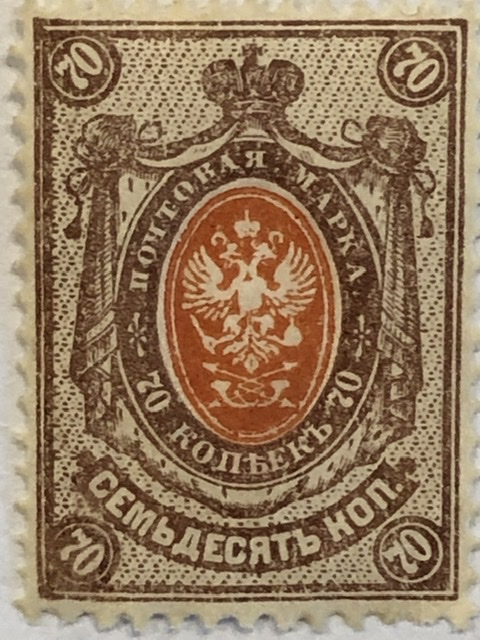
It would help if you told us why you think it may be a stamp with inverted groundwork. The burden of proof is always on you.
As a general rule, especially true for a beginner, when you think you may have a valuable variety, assume you don't.
And when you come back with "Yes, but what about...?," assume you still don't.
Now go back to first steps. Using a "recent" edition of the Scott catalogue which includes Russia (Volume 5), first determine the catalog number of the stamp in question. This is very important and should be the starting point before any thought of "hitting it big" comes into play.
Looking at the first stamp from your last scans, it is a 70 kopeck value.
Looking in my 2009 Scott Volume 5, I see three possibilities for the 70 kopeck stamp:
Scott 38, issued 1883-1888.
Scott 67, issued 1902-1905.
Scott 86, issued 1909-1912, vertical lozenges of varnish on face.
So now you have the list of potential candidates. The work of determining which is your stamp falls to you, and is an exercise you need to become comfortable with if you intend to continue this collection.
That said, in doing the work to determine which Scott numbers your stamp could be, I saw that none of the three is listed as having a variety with inverted groundwork.
I hope you will spend some time thinking about this, and thinking about your plans for this collection. What do you really want to do? I'm hoping it's not a "win the lottery" type of thing, but so far I'm not seeing a whole lot to convince me otherwise.
I'll leave you with a line from an old song that seems appropriate.
Quote:
I know you're looking for a ruby in a mountain of rocks
But there ain't no Coupe de Ville
Hiding at the bottom of a Cracker Jack box
Dale





 Posted 09/18/2020 7:44 pm