| Author |
 Replies: 414 / Views: 36,387 Replies: 414 / Views: 36,387 |
|
|
|
Pillar Of The Community
Romania
596 Posts |
|
|
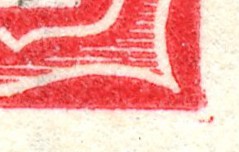
Thanks rod222 I do not sell the varieties found even if they are from countries other than Germany. I am interested in the value for a future exchange with varieties of German stamps. I didn't understand Electro VI or Electro 7 well, what number is it and what is the standard numbering method? (VI or 6? VII or 7?). Thank you Partime for the visual confirmation for the constant variety. George 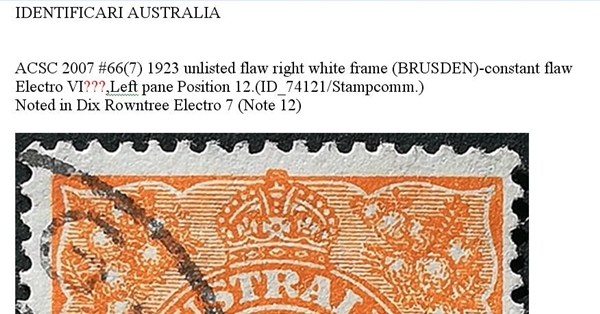 |
Send note to Staff 
|
|
|
Bedrock Of The Community
Australia
38679 Posts |
|
|
Electro. (Plate)
A flat die (negative) was used to strike single lead moulds (Positives)
These lead moulds were assembled in a forme of 120 cliches, and the forme was copper plated.
The Copper skin (negative) was backed and, in some cases subsequently nickle plated (still negative)
It was the ready for printing positive images of the sheet of 120 stamps.
the half penny value was certainly done from upper and lower electros used in pairs.
As plates wore, new electros were struck
In our opinion (dix rowntree) therefore only 9 electros were used, each from a new set of lead moulds
Rod:
Ergo no flaw occurs on more than 1 particular electro
Source : Dix Rowntree (First Published 1959)
"The Australian Commonwealth George V halfpenny."
Hope that helps
|
|
Send note to Staff
|
| Edited by rod222 - 11/06/2020 02:39 am |
|
|
Bedrock Of The Community
Australia
38679 Posts |
|
|
Your type needs correction
The ACSC (Australian Commonwealth Stamps Catalogue)is BRUSDEN-WHITE
Electro 7 (same as ) Electro Vll (roman numerals)
You can employ either, but ACSC uses Roman eg = Vll
|
|
Send note to Staff
|
| Edited by rod222 - 11/06/2020 02:34 am |
|
|
Pillar Of The Community
Australia
937 Posts |
|
|
Bedrock Of The Community
Australia
38679 Posts |
|
|
Right.
Thank you FDS.
A lot of water has passed under the bridge, since Dix Rowntree.
Not surprised.
|
|
Send note to Staff
|
|
|
Pillar Of The Community
Romania
596 Posts |
|
|
Thank you all. Very interesting details about the production of the plate (electro) and his number. Did I get it right? My stamp is from electro VI for ASCS and VII for Dix Rowntree? Or no? I understand that the plate (itma writes - ".. left pane ...") is divided into several panels. How many? 2 or 4? Does the position number start with 1 for each pane? Example: 1 to 60 for the left pane and 1 to 60 for the right pane? How many columns / rows does the plate (electro) have and the 2 or 4 (??) panels? For German stamps the constant varieties can appear on one only or more plates (A.B.C ...) I think that the production mode of the plate differs. See page from Michel for the varieties of Berlin-Brandenburg stamps from 1945. 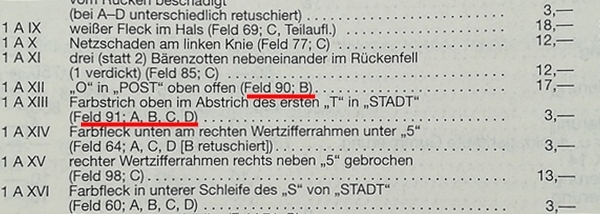 |
|
Send note to Staff
|
|
|
Bedrock Of The Community
Australia
38679 Posts |
|
|
Suggestion. Try not to compare with German production, may lead to misunderstandings. Quote:
Did I get it right? My stamp is from electro VI for ASCS and VII for Dix Rowntree? Yes, according to Fairdinkumstamps, and he would have the latest reference material, that I do not have. Be aware: This philately is still a work in progress, what we read is the best available at this time. Layout Plates : 120 on, arranged in left and right panes of 60. Pane: 10 rows of 6 stamps Plates were generally used as pairs (=120) [Upper and Lower] For stamps values in great demand, in blocks of 4 (=240) Upper Left, Upper Right, Lower Left and Lower right. Guess I don't recall reading the halfpenny orange having "marginal lines" aka Jubilee Lines The Mullet print of 1926 appears to have them (small mult wmk) I may stand corrected there. |
|
Send note to Staff
|
| Edited by rod222 - 11/06/2020 08:14 am |
|
|
Pillar Of The Community
Romania
596 Posts |
|
|
Thank you rod.
What about the position number? 1-60 for left and right pane? or 1-120? |
|
Send note to Staff
|
|
|
Bedrock Of The Community
Australia
38679 Posts |
|
|
1-60 George.
YoursDix Rowntree reference P35
"Unpositioned constant flaws"
B15
No supporting image shown.
|
|
Send note to Staff
|
| Edited by rod222 - 11/06/2020 2:57 pm |
|
|
Pillar Of The Community
Canada
877 Posts |
|
|
Well, I take a day and a half off and miss all the excitement.
Rod:
Sorry about my typo. It seems you had to go around the block a couple of times to set me right, for which many thanks. Also:
1: This variety is not in the 2018 ACSC
2: There seems to be good appreciation as the ACSC used price for 66(6) varieties is now generally $50. (There are a couple with higher prices.)
3: Re a description for selling, I think it should be BW 66(6) and D+R Electro VII, Position 16. People who use D+R regularly will be more used to the Roman numeral (just as ACSC uses Roman numbers for 1d electros).
This is my first foray into Dix and Rowntree. I see that the discrepancy between D+R and ACSC in electro numbers (thanks to fairdinkium stamps for pointing this out) is because D+R decided to omit Electro 4 from their numbering so that the upper electro number would always be odd. For those interested, D+R divide the electros into "sets". The first set had electro 1 in the upper position and 2 in the lower. The second set had electro 3 in the upper and electro 2 again in the lower. Skipping 4, the third set used electros 5 and 6, the fourth 7 and 8 and the fifth 9 and 10. Thus, electros 5 to 10 in D+R equate to 4 to 9 in ACSC.
Thanks, Partime, for showing your example of BW 66. It's always nice to see a second opinion, particularly when they match exactly as in this case.
Regards to all,
Frank.
|
|
Send note to Staff
|
|
|
Moderator

United States
5107 Posts |
|
|
Quote:
Thanks, Partime, for showing your example of BW 66. It's always nice to see a second opinion, particularly when they match exactly as in this case. Glad to do it. I have lots of KGV varieties, but there are lots and lots that I don't have, so it's nice to show a confirming copy. I'll keep tracking the various postings in this thread. |
|
Send note to Staff
|
|
|
Bedrock Of The Community
Australia
38679 Posts |
|
|
Quote:
It seems you had to go around the block a couple of times to set me right, for which many thanks. Also:
No, No, thanks go to you. I do not learn as much, as when helping others. Made me read the catalogue more closely. I had completely missed the Dix reference. |
|
Send note to Staff
|
|
|
Pillar Of The Community
Canada
877 Posts |
|
|
Here are three BW 82 (SG 125) 1d Green stamps which show the complete development of its variety. This comes from Plate 1, Pane I, Position 16. The variety first appeared in June 1928 as a thinning of the lower frame under NE P of ONE PENNY. Variety (I/16) For one printing, the frame is notched upwards under the E P. Variety (I/16a) Following a retouch, the lower frame became irregular. Variety (I/16R) It is worth noting that two features of (I/16a) seem to have carried over to (I/16R). A remnant of the break seen under the N of ONE in (I/16a) can be seen as a small nick in (I/16R). Also in both cases there is a small nick in the lower frame under the left upright stroke of the second N in Penny. Of course, additional copies of this would be needed to confirm that this is not just a figment of my imagination. Images of the three stamps are below, followed by a composite image comparing the features of the variety. 82(I/16)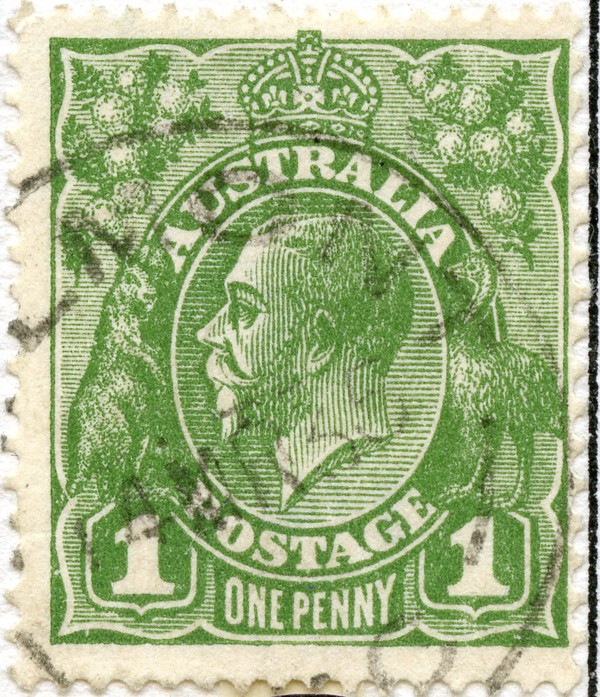 82(I/16a) 82(I/16a)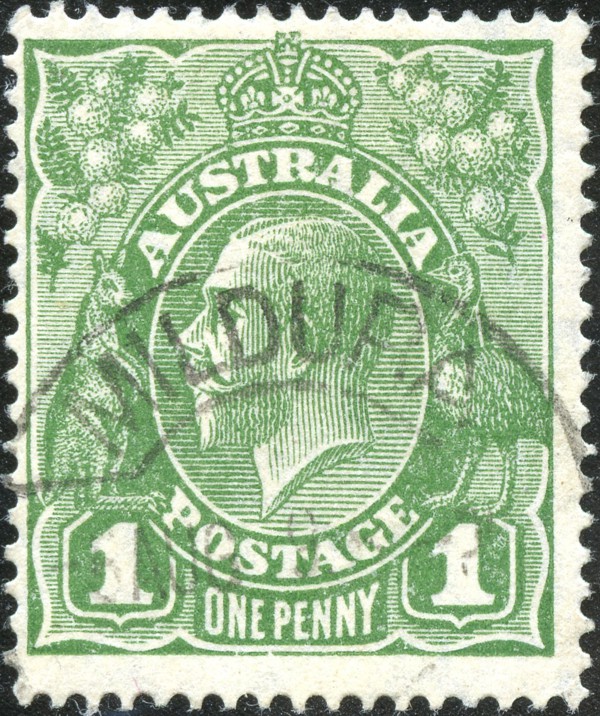 82(I/16R) 82(I/16R)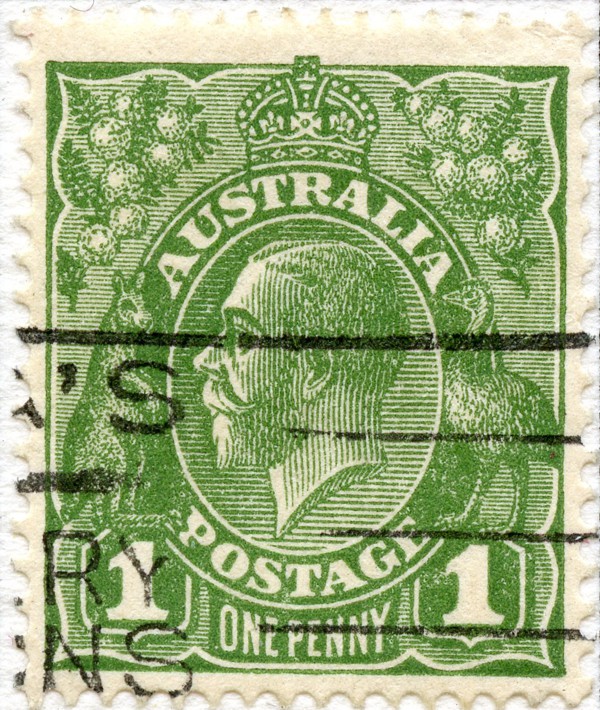 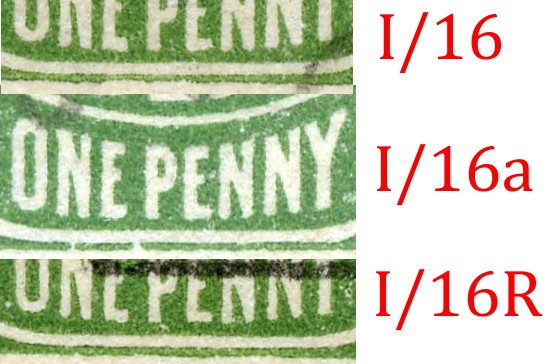 |
|
Send note to Staff
|
|
|
Pillar Of The Community
Canada
877 Posts |
|
|
Pillar Of The Community
Canada
877 Posts |
|
|
Here is a variety (2 copies) on BW 89 (SG 77) 1d Red Die I that I am not able to identify. Both examples show a broken top left corner. Can anyone suggest a decent study of the 1½d Die I stamps? (Several good studies are available for Die II.) 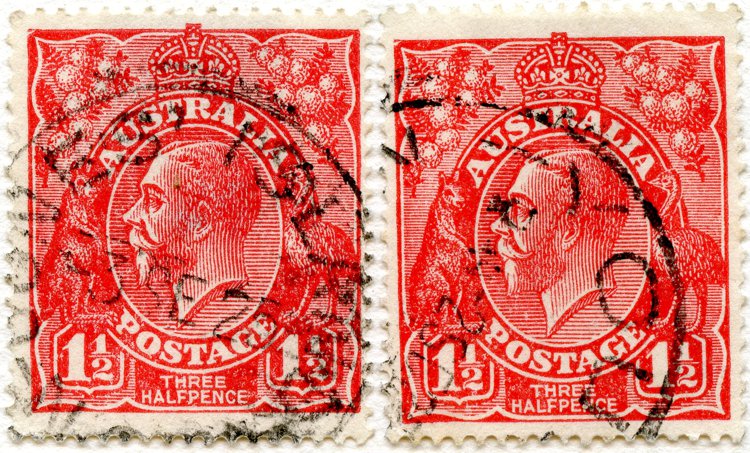 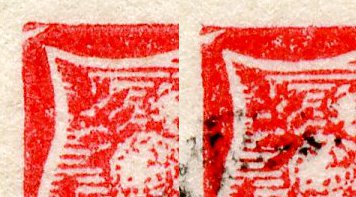 |
|
Send note to Staff
|
|
|
Replies: 414 / Views: 36,387 |
|



 Posted 11/06/2020 01:42 am