| Author |
 Replies: 32 / Views: 6,551 Replies: 32 / Views: 6,551 |
|
|
|
Moderator

United States
12330 Posts |
|
|
Firefox1492 (aka Drstampguy1) was a SCF member who was a moron, he is no longer a member.
Don |
Send note to Staff 
|
|
|
Pillar Of The Community
Netherlands
6641 Posts |
|
|
Quote:
Firefox1492 (aka Drstampguy1) was a SCF member who was a moron, he is no longer a member. Yesterday, I could not help thinking he was related to version 3. @Rod222 Quote:
Experimental rouletted stamps actually preceded stamps with perforations, but rouletting has been used much less frequently than perforating. Now, there is a Penny Red I would love to have in my collection. In 1848, Henry Archer performed some trials to make separation of individual stamps easier. He used to rouletting machines with a gauge of approximately 11 ½. A few stamps from plates 70 and 71 of Die I, alphabet I survived. They are listed as SG (Stanley Gibbons) 16a, specialised CE1. These trials were considered a failure. He continued with a perforating machine – as we now understand a perforation – gauged 16 (SG16b). These date from the period 1850 – 1854. Archer received stamps from plates 90 – 101 for these trials. In June 1853, Archer's patents were purchased. At the latest from 27 January 1854, the government performed perforation trials on stamps from Die I, alphabet II plates are listed as SG16c. It is likely Archer's perforating machine was used for this. Late in February 1854, the first officially perforated stamps (Penny Reds) were issued. Edit: 1900s dates corrected in 1800s. |
|
Send note to Staff
|
| Edited by NSK - 12/26/2020 3:44 pm |
|
|
Bedrock Of The Community
United States
10855 Posts |
|
|
Pillar Of The Community
Netherlands
6641 Posts |
|
|
Pillar Of The Community
Israel
1238 Posts |
|
|
Anyway, I mailed a question to stampworld, hope to hear from them soon. (question about the perforation, not firefox) |
|
Send note to Staff
|
|
|
Pillar Of The Community
Netherlands
6641 Posts |
|
|
Pillar Of The Community
Israel
1238 Posts |
|
|
Stampworld's answer:
"You may be referring to the inflation period of the 1920s German stamp issues, in which the stamps may be rouletted or perforated.
Perf is the abbreviation for the word "perforation" in stamps.
Blind Perf is a missed hole or holes in a row of perforations.
Penetrated Perf is probably another way of StampWorld's terminology which says the stamps have been rouletted.
Roulette are a series of cut slits in a straight line almost joined making it easy to tear apart. Roulette can be line-roulette, pin-roulette, sawtooth-roulette, serrated- roulette, or sheet-roulette.
Zig Zag is a form of roulette which is cut by contra-positioned blades which resemble the letter Z."
|
|
Send note to Staff
|
|
|
Pillar Of The Community
Netherlands
6641 Posts |
|
|
It is astounding that a site that claims to be set up by collectors around the world uses a terminology that hardly any collector ever heard of. It also is interesting they reply Quote:
Penetrated Perf is probably another way of StampWorld's terminology which says the stamps have been rouletted. Do they even know what they are doing? Another one of these things is "lying watermark" where this is mostly called "sideways watermark." |
|
Send note to Staff
|
| Edited by NSK - 12/28/2020 03:54 am |
|
|
Pillar Of The Community
United States
2941 Posts |
|
|
Quote:
Another one of these things is "lying watermark" where this is mostly called "sideways watermark." Unlike "penetrated perf", this is no-doubt a translation error. In Michel, you commonly see notations that say "liegendes (statt stehendes) Wz." or something similar, which literally translates to "lying (instead of standing) watermark". |
|
Send note to Staff
|
|
|
|
Moderator
United States
12330 Posts |
|
|
Quote:
...It is astounding that a site that claims to be set up by collectors around the world... Agreed, the hobby has enough to learn without making things more complex and confusing. But this community reflects the rest of the hobby and even we have trouble with nomenclature and terminology. As a group I think that we are stubborn and tend to insist upon using whatever terminology we learned when we were young (whether it is right or wrong matters little). If I grew up using a word a certain way or believing it means one thing, in my older age I may refuse to change. So if I now find out that others, especially in a worldwide community encompassing other languages, use the word differently, I may just ignore it and refuse to change. Being accurate is important and having everyone on the same page is important when your audience is worldwide. Standardizing the definitions of our hobby's terminology is important if we want to be efficient in our communications. Having Glossaries helps... https://www.stampcommunity.org/dictionary/https://stampsmarter.org/Learning/G...aryHome.htmlDon |
|
Send note to Staff
|
|
|
|
Pillar Of The Community
Netherlands
6641 Posts |
|
|
@PostmasterGS
I am not sure, but I suspect the people running the site are German or Dutch. As you wrote, the German terminology for sideways watermark is "liegendes Wz." In Dutch we use the same terminology: "liggend watermerk." Oddly, if you look at the German version, you also see "lying watermark." It looks like someone who is a native speaker of a Germanic language used Google translate to translate this into English. The remarks do not appear to be translated from English.
I have been thinking very hard whether we us something like "gepenetreerde perforatie." But as far as I am aware, in Dutch we would use the French terminology "roulette." I also cannot imagine a German saying "penetrierte Perforation."
@Don,
I am afraid we GB collectors will always keep talking about "shades." |
|
Send note to Staff
|
| Edited by NSK - 12/28/2020 04:43 am |
|
|
Pillar Of The Community
United States
2941 Posts |
|
|
Quote:
I also cannot imagine a German saying "penetrierte Perforation." The term for rouletting in German in durchstochen, which I believe translates literally as "pierced". It's not a stretch to mistranslate it as "penetrated". |
|
Send note to Staff
|
|
|
|
Pillar Of The Community
Netherlands
6641 Posts |
|
|
You could translate that as "penetrated." I think the literal translation is not even wrong.
A synonym would be "durchbohren." A knive or sword can "durchstechen" or "durchbohren." In English a sword or knive can penetrate a body.
That is one reason I suspect someone who speaks a Germanic language is behind this. |
|
Send note to Staff
|
|
|
Valued Member
Germany
6 Posts |
|
|
Hello, sorry for bringing this topic back up, but is this thread about this type of perforation in stamps no. 307-307a (stampworld)? I'm currently organizing my new album and I'm interested in the term (Penetrated perf.) and I don't know if my stamps qualify for this term...the one on the left for example with regular perforation 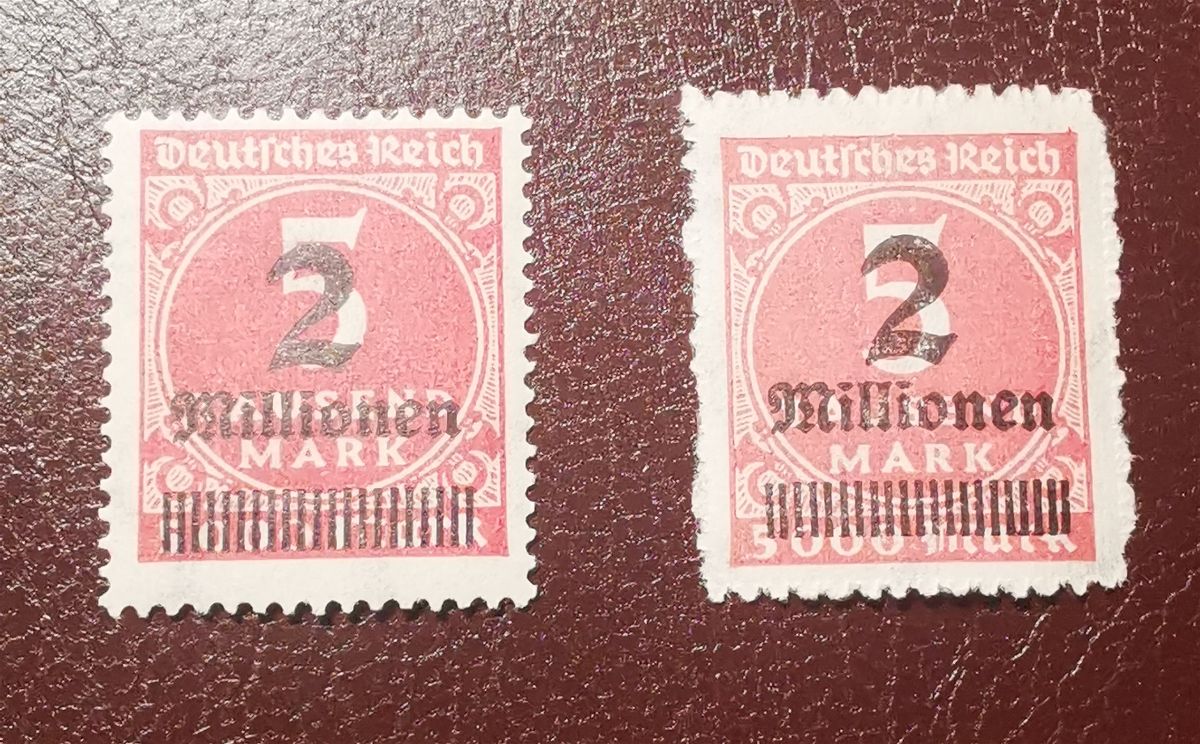 |
|
Send note to Staff
|
| Edited by Bandi1pl - 09/15/2024 09:48 am |
|
|
Valued Member
Canada
395 Posts |
|
|
@NSK Quote:
I have been thinking very hard whether we us something like "gepenetreerde perforatie." But as far as I am aware, in Dutch we would use the French terminology "roulette." I also cannot imagine a German saying "penetrierte Perforation." In response to your quote above from four years ago, the NVPH catalog (Netherlands Speciality Catalog) uses the term "doorstoken" (see Suriname 58, and after Netherlands 85). As mentioned above the best translation is "pierced" (which implies cutting) as opposed to "penetration" which does not imply cutting. Jan |
|
Send note to Staff
|
|
|
Replies: 32 / Views: 6,551 |
|




 Posted 12/26/2020 12:03 pm


