| Author |
 Replies: 7 / Views: 2,163 Replies: 7 / Views: 2,163 |
|
|
Pillar Of The Community

United States
1012 Posts |
|
|
Hello. I have tried with this one stamp, but have not figured it out. At first I thought Greece - however, I realized most likely not. Thanks for your help - I bet it is obvious but I am drawing a blank. Nora. 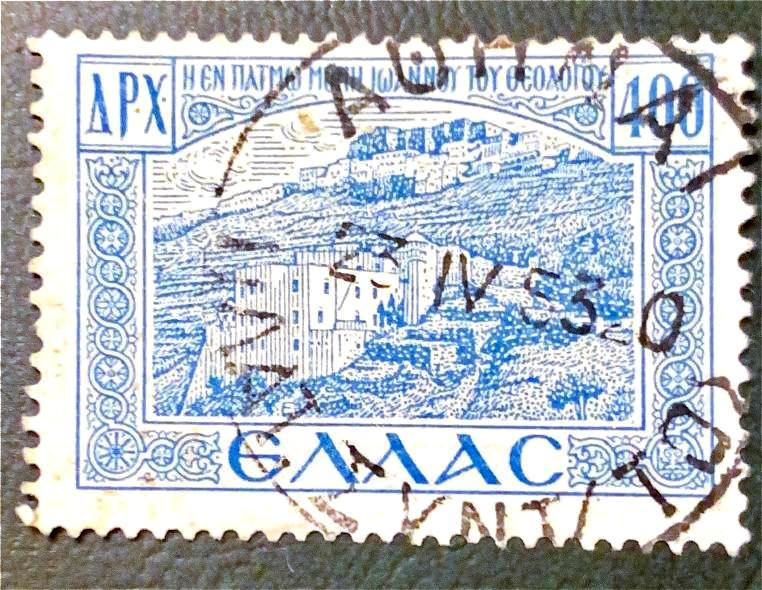 |
|
Send note to Staff
|
|
|
|
|
Pillar Of The Community
United States
1430 Posts |
|
|
Pillar Of The Community
United States
1012 Posts |
|
|
Pillar Of The Community
United States
506 Posts |
|
|
The epsilon, lambda, lambda, alpha, final sigma at the bottom of the stamp spells ELLAS or Hellas and is found on almost all Greek stamps. It is the Greek name for Greece, I believe, as in the Hellenic Republic |
Send note to Staff 
|
|
|
Valued Member
United States
399 Posts |
|
|
As Willwood42 points out, the Greek letters spell the name of the country: ELLAS, with epsilon, lambda, lambda, alpha, sigma, but this stamp has something I hadn't noticed before on either stamps or any other rendering of Greek writing. The sigma in this case isn't the normal capital sigma you usually see, which looks a bit like a squared off backwards "3", but more like the letter "C" in the Roman alphabet, which normally only has an "S" sound in English when it precedes an E or an I, and never at the end of a word. The Cyrillic letter C also has an S sound: look at old Russian stamps from 1923 onward, they have CCCP on them, the Russian equivalent of SSSR. I had a quick look in my Scott Classic catalogue, and up until 1940, I found a few other Greek stamps that use this C as a sigma: Scott 416 and 417 , and Scott C14. Does anyone on the forum who is familiar with the Greek language know about this? |
|
Send note to Staff
|
|
|
Pillar Of The Community
United States
1012 Posts |
|
|
Exactly. That is what confused me. I have several Greek stamps- all similar, this one was unique...looking forward to any insight. |
|
Send note to Staff
|
|
|
Pillar Of The Community
Australia
1865 Posts |
|
|
from Wikipedia, see Note 4: The letter sigma also has an alternative variant, the lunate sigma (uppercase C, lowercase c), which is used in all positions. This form of the letter developed during the Hellenistic period (323–31 BC) as a simplification of the older #931; #963;/#962; variant. Thus, the word stasis can either be written #963;#964;#940;#963;#953;#962; or #1010;#964;#940;#1010;#953;#1010;. In modern, edited Greek texts, the lunate sigma typically appears primarily in older typesetting. https://en.wikipedia.org/wiki/Greek_alphabetSorry, the Greek letters don't come up, but you can see them in the link. |
|
Send note to Staff
|
| Edited by 22crows - 02/06/2021 01:22 am |
|
|
Pillar Of The Community
France
2942 Posts |
|
|
In addition :
" In handwritten Greek during the Hellenistic period (4th–3rd century BC), the epigraphic form of sigma was simplified into a C-like shape,which has also been found on coins from the 4th century BC onward. This became the universal standard form of sigma during late antiquity and the Middle Ages.
Today, it is known as lunate sigma (uppercase C , lowercase c), because of its crescent-like shape, and is still widely used in decorative typefaces in Greece, especially in religious and church contexts, as well as in some modern print editions of classical Greek texts."
(from "Sigma" on Wiki) |
|
Send note to Staff
|
| Edited by vayolene - 02/06/2021 02:04 am |
|
| |
Replies: 7 / Views: 2,163 |
|




 Posted 02/05/2021 12:14 am


