This is not a foolproof method and assumes that the majority of stamps are used shortly after purchase and that Post Offices mainly have stocks of the later or latest printing.
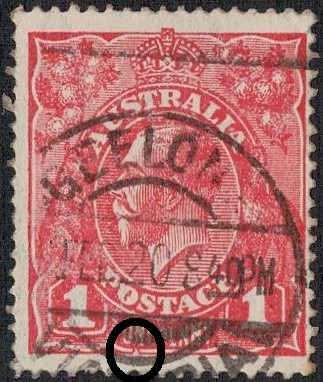
Firstly, your stamp is 1d, not 1½d. Secondly, your stamp has a very nice FEB 20 postmark. Thirdly, the printing prior to February 1920 of the 1d with Large Multiple watermark has an earliest known use of 17 December 1919. And finally the Australian Commonwealth Specialists' Catalogue (ACSC) gives the five following colour options for the late-1919 printing of BW 74:
- BW 74A - Carmine-Pink
- BW 74B - Deep Carmine-Rose
- BW 74C - Pale Carmine-Rose
- BW 74D - Carmine (Aniline)
- BW 74E - Deep Carmine (Aniline)
The following can break the options to one of two groups:
- BW 74A, B and C have a bright red reaction under UV light.
- BW 74D has a similar shade to 74B in daylight but the reaction of it and 74E to UV light is bright purplish red.
- BW 74D and E used aniline ink and normally this makes the stamps colour more visible on the back of the stamp.
As a first cut, I would rule out the the earlier BW 73 printing because of its relative rarity. (The earlier printing also has a different UV reaction.)
Beyond that, I am unable to suggest a refinement to the colour other than by comparison with with other stamps.





 Posted 03/14/2021 04:54 am