|
This page may contain links that result in small commissions to keep this free site up and running.

Welcome Guest! Registering and/or logging in will remove the anchor (bottom) ads. It's Free!
To participate in the forum you must log in or register.
| Author |
 Replies: 920 / Views: 197,992 Replies: 920 / Views: 197,992 |
|
|
|
Pillar Of The Community
Australia
3547 Posts |
|
|
Did a quick trawl through my Cochin covers, and couldn't come up with a definite sighting of a railway-related cancellation. The best I can do is this 'Too Late' marking (the leaf-shaped stamp) on this cover - and I'm not at all sure it was necessarily associated with the railway service:  Here is the front of the cover:  It's of minor interest in having SG 36 with a 'D' (= Devaswom - the State temple administration) perfin. Hyderabad will take a bit more effort  |
Send note to Staff 
|
|
|
Pillar Of The Community
Australia
3547 Posts |
|
|
Further to the railways business: I've just checked through my archive of the India Study Circle journal, and there's a mountain of material on the Indian and States railways and cancellations. Far too much to post here, but if there's anything in particular you'd like me to follow up, do let me know - here, or off-list. |
|
Send note to Staff
|
|
|
Pillar Of The Community
2664 Posts |
|
|
Pillar Of The Community
Australia
3547 Posts |
|
|
Not likely! There are 50 years' worth of journal articles. I will try to answer specific questions, but it's not something I've looked into at all, so I can't claim any expertise. |
|
Send note to Staff
|
|
|
Pillar Of The Community
Australia
3547 Posts |
|
|
Now, to return to the matter in hand ... In 1878, Jammu & Kashmir issued a combined series for both halves of the State, in new designs. They started out with four values, from ¼ to 2 Annas. Initially, at least, the Post Office seems to have tried to cling to the old differentiation between Jammu and Kashmir. The first stamps were issued in red, probably for Jammu, and shades of blue, probably for Kashmir. The Post Office also experimented, briefly, with those newfangled perforation things. Here is a sheet (minus margins) of the perforated ½ Anna, SG 102  This wasn't a great success, and was soon abandoned. (Although it may have been taken up very briefly again later, before being discarded once again.) Here is a cover with SG 105, the imperf ½ Anna blue:   These printings continued on different papers and in varying shades of 'red'. (There was an uncommon printing around 1881 in a distinctly orange colour.) In 1879, the set was completed with the release of 4 and 8 Anna values, in slightly different designs:  SG 129 - sheet of 4 Anna on thin wove paper As an aside, should you ever come across a cover with a bisected 1 Anna stamp of this period on it, please don't soak the stamp off. These bisects were made at Leh in Ladakh (also known as Little Tibet). They start at around £6000 on cover, and head north from there  |
|
Send note to Staff
|
|
|
Rest in Peace
Canada
6750 Posts |
|
|
Thanks for all the railway information.
I have an interest in railways and stamps and covers posted on or travelled on railways. Nothing specific, just something I pay attention to whenever it pops up. Knowing there are some does pique my interest more though.
Thanks for sharing the nice covers! |
|
Send note to Staff
|
|
|
Pillar Of The Community
Australia
3547 Posts |
|
|
In 1883, Jammu & Kashmir was entering the home stretch. In a final burst of generosity to collectors, it issued a new value (1/8 Anna) and released the set now in different colours, according to denomination:  The great delight of the Indian States is that they never did anything simply: if it was possible to complicate, they did. This set is a good example. The 1/8 Anna was required for the special concessional half-rate postcard rate for European visitors to Kashmir. The earlier printings were made with an ink compounded from turmeric (the spice which makes curries yellow). It works a treat in curry, but isn't really a suitable printing ink. Many early 1/8 Anna stamps are just a curry-coloured blur.  (SG 138) The ½ Anna remained in red, and can only be distinguished by the three-circle CDS introduced in 1990. There is a huge range of shades of the 1 Anna, and of paper colours for the 2 Anna - from yellow to the flimsy green pelure shown above. In fact a broad range of papers, including laid, which Gibbons prices separately, was used for these stamps. Specialists distinguish at least five types, from thin yellowish to bright white. Few of these stamps are really expensive, and trying to plot the changes in paper can be an interesting exercise. A very few of these have been reported perforated. They're rare, and worth hanging onto - or flogging off for a tidy sum - as takes your fancy. Official stamps were also introduced in 1878. These were all denominations of the ordinary set, printed in black. They can be found on the papers used for the ordinary stamps, and the ½ Anna on laid paper can be found perforated. (Though don't hold a space for it in your album, unless you have a lazy £2250 to throw at it.) Lastly ... another curiosity. ¼ Anna stamps in a design resembling that of the 4 and 8 Anna  first turned up in 1886, but were apparently never officially released for use. They come in red and black, and on most of the papers in use for the postage stamps of the time. The red version on wove paper is fairly common; the black are less common. The Jammu & Kashmir State Post Office closed on the 1 November 1894, to the sorrow of discerning collectors everywhere. These stamps may not be to everyone's taste - they may not be to your taste - but they really are full of interest, and well worth considering. |
|
Send note to Staff
|
|
|
Pillar Of The Community
Australia
3547 Posts |
|
|
Jasdan was something of a contrast. It should be a delight to collectors of the world on a simplified basis, because (simplified) it only issued one stamp, in 1942: 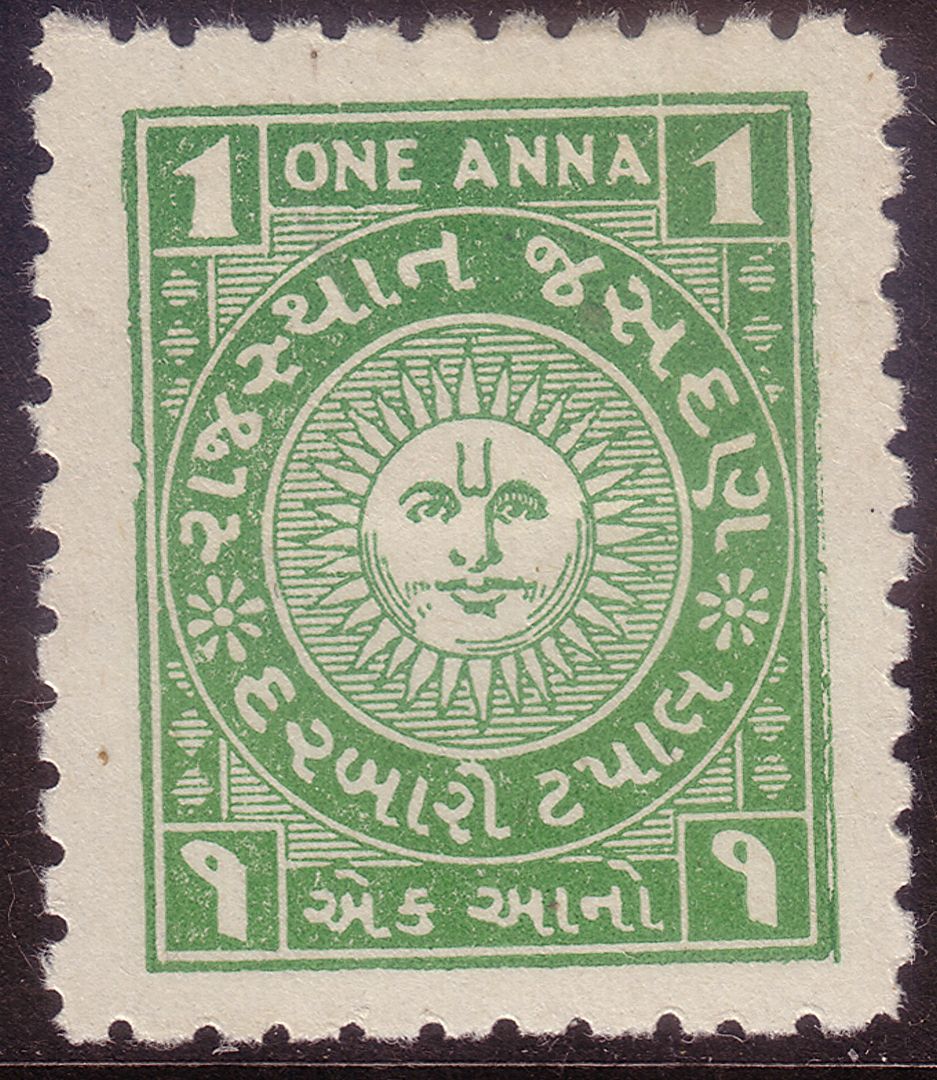 SG 5 As you can see from the SG number, the unsimplified reality is rather more complex. There were quite a few printings, distinguished by shade, perforation gauge and the arrangement of the cliches in the printing plate, as well as by size of the sheet: 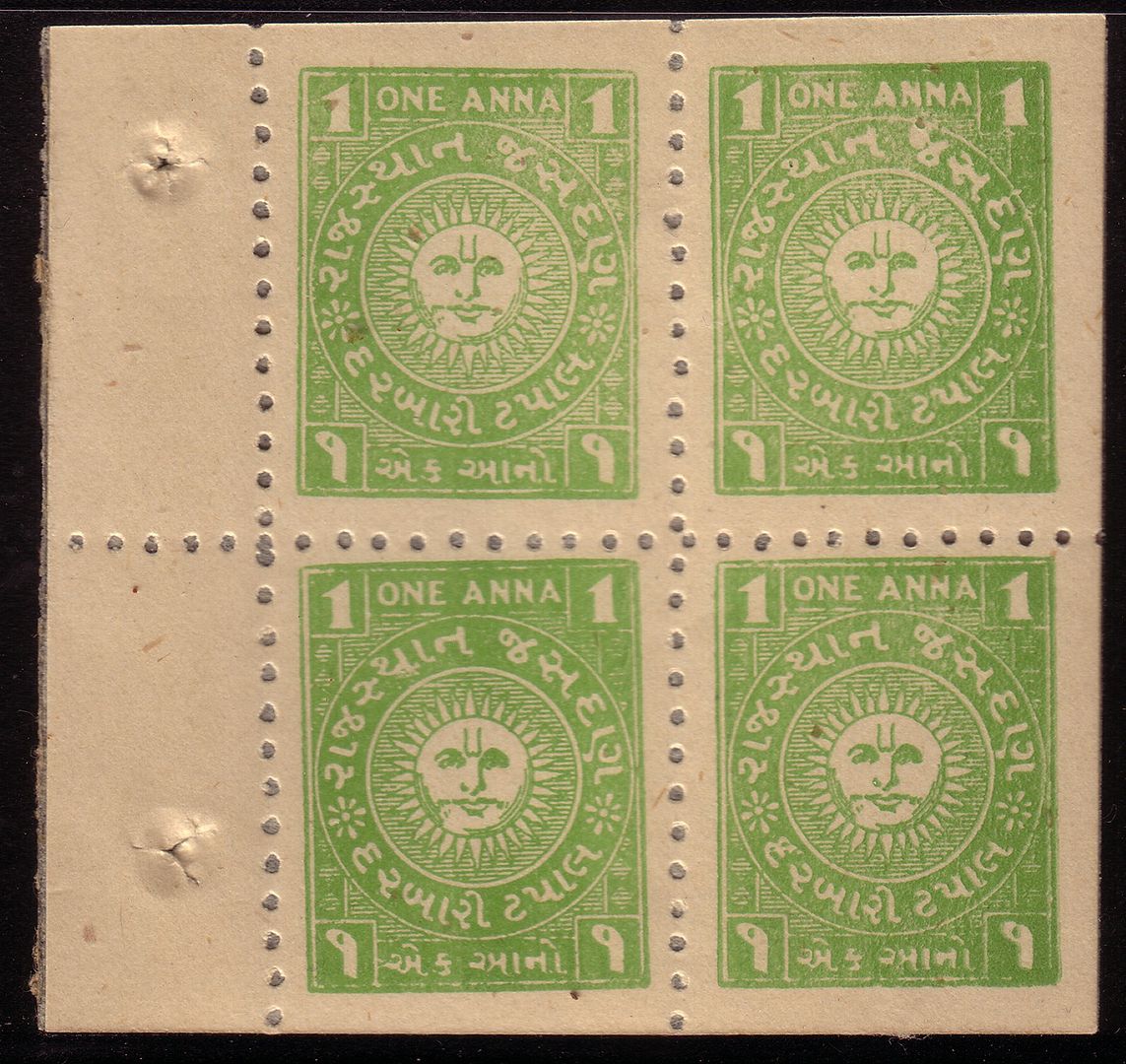 SG 4, and a sheet of SG 5  Jasdan was also the smallest State to issue stamps, with a population of around 30,000, and the State PO was closed in 1948. However, within those limitations, it offers a great deal for the well-heeled and patient specialist  |
|
Send note to Staff
|
|
|
Pillar Of The Community
Australia
3547 Posts |
|
|
Puzzler, at the risk of drifting off-topic, there's a really vast amount of British Indian railway-related material. I pulled out this cover as an example in Another Place of the sort of markings used:  The RMS in the killer stands for Railway Mail Service, and the RS in the Cawnpore CDS is I'm pretty sure also TPO-related. |
|
Send note to Staff
|
|
|
Pillar Of The Community
2664 Posts |
|
|
ok tony you have drifted of topic to get more readers I say as a fine you should give yur regular readers a complete set of mint Jasdan. since thart is limited ot only me. I will accept it :) |
|
Send note to Staff
|
|
|
Rest in Peace
Canada
6750 Posts |
|
|
Good Day, eh? and welcome to me, the second constant reader of this wonderful thread. I think the readers should be donating stamps to the poster for giving us the opportunity to educate ourselves about India. Except I don't have any yet (Indian States that is). But, now that I know somewhat about the Indian States (need to study more though), if I run across any, I will be sure to lat interested readers (and posters) know. |
|
Send note to Staff
|
|
|
Pillar Of The Community
Australia
3547 Posts |
|
|
Hmmm ... I think I'll pass on Spock's fine. Jasdan complete mint according to the 2010 Gibbons Part 1 (SG 1 to 6) is about £2400.
But Puzzler, if you do get infected by the Indian States bug (and just handling some of them will do it), I'll be happy to take your uninfected hand, and guide you through the maze. |
|
Send note to Staff
|
|
|
Pillar Of The Community
Australia
3547 Posts |
|
|
I was reminded by a new arrival from ebay yesterday that I'd forgotten to mention this:  It may not ne immediately obvious to some ... but this is from the State of Duttia, which I dealt with earlier. It was normally used as a fiscal, and that's how you're likely to find it, but it was used (and accepted) for postage for a while, although the catalogues don't list it. If you find it adorning an envelope, rather than a document, leave well enough alone. You have a four-figure item already. Do not attempt to remove it and soak it off paper. It's printed in watercolour, and you will end up with a very expensive bowl of blue water. |
|
Send note to Staff
|
|
|
Pillar Of The Community
Australia
3547 Posts |
|
|
Moving right along ... Jhalawar is twice as big as Jasdan, on a simplified basis, anyway. It issued two designs. Again, like Jammu & Kashmir, and Bhor, these are uncompromising. They are simply what they are: no bowing and scraping to classical ideas of stamp design. The second was judged one of the ugliest in the old Gibbons anti-beauty contest I mentioned earlier. The two stamps appeared in 1886, and the State post office was closed in 1900. Both stamps were printed imperf in horizontal strips of 12 (I don't have one of the smaller design, and the 'sheet' of the larger design won't fit on my scanner anyway  ) Here's a part sheet of SG 1, the 'yellow-green' (but shades exist), and a single of the blue-green shade, SG 1a  And here are the two halves of my sheet of SG 2   (Don't worry: they're still in one piece in my collection  ) So, you may think: only two, or at worst, three stamps to find. A very boring little place. Well, first, try finding covers of SG 1 (or worse still, SG 1a):  Covers of SG 2 are relatively common  (Yes, it is an SG 2 under that beautifully socked-on-the-nose cancel.) But registered covers are scarcer, and look rather impressive:  Then there's the question of the paper. These were printed on laid paper. The laid lines are usually vertical - I believe because they were printed onto sheets of foolscap paper. However, both values can be found with horizontal laid lines. These are scarcer, by a factor of about 10. SG 2 (and it is said SG 1 also) can be found on what looks like a wove paper. Gibbons used to list them, but then delisted them. According to Gibbons, they're actually on laid paper, but with the lines nearly invisible. I have a couple (they're distinctly scarce), and I can't see any lines in them. (But then, I wouldn't, would I?) So there you are. Jhalawar might not be big enough to make it your life's work, but there is in fact lots of interest in those two little stamps. |
|
Send note to Staff
|
|
|
Pillar Of The Community
Australia
3547 Posts |
|
|
Jind was one of those States that made me fall in love with the Indian States - another set of take-no-prisoners designs. Like Jammu & Kashmir, you've got to love 'me or hate 'em. To me, there's no argument. Here are the designs of the first set:  SG J8 (½ Anna); SG J9 (1 Anna); SG J10 (2 Anna); SG J11 (4 Anna) and SG J12 (8 Anna, and the nicest of three listed shades for this value) I chose my words carefully, here. The first issue in these designs appeared in 1874, in slightly weaker colours on a thin yellowish wove paper. The stamps above are from the 1876 reissue on a laid card-paper, which gave far better impressions. Now here's one for any fly-speckers watching, who delight in retouches that can only be seen under a magnifying glass, after they've been pointed out to you. SG J1 has a variety (J1a) 'No frame to value (retouched all over)':  SG J1a is the one on the right  These were followed in 1882 by a longer set, which now included a ¼ Anna stamp:  In my opinion, a serious decline in design standards from the first set - and the ¼ Anna is just small enough to be really tiresome to manhandle. This set first appeared on the thin wove paper (the examples above are on this paper), but also on laid paper (of various sorts, including one with a distinctly bluish tinge - fairly common on the 1 Anna value) and a thick wove paper, and also perforated. There were two rather striking errors in these issues. The ¼ Anna printed double:  and an imperf between pair of the 4 Anna:  The R in all the stamps, by the way, is the initial of the Raja, Raghubir Singh. |
|
Send note to Staff
|
|
|
Replies: 920 / Views: 197,992 |
|
|
To participate in the forum you must log in or register. | |
Disclaimer: While a tremendous amount of effort goes into ensuring the accuracy of the information contained in this site, Stamp Community assumes no liability for errors. Copyright 2005 - 2026 Stamp Community Family - All rights reserved worldwide. Use of any images or content on this website without prior written permission of Stamp Community or the original lender is strictly prohibited.
Privacy Policy / Terms of Use Advertise Here |
| Stamp Community Forum |
© 2007 - 2026 Stamp Community Forums |
| It took 0.24 seconds to lick this stamp. |
 |
|
|
|


 Posted 04/28/2010 8:43 pm


