|
This page may contain links that result in small commissions to keep this free site up and running.

Welcome Guest! Registering and/or logging in will remove the anchor (bottom) ads. It's Free!
To participate in the forum you must log in or register.
| Author |
 Replies: 920 / Views: 197,993 Replies: 920 / Views: 197,993 |
|
|
|
Pillar Of The Community
Australia
3547 Posts |
|
|
Most of these stamps were printed in sheets of 50, with a marvellous imprint around the margins: 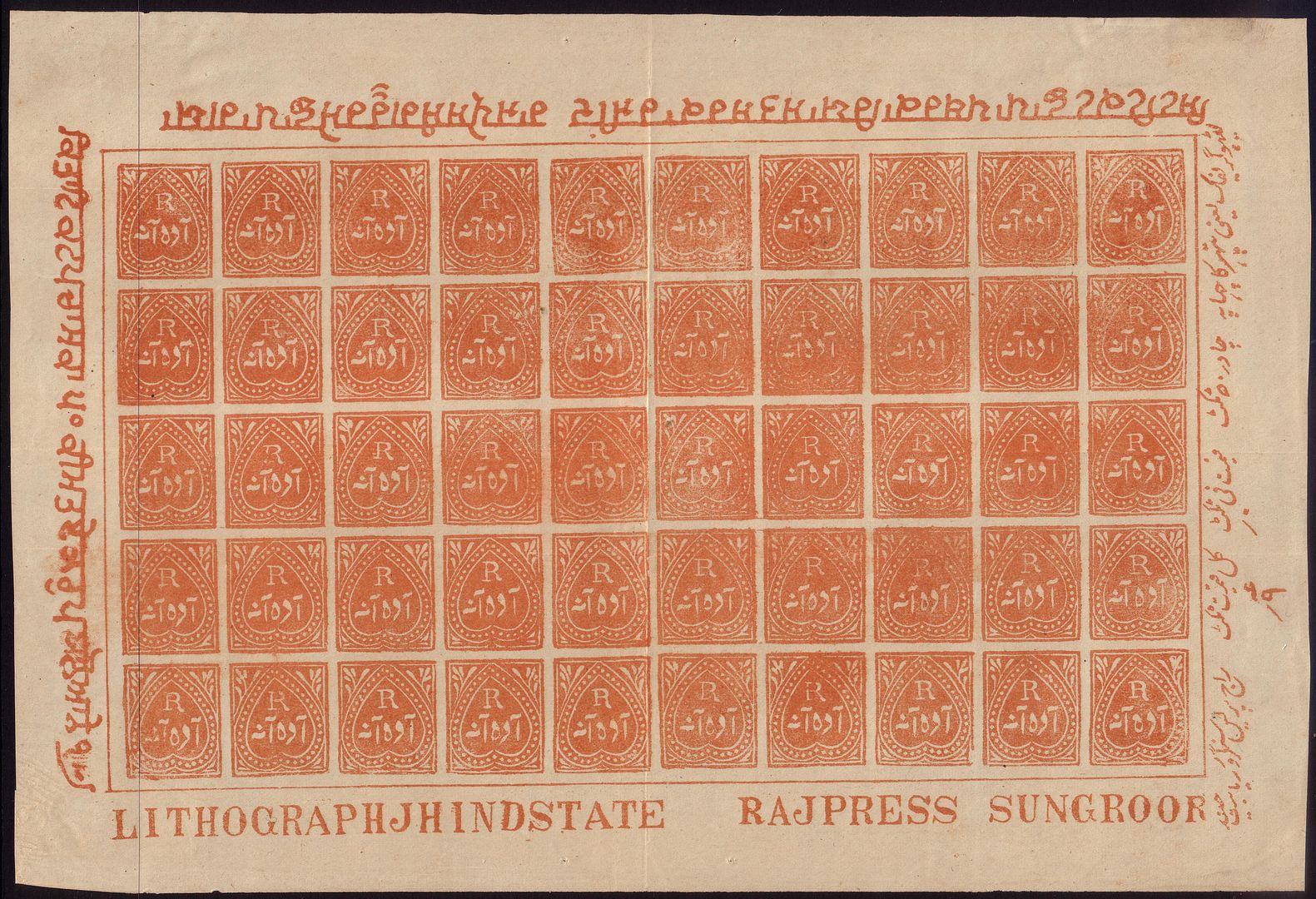 Sheets of 50 may sound reasonable, but they must have irritated the post office clerks at the end of the day. Remember the currency was 16 Annas to 1 Rupee, so a sheet of 50 1 Anna stamps was worth 3 Rupees 2 Annas. (Takes me back to my primary school days, with £sd and Imperial measures. We'd be given Sums to do like 'Mrs Kafoops goes to the draper and buys 5 furlongs 17 yards 2 feet 9½ inches of cloth at £27/19/11½ a mile. How much did she spend?') These stamps were well used. Prices for used are often cheaper than for mint, but covers are like hen's teeth. I showed this earlier, but it's worth repeating. My one and only Jind cover, with a copy of SG J17, the ½ Anna lemon, going to Bombay, so with a British Indian ½ Anna stamp added, to pay the postage beyond the borders of Jind: 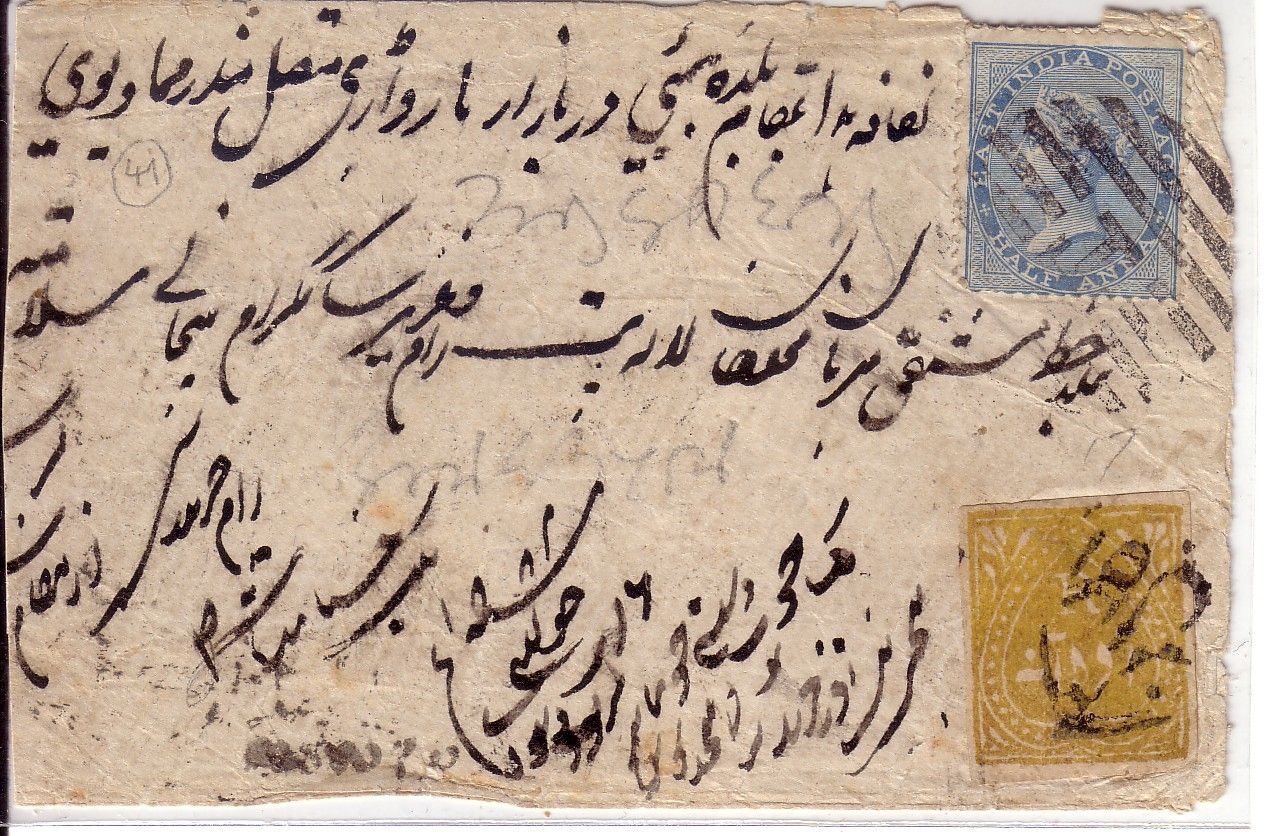 Before leaving Jind, I should mention the so-called 'Lion essays'.  These were obviously printed early in the piece, but were never actually issued. It's thought they were intended for use as official stamps, but that that idea was scrapped. These stamps continued in use as revenues into the 1940s, but Jind joined the Postal Convention in 1885 (see above under Faridkot) and then resorted to British Indian stamps overprinted Jhind, Jeend or Jind. Such a comedown  |
Send note to Staff 
|
|
|
Pillar Of The Community
2664 Posts |
|
|
Pillar Of The Community
Australia
3547 Posts |
|
|
Kishangarh seems an odd choice for my auspicious 200th post, but so be it. Kishangarh is curiously ubiquitous for a small state in Rajasthan. Its stamps turn up quite regularly in collections. Some of its stamps, such as the earlier high values, turn up rather too regularly for comfort. (The 1913 5 Rupee is one of the few Indian States stamps to have gone backwards in value over recent years.) Still... The first stamp of Kishangarh  SG 1 appeared in 1899. It's one stamp that doesn't crop up too often. However, beware. Stamps of this type, and in different colours as well, were also used as fiscals, like this copy of SG 3  Which is a bit of a pity. Gibbons prices SG 3 at £400 mint, and unpriced used. (Any Kishangarh stamp with a manuscript MC cancel, or a hole punched out, has been fiscally used.) These were followed in the same year by a long set, from ¼ Anna to 5 Rupees, either imperf or pin-perf, and each printed from a single die, struck as many times as needed across the sheet of 168. On some values, the denomination is shown in English and Nagari; in others, in Nagari only. There doesn't seem to be any rhyme or reason to the decision in each case. Here are two imperf examples, the ½ Anna pale yellow-olive (yuk  ), SG 10  and the 5 Rupees, SG 20  If you look at the lower part of the ½ Anna stamp, you'll see a pencil line drawn across the stamp. In the early days, the assist the 'printer', spaces were ruled in pencil across the sheet, to assist in placing the impressions. For those of you who may be unsure about 'pin-perf', here is a block of the common ¼ Anna rose-pink, SG 22  You'll see that the perforations are made with pins that puncture the paper, without punching out a hole. Not surprisingly, the method never really caught on. And here is the 2 Anna, SG 30. Probably the most unflattering stamp portrait of all time  Before leaving this set, I should mention that the sheets were printed one half at a time, with the paper being turned around for the second half. This produces tete-beche pairs, which Gibbons prices a little generously at 3x normal:  |
|
Send note to Staff
|
|
|
Pillar Of The Community
Australia
3547 Posts |
|
|
In the next few years, some slightly revised designs were produced, as well as two quite new ones (this time lithoed instead of being handstamped, and on a thick white surfaced paper, which will appear again later):  SG 39 (a ¼ Anna), and a replacement portrait of Maharaja Sardul Singh  which was a bit late, really, because Sardul Singh had died 3 years before this appeared, quite possibly of embarrassment and mortification  In 1904, Kishangarh made a complete about-face. It ordered a long set (again ¼ Anna to 5 Rupees) from Perkins, Bacon. These were beautifully printed in recess in this design 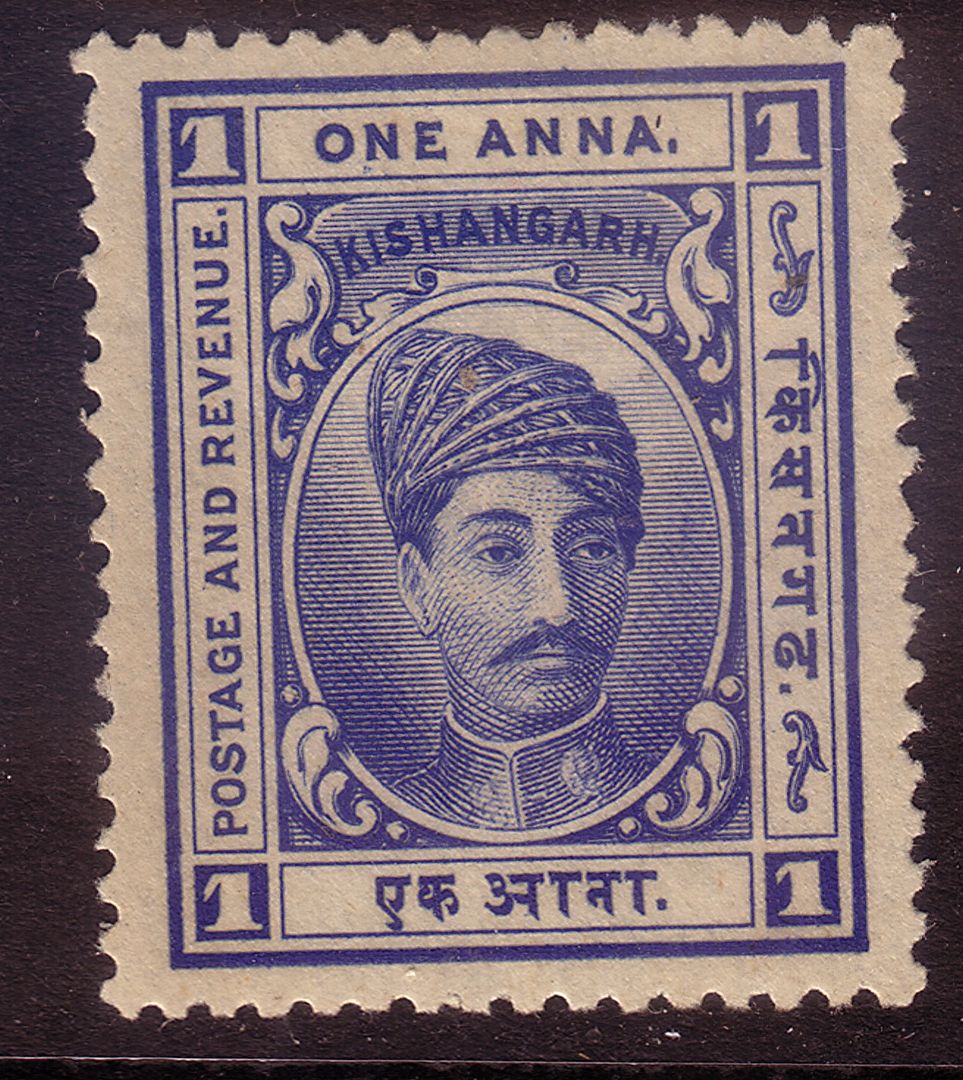 and probably in large numbers. There were still supplies sitting around in the State Treasury in 1948. There are some scarce perforation variations in this set. It's worth checking anything you may come across against Gibbons. |
|
Send note to Staff
|
|
|
Bedrock Of The Community
Australia
38679 Posts |
|
|
Quote:
At some point around 1900 Bundi seems to have stopped issuing stamps. Stampless covers exist from this period. Every Post Office was forced to close down in the Indian Principality of Bundi except the Head Office in 1899 when famine swept the country and the economy virtually collapsed. The reconstruction of the postal services was not completed until 1914 when the offices were re-opened. Famine had been a constant curse for India, in one famine in 1670 the Dutch traveller Van Graaf wrote: "we saw nothing but poverty and misery...the people died in heaps and their corpses remained extended on the roads streets and market places" The british govt began to study the problem of famine systematically, and in 1866, due to the catastrophe in Orissa where over 1 million died, political machinery was put into place and go into action when famine arrived. In 1876 and 1877 a holocaust was experienced in central and south india, and 5 million people lost their lives, and under Sir John Strachey a famine commission was implemented and a famine code set up in 1883. Under this code, a chain of "protective railways" was built to deliver adequate stocks of food to any part of the country that may be threatened by famine. By 1900 India could claim to have the greatest irrigation system in the world serving some 14 million acres. Acknowledgement: A short history of India and Pakistan walter t wallbank 1958 |
|
Send note to Staff
|
| Edited by rod222 - 05/01/2010 01:40 am |
|
|
Pillar Of The Community
2664 Posts |
|
|
. During the times of the great mogul emperors famine was non existent. The britsh were responsible for a lot of the famines they forced the farmers to grow and sell neel dont know the english translation but that caused the lands to go barren and the railways were systematically used to drain india of all her wealth. the britsh if anything wanted the locas dead. they cleansed most of the red indians in north america almost wiped out the locals of australia and killed millions of indians before they made india into a colony. and then after 1857 they didnt even spare woman and children |
|
Send note to Staff
|
|
|
Pillar Of The Community
Australia
3547 Posts |
|
|
Thanks for that, Rod. I hadn't made, or had forgotten, the connection to the 1899-1900 famine, but it makes perfect sense. It seems to have been particularly bad across Central and Northern India. The Barwani Gazetteer records that around 7,000 of the State's population died in that famine - around 10% of the population. And that was despite what seems to have been a massive effort by the State authorities to relieve its effects. Having been raised on stories of the Potato Famine (and how my family were forced to emigrate to Australia because the peasants stopped paying their rents  ) famine rather strikes a chord. The picture in Bundi is clouded, because there are apparent postal items from the hiatus period. However, their status is uncertain. |
|
Send note to Staff
|
|
|
Bedrock Of The Community
Australia
38679 Posts |
|
|
Indeed,
Mail would have cetainly got out, albeit in ad hoc fashion,
especially in the country.
Makes interesting collection inspection.
I was remiss in not acknowledging the first paragraph.
attributable to Mr. James Mackay 1982.
|
|
Send note to Staff
|
|
|
Pillar Of The Community
Australia
3547 Posts |
|
|
And now we enter stamp trivia quiz time: What country printed its stamps in a soap works? I guess the answer isn't too difficult, given the context. Probably the Perkins, Bacon experiment was financially painful, so in 1912, the Kishangarh Post Office decided to look to a printer closer to home, the local Diamond Soap Works, who had experience (presumably) printing soap wrappers. Two values - ½ Anna and 2 Annas - were produced using half-tone blocks, the 2 Annas in a couple of types. Here is the cheapest of them, SG 54, with the D(iamond) S(oap) W(orks) imprint in the margin:  In 1913, the same two values were produced in a larger design. (This is the first printing identified in Gibbons as by the DSW, so is usually used to illustrate this oddity.) These were type-set, a little inexpertly, leading to some spelling errors:  SG 58c - 'OUARTER' for 'QUARTER' and SG 58d 'KISHANGAH R' for 'KISHANGA RH', and the 2 Anna  This seems to have been considered a success, because a full set, ¼ Anna to 5 Rupees again, was printed at the Soap Works. Here is the 4 Anna stamp from the set, with part imprint: 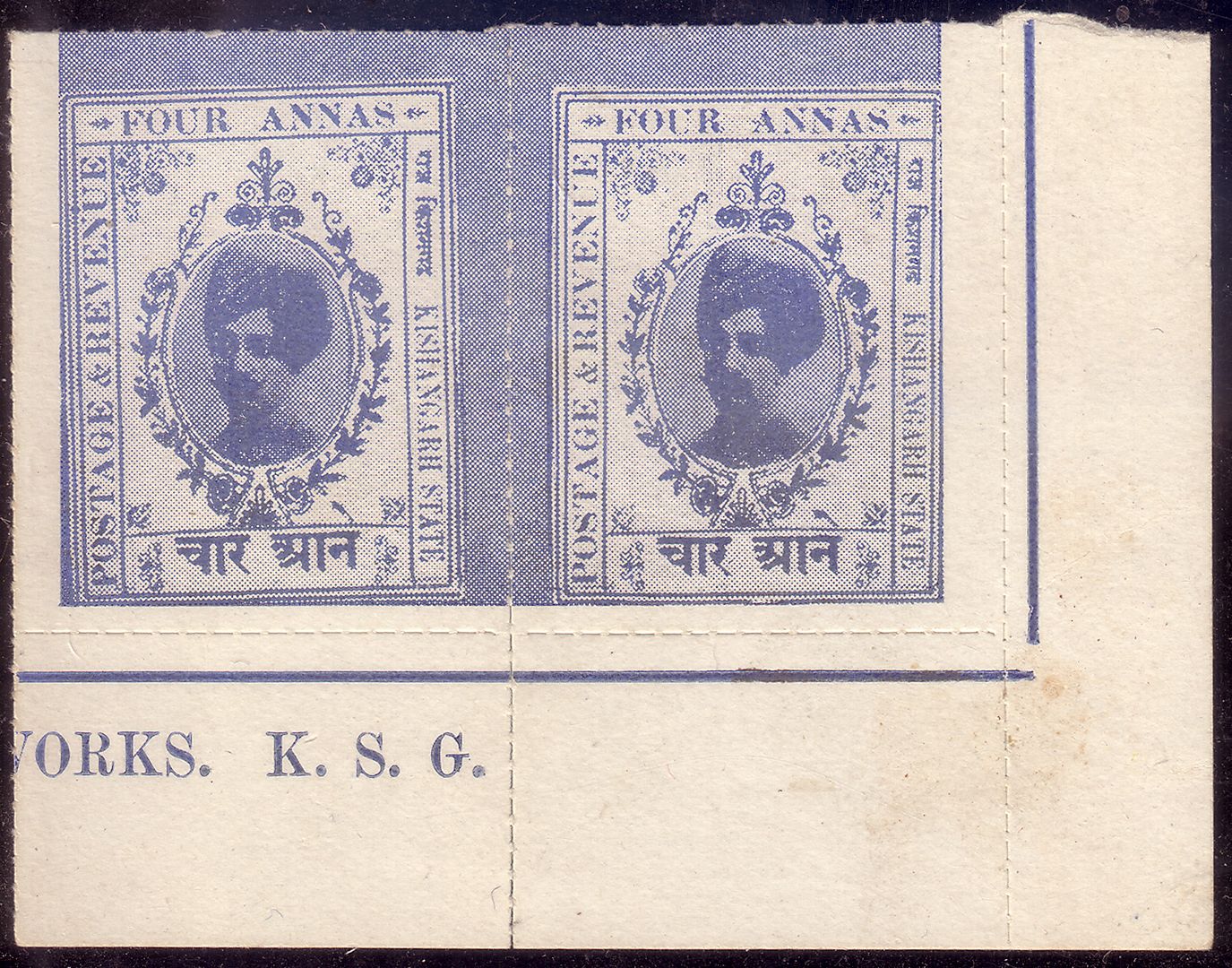 The 5 Rupees (spelt 'RUPIES' on the 2 and 5 Rupees values)  (SG 71) is a bit of a conundrum. We all know catalogue editors hate to reduce their prices. Well, in 2000 Gibbons rated this at £90; they cut it to £65 in 2002, and gradually to £40 in 2005, where it's remained ever since. I've seen sheets (of 20) of this stamp offered for sale. A sheet of 20 of the 5 Rupees in 1914 would have cost, at full face value, £7/10/-, or a couple of weeks' wages for the average worker in Britain or Australia. Something is clearly not right here. |
|
Send note to Staff
|
|
|
Pillar Of The Community
Australia
3547 Posts |
|
|
Kishangarh goes slightly tame after this. In 1928, it released a new long set of the usual values for the new Maharaja, Yagyanarain Singh. These appeared first on the surfaced paper used for the last set. This is the 2 Anna of the set  (SG 75a) If you tilt your computer (or even better, tilt the stamp) at an angle to the light, you'll clearly see the shiny surface. A new printing of the set appeared in 1943, on an unsurfaced paper, which gives quite a distinctive appearance. Here is the corresponding 2 Anna  And here are the two together. Ignore the shade differences, and focus only on the paper and print quality. The unsurfaced paper is on the left; the surfaced paper on the right:  And lastly, and just because I can, a used sheet of the ½ Anna imperf, SG 83a:  |
|
Send note to Staff
|
|
|
Pillar Of The Community
2664 Posts |
|
|
state stamps are sold by the kilo here no one wants them Tony and forget SG prices |
|
Send note to Staff
|
|
|
Pillar Of The Community
Australia
3547 Posts |
|
|
Some States (Hyderabad, Travancore) without a doubt - but I'll happily pay you $US1,000 or even £1,000 for a kilo of genuine used Barwani postage stamps  |
|
Send note to Staff
|
|
|
Pillar Of The Community
Australia
3547 Posts |
|
|
In 1918, Kishangarh also overprinted some of everything it had sitting in the State Treasury back to the 1899 issue On K(ishangarh) D(urbar = Government) S(ervice):  (SG O31a) in black and red. Some values and colours are scarce, but most are fairly readily available. The overprints can be found double and inverted, but aren't worth more than a few percent premium, if that. These can also be found used - almost invariably CTO. I have seen what looked like a genuine usage on cover, but I saw only the back of the cover, with the stamps, not the front. I have no way of knowing if it was properly used for government mail. I suspect not: these overprints were really only made for collectors. Speaking of covers, there are plenty of what purport to be Kishangarh covers on the market. In most cases, they're court documents, with postage stamps used to pay court fees. Look out for large black oval seals, away from the stamps: they're a dead give-away for court use. Proper covers should look like, well, proper covers:  (SG 26) One last note: I've been warning about fiscal uses all through these notes on Kishangarh. I don't want to put you off Kishangarh, or more particularly its fiscals. They make a really fascinating and colourful study. Some stamped papers, with stamps added to pay fees, are spectacular. I don't own this one any more (I passed it on to a collector who is more interested in fiscals than I am): Front side  and back  (All the items I show are from my own collection unless stated otherwise) |
|
Send note to Staff
|
|
|
Pillar Of The Community
2664 Posts |
|
|
Dear Tony,
how can I get Barwani stamps? they are cindrella issues manaufactured under his highness Tony emperor of Tonylan sometimes known as Barwani :) |
|
Send note to Staff
|
|
|
Pillar Of The Community
Australia
3547 Posts |
|
|
Well, it is true that I own about half the Barwani stamps ever issued, and I know where most of the rest of them are ... |
|
Send note to Staff
|
|
|
Replies: 920 / Views: 197,993 |
|
|
To participate in the forum you must log in or register. | |
Disclaimer: While a tremendous amount of effort goes into ensuring the accuracy of the information contained in this site, Stamp Community assumes no liability for errors. Copyright 2005 - 2026 Stamp Community Family - All rights reserved worldwide. Use of any images or content on this website without prior written permission of Stamp Community or the original lender is strictly prohibited.
Privacy Policy / Terms of Use Advertise Here |
| Stamp Community Forum |
© 2007 - 2026 Stamp Community Forums |
| It took 0.23 seconds to lick this stamp. |
 |
|
|
|


 Posted 04/30/2010 09:58 am


