Stamp Community Family of Web Sites
Thousands of stamps, consistently graded, competitively priced and hundreds of in-depth blog posts to read


Stamp Community Forum
 
Username:
Password:
Save Password
Forgot your Password?

This page may contain links that result in small commissions to keep this free site up and running.

Welcome Guest! Registering and/or logging in will remove the anchor (bottom) ads. It's Free!

So Who's Afraid Of The Indian States?

Previous Page | Next Page    
 
To participate in the forum you must log in or register.
Author Previous TopicReplies: 920 / Views: 194,788Next Topic
Page: of 62
Bedrock Of The Community
Australia
38679 Posts
Posted 05/07/2010   04:01 am  Show Profile Bookmark this reply Add rod222 to your friends list  Get a Link to this Reply

Quote:
thanks for letting me know Rod I will begin listing again.


For purchases now on, I shall take a screen capture
to allow me to navigate back to the original sales thread.
Sorry for hijacking your thread Tony.
Send note to Staff  Go to Top of Page
Edited by rod222 - 05/07/2010 04:02 am
Pillar Of The Community
Australia
3547 Posts
Posted 05/07/2010   09:44 am  Show Profile Bookmark this reply Add tonymacg to your friends list  Get a Link to this Reply
Never mind, for now, Young Rodney. But I have a long memory - like the elephants in the next set issued by Sirmoor, in 1894:


SG 22-29

Of course, this was a blatant grab for the early thematic rupee. But on the other hand, the lower values, at least, did see legitimate use. The 1 Rupee value in this set is particularly prone to oxidation - dark discolouration in patches.

Sirmoor's last set was an even more blatant attack on the collector's back pocket: four high values to 1 Rupee, that had no serious justification at all:


Once again, the 1 Rupee often suffers from oxidation.

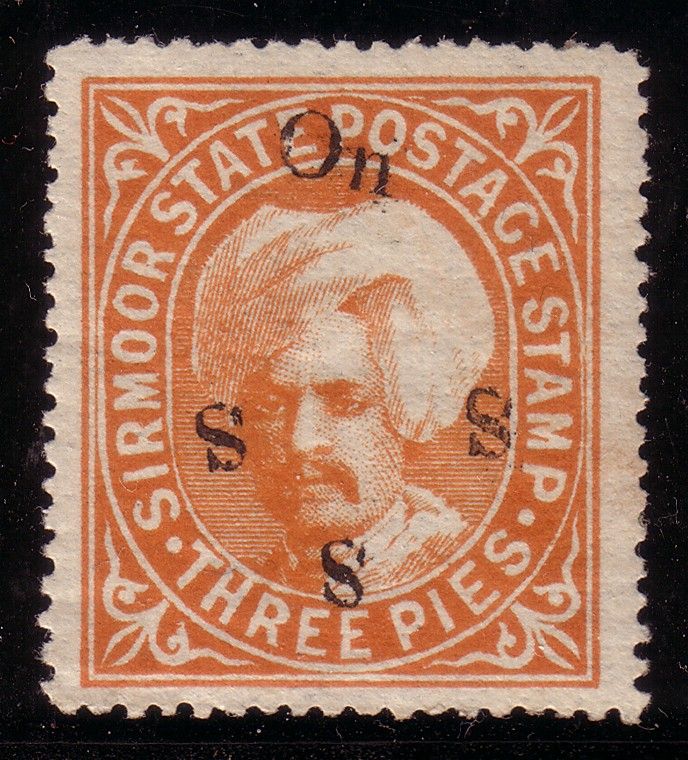
Sirmoor overprinted the 1885 issue for government use - endlessly, both by machine and by hand. The listing of the ordinary stamps in Gibbons occupies about a column; the On S(irmoor) S(tate) S(ervice) overprints, over three columns.

I won't even try to guide you through these. I have enough trouble finding my own way. The type-set Service overprints are the big problem; the handstamped overprints are, paradoxically, easier. At least with them, you don't have to worry about measurements. When each element was stamped separately -


measurements are strictly academic.

The Elephant set of 1894 also turns up regularly with machine On S S S overprints


complete with overprint errors (comma for full stop after the bottom S). These apparently were never officially overprinted.

A final word of warning about condition. The tiny perforations on the Raja's head types seem to have made separating stamps cleanly difficult. The Service stamps in particular are hard to find in perfect condition.
Send note to Staff  Go to Top of Page
Bedrock Of The Community
Australia
38679 Posts
Posted 05/07/2010   10:24 am  Show Profile Bookmark this reply Add rod222 to your friends list  Get a Link to this Reply

Inverted "S"'s on the 3 pies?

Nice to see you make a trunk call with your Sirmoor,

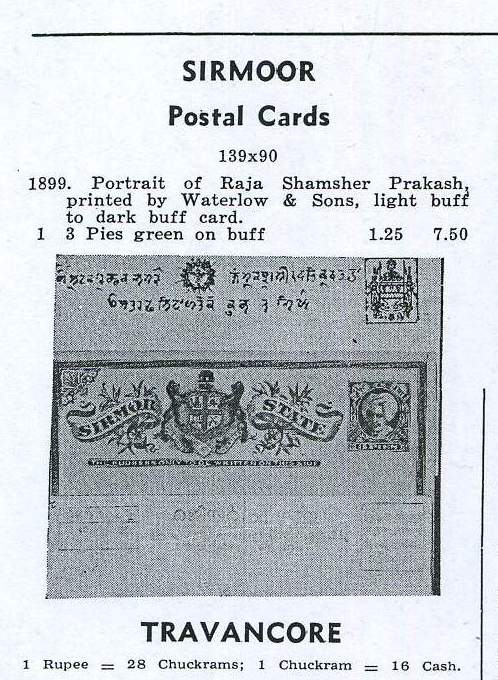
Here is some selvedge from the main page of TRAVANCORE
in Billigs. SIRMOR ??


Your oxidisation perhaps..
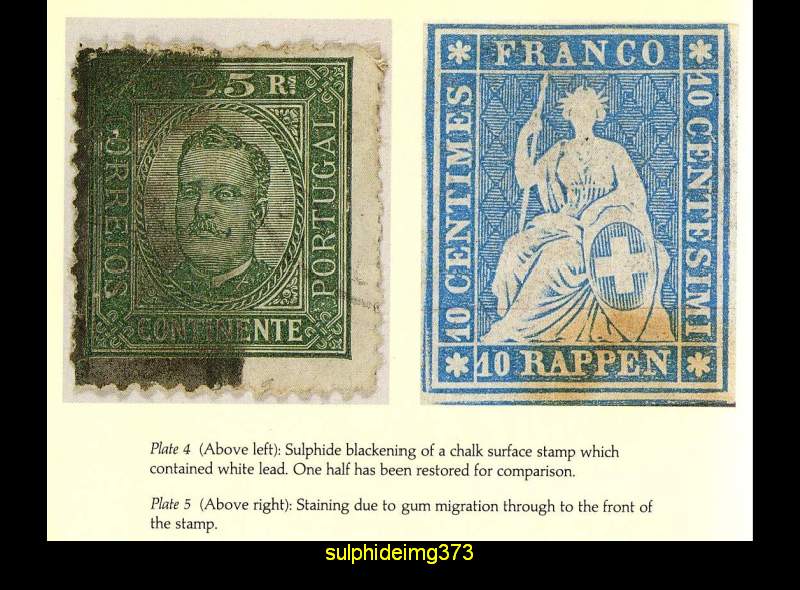
Using the US 1898 Orange 4c Trans-Mississippi as an example, the colors used to make these - orange and chrome yellow are both lead mineral pigments, the lead being susceptible to darkening by exposure to sulfurous gases.

These mineral pigments are referred to as the old artificial pigments and the modern pigments are referred to as the new organics as their central atom is carbon. The new modern organics have stronger tinting and are more permanent (a generalization).
Send note to Staff  Go to Top of Page
Rest in Peace
Canada
5701 Posts
Posted 05/07/2010   11:14 am  Show Profile Bookmark this reply Add BeeSee to your friends list  Get a Link to this Reply
Nice display Tony!
Send note to Staff  Go to Top of Page
BeeSee in BC
"The Postmark is Mightier than the Stamp"
http://brcstamps.com ---- BNAPS, RPSC, APS
Rest in Peace
Canada
6750 Posts
Posted 05/07/2010   12:48 pm  Show Profile Bookmark this reply Add Puzzler to your friends list  Get a Link to this Reply
Could the oxidation of Canada 3c small Queens be similar?
Thread that discusses use of hydrogen peroxide on them:
https://goscf.com/t/6683&SearchTerm...gen,peroxide
Send note to Staff  Go to Top of Page
Pillar Of The Community
Australia
3547 Posts
Posted 05/07/2010   7:09 pm  Show Profile Bookmark this reply Add tonymacg to your friends list  Get a Link to this Reply

Quote:
nverted "S"'s on the 3 pies?

Nice to see you make a trunk call with your Sirmoor,

Here is some selvedge from the main page of TRAVANCORE
in Billigs. SIRMOR ??

[Click the image to enlarge]


Your oxidisation perhaps..
Using the US 1898 Orange 4c Trans-Mississippi as an example, the colors used to make these - orange and chrome yellow are both lead mineral pigments, the lead being susceptible to darkening by exposure to sulfurous gases.

These mineral pigments are referred to as the old artificial pigments and the modern pigments are referred to as the new organics as their central atom is carbon. The new modern organics have stronger tinting and are more permanent (a generalization).


Rodney, if you can't improve the standard of your puns, I'll refuse to discuss TravAncore. Now back to specifics,

Yes: an inverted S (again). Not surprising, when the 'On' and 'S' were separate and, in the case of the 'S' had to be applied three times to each stamp. Maybe, to relieve the boredom, the printer (for want of a better word) was overprinting one whole stamp at a time by this stage. He printed his 'On', put that down, picked up the 'S', applied one, discovered it was upside down, turned it around, and did the rest. Goodness knows with Sirmoor.

The Sirmoor postcard: these aren't particularly common. They were also printed by Waterlow, who did the later stamps, and so should have known the proper spelling. (That is a Jammu & Kashmir postcard sitting above the Sirmoor, BTW. Both States were in the Himalayan region, but apart from that, I don't see the connection. Waterlow did not do the printing for Jammu & Kashmir ...)

Oxidation: These stamps date from the 1890s, and Waterlow were a mainstream printer, so I'd guess they were using the standard inks for the time.

BTW, it's just struck me that all these examples of oxidation are occurring on recess printed stamps. Are there any examples on surface/typographed/letterpress printed stamps? Was there some particular formulation of the red family inks for recess printing that caused the problem?
Send note to Staff  Go to Top of Page
Pillar Of The Community
Australia
3547 Posts
Posted 05/07/2010   7:19 pm  Show Profile Bookmark this reply Add tonymacg to your friends list  Get a Link to this Reply
Thanks, BeeSee. I'm afraid things will take a turn for the worse, though, when we (and if, Rodney) get down to Travancore. You'll just have to grit your teeth, and think of something else until we get past it.
Send note to Staff  Go to Top of Page
Bedrock Of The Community
Australia
38679 Posts
Posted 05/07/2010   10:26 pm  Show Profile Bookmark this reply Add rod222 to your friends list  Get a Link to this Reply

Quote:
Could the oxidation of Canada 3c small Queens be similar?


I should think so Puzzler, but keep in mind the chemistry is a fairly complex science with particular philatelic examples.
Oxidation is defined as "A chemical reaction where oxgen is added, or a decrease in electronegativity of the material"

I looked through "the care and preservation of philatelic materials,
and only a few detailed stamp examples are included, to the most part
it is generalisation regarding stamps.


Send note to Staff  Go to Top of Page
Rest in Peace
Canada
6750 Posts
Posted 05/07/2010   10:46 pm  Show Profile Bookmark this reply Add Puzzler to your friends list  Get a Link to this Reply
The Canada small Queens are not chalk surfaced (I think older Canada some are) and that gum migration is nasty, but I believe the pigment is lead based. Not a chemist myself either.
Send note to Staff  Go to Top of Page
Bedrock Of The Community
Australia
38679 Posts
Posted 05/07/2010   10:58 pm  Show Profile Bookmark this reply Add rod222 to your friends list  Get a Link to this Reply
Tony the Billigs booklets are nearly as old as
your good self, so one can presume they are results
of roneoed multiple sheets used for brevity.
J&K just poked their nose in (although I didn't pick that)

I cannot see you taking on TRAVANCORE, but it would be warmly welcomed if you did, to add class to the thread,
and no doubt would be followed by many Trav- "encores"


I think for your ink query, it is extremely difficult to ascertain, one can only go on the result, then work backwards to the probable cause, especially where pigments are concerned.
You are quite correct in your assumption of the ink recipe however
Letterpress, collotype and lithography use "paste" inks in their process, pigment based systems using drying oil similar to linseed as a binding agent,(vehicle) with other additives including dyes.

Whilst the following may not be entirely pertinent, I'll post it as it is fascinating reading regarding the associated problems using certain inks, if not on the stamp itself but the printing plate.

February, 1993
SOME PRACTICAL CHEMISTRY
by Max Hooper

In the early days of postage stamp production, a favorite pigment was vermilion,
which consists of mercuric sulphide. It was valued because of its strong red colour
which did not fade.

But mercury compounds react with copper, as most of us were taught in chemistry
lessons at school. I can remember naughty boys who placed a halfpenny in a solution
of a mercury compound. Soon it would be coated with a mercury alloy and would
look like a shilling.

Perhaps printers in the nineteenth century were not taught chemistry, because some of
them had to learn the hard way.
Basset Hull's book tells us on pages 47 and 99 that vermilion was one of the
ingredients of the Id Sydney Views. It is not surprising that the copper plates had a
short life.

Later, the printers switched to steel plates, but on age 231, we again read of copper
plate (for the De La Rue 1d) being destroyed by vermilion.

De La Rue had the same problems with the Great Britain 4d in 1861. ( See page 20 of
Easton's history.) They ended up coating the plate with silver. They later did the same
with some other plates, and charged extra for it.
In 1879, Queensland began using copper plates. Most of their Id reds were coloured
orange or yellow, and some of the plates wore out quickly, until in 1896 they finally
learned to coat them with nickel .

Our early stamp printers had other chemical problems. Basset Hull tells us that
ultramarine was one of the ingredients of the 2d blue Sydney Views. Ultramarine is a
mineral which contains colloidal sulphur, and this also reacts with copper. No wonder
the plates didn't last.

The inks also used flake white, or basic lead carbonate. This reacts with the sulphur in
ultramarine {and also with vermilion) to produce black lead sulphide. This may not
have worried the printers who expected the stamps to be used up quickly, but it should
worry collectors. A lot of 2d Sydney view stamps now look grey rather than blue,

We may also spare a thought for the health of the early printers. Recess printing
required the printer to wipe the surface of the plate free of ink each time a sheet was
printed. Now vermilion and flake white are poisonous. How much of these ingredients
would have stayed on their hands? What hope was there of cleaning their hands before
eating?

A.F.Basset Hull: The postage stamps, envelopes, wrappers, postcards and telegraph
stamps of New South Wales (1911)
J. Easton: The De La Rue History of British and Foreign postage stamps 1855 to
1901.


Send note to Staff  Go to Top of Page
Bedrock Of The Community
Australia
38679 Posts
Posted 05/07/2010   10:58 pm  Show Profile Bookmark this reply Add rod222 to your friends list  Get a Link to this Reply
r
Send note to Staff  Go to Top of Page
Edited by rod222 - 05/07/2010 11:00 pm
Pillar Of The Community
Australia
3547 Posts
Posted 05/07/2010   11:16 pm  Show Profile Bookmark this reply Add tonymacg to your friends list  Get a Link to this Reply
Lead sulphide is black, or shiny grey when it occurs as the mineral galena, so it would make sense that sulphur combining with lead in the pigments should turn reds and oranges dark.

Of course, 'oxidation' is a misnomer. (And as a keen amateur metallurgist , I should be thoroughly spanked for using the word. It's just that 'sulphurization' seems a little excessive.)

Of course, lead wasn't the only unpleasant natural substance used for pigments once upon a time. Back under Jammu & Kashmir, I mentioned that the green for these stamps


was arsenic-based, and these yellows from Jammu & Kashmir


could well also have been produced with orpiment (arsenic sulphide).

(Largely written before your latest contributions, Rod, but I hope there isn't too much overlap.)
Send note to Staff  Go to Top of Page
Pillar Of The Community
2664 Posts
Posted 05/08/2010   01:15 am  Show Profile Bookmark this reply Add spock1k to your friends list  Get a Link to this Reply
so if you licked the stamps you would be poisoned right?
Send note to Staff  Go to Top of Page
Pillar Of The Community
Australia
3547 Posts
Posted 05/08/2010   01:20 am  Show Profile Bookmark this reply Add tonymacg to your friends list  Get a Link to this Reply
Poisoned and impoverished at the same time. I wouldn't recommend it, myself ... but then, I do collect them.
Send note to Staff  Go to Top of Page
Pillar Of The Community
2664 Posts
Posted 05/08/2010   01:37 am  Show Profile Bookmark this reply Add spock1k to your friends list  Get a Link to this Reply
maybe we can trade indian state stamps there are some coming out this year and your collection will become incomplete without them :)
Send note to Staff  Go to Top of Page
Page: of 62 Previous TopicReplies: 920 / Views: 194,788Next Topic  
Previous Page | Next Page
 
To participate in the forum you must log in or register.

Go to Top of Page

Disclaimer: While a tremendous amount of effort goes into ensuring the accuracy of the information contained in this site, Stamp Community assumes no liability for errors. Copyright 2005 - 2026 Stamp Community Family - All rights reserved worldwide. Use of any images or content on this website without prior written permission of Stamp Community or the original lender is strictly prohibited.
Privacy Policy / Terms of Use    Advertise Here
Stamp Community Forum © 2007 - 2026 Stamp Community Forums
It took 0.25 seconds to lick this stamp. Powered By: Snitz Forums 2000 Version 3.4.05