|
This page may contain links that result in small commissions to keep this free site up and running.

Welcome Guest! Registering and/or logging in will remove the anchor (bottom) ads. It's Free!
To participate in the forum you must log in or register.
| Author |
 Replies: 920 / Views: 198,027 Replies: 920 / Views: 198,027 |
|
|
|
Pillar Of The Community
Australia
3547 Posts |
|
|
Soruth has enough complexity to keep the most demanding collector happy. Just to begin with, there's the question of its name. Properly speaking, the State should be called Junagadh; Soruth or Saurashtra (or Sourashtra) is a region in the Kathiawar Peninsula on the northwest coast of India which includes Junagadh State. However, for reasons best known to the State, it inscribed its stamps Soruth, or Sourashtra or Saurashtra, when it used an English name at all. It was also the most long-lived of the States. It was the first of the Indian States to issue stamps, in 1864, and one of the last to stop, in March 1950. Soruth's first venture into stamps was a true Ugly:  These were handstamped from a single die. Varieties on cream rather than azure papers are distinctly rare. (This is a recurrent theme of Soruth philately. It has far more than its fair share of rarities, along with a good sprinkling of very common stamps.) The second issue of Soruth appeared in 1868, and most unfortunately, the world of philately didn't discover its existence until after it had been replaced. Unfortunately, because it involved an unknown number of settings and sub-settings, on various sorts of paper, and with spellings of the value in various forms in two Indian languages. At least one of the stamps, SG 5, is probably unique, and only two or three of some others may be known. On the other hand, some varieties are still reasonably common:  SG 11, a bottom marginal example - and the cheapest of the second type (at £10 used) I won't normally deal with reprints and so on here, but as with Jammu & Kashmir, reprints of these stamps are so common, and so often the cause of unwarranted excitement, I thought I'd break with my usual rule again. Briefly, to pick a reprint of the second type of Soruth: - If it's perforated, it's a reprint. - If it's on wove paper coloured anything but pink, it's probably a reprint, especially if it's unused. - If it's in a multiple (two or more), the chances are it's a reprint. - If it looks too neat and tidy, it's probably a reprint. Here are some examples of reprints:   Please: don't be fooled. Reprints are far more common than the genuine. That second type Soruth in that Old Tyme Collection ... is probably a reprint. |
Send note to Staff 
|
|
|
Pillar Of The Community
2664 Posts |
|
|
there is nothing to be afraid about. I was always looking for a millionaire collector :) |
|
Send note to Staff
|
|
|
Pillar Of The Community
Australia
3547 Posts |
|
|
Now for a complete change of pace. From stamps ranging from uncommon to howling rarities, we switch abruptly to stamps that are (errors aside) all quite accessible. In some cases, they're very common. In 1876, Soruth released two stamps, a One Anna  and a 4 Anna  which were to remain in use until 1914. They were first issued imperf, and later perforated, on different types of laid paper and on wove paper. None of these is particularly scarce. Gibbons lists the 4 Anna in brown  although it was probably due to careless mixing of the ink, rather than a deliberate decision to print in brown. Gibbons also lists a rare error of the 1 Anna in blue. I don't happen to have one, but I don't think it would be too hard to create one. I remember in my youth having great fun converting the green Australian 5d Walter Burley Griffin of 1963 to blue with some sort of household solvent, probably methylated spirits. These blue errors crop up occasionally at auction and on ebay, and always without an expert certificate. Curious that ... In 1913, Soruth adopted Imperial currency. The local currency, the kori or koree apparently fluctuated rather wildly against the Imperial rupee. As Junagadh, and Kathiawar in general, was a notable trading region, the local currency must have been a problem. (Junagadh was also neighbour to the Portuguese island of Diu, part of the Portuguese Indian colonies. Apparently, to add confusion on confusion, Arab riyals were often used as currency in that part of Junagadh next to Diu.) The stamps were surcharged in Imperial currency. The surcharges on wove paper (white or toned) are common:  SG 35 and  SG 36, with the printer's fingerprint as a guarantee of genuineness  On laid paper, they're rather uncommon. There are also the inevitable errors in the surcharges. One stamp (in the sheet of five) of the 1 Anna on 4 Annas had the error 'A' for 'a' in 'Annas' in the surcharge. Not a great rarity, as 20% of the printing had it. |
|
Send note to Staff
|
|
|
Pillar Of The Community
2664 Posts |
|
|
i am thinkign it would have been better if they ( all the indian states ) never released stamps |
|
Send note to Staff
|
|
|
Pillar Of The Community
Australia
3547 Posts |
|
|
Pillar Of The Community
2664 Posts |
|
|
yes. I will have to spend millions to complete my collection in MNH. sigh :( |
|
Send note to Staff
|
|
|
Pillar Of The Community
Australia
3547 Posts |
|
|
Ah, well, Spock, if that's all that's worrying you, forget it. It can't be done. Not in all MUH or all used; you'd have to settle for a mixture, I'm afraid. As one example of many, this is the only example I know of of Barwani SG 30a  and it's not for sale. |
|
Send note to Staff
|
|
|
Pillar Of The Community
Australia
3547 Posts |
|
|
Soruth replaced the surcharges with two permanent values in 1914:  SG 40a - the regular stamp was perforated, but this is a cleaner specimen, and  SG 41a - also cleaner than my perforated examples. Sheets of these are reasonably easy to find  SG 40ca (imperf, on laid paper - rather than perf and on wove paper) and the inscriptions in the margins can be used to identify individual printings, of which there were many. |
|
Send note to Staff
|
|
|
Pillar Of The Community
Australia
3547 Posts |
|
|
Nawab Mahabat Khan succeeded to the throne in 1911. It appears he didn't have any objection to his face appearing on his stamps. Unfortunately, things didn't really get off to a great start, when the new portrait stamps were finally released in 1923:  SG 42 As a 3 Pies stamp was also needed, as a temporary measure, these were issued at the same time, surcharged '3 Pies'  SG 43a and 43: the left hand stamp shows the 'tail' on the last letter which makes it 43a. Hardly a major rarity, because four stamps in the sheet of 16 had it. Incidentally, this is a good example of a pin-perf: note that the pins puncture the paper, but don't punch out holes/perforations. The permanent 3 Pies stamp appeared in October 1923, but the authorities weren't altogether happy with the effect:  So they tried again next year, with new plates of both values:  SG 45, and  SG 46 In 1929, the 3 Pies was reprinted, on laid paper. This printing was made largely because the authorities now needed a 6 Pies (½ Anna) stamp. Rather than make up a new plate (they were understandably a bit leery of new plates by now), they simply omitted every second vertical row of perforations, giving undivided pairs of 3 Pies stamps:  SG 47a (stamps perforated all around are worth about 50% more ) These old plates/new plates printings cause a great deal of aggravation to newer collectors. The easiest way to separate them is to focus on the perforations: the blurred impression stamps were both pin-perforated. If a stamp has large perforations, it must be from the new plate if it's a 3 Pies; the 1 Anna from the new plate was also pin-perforated, but it was printed on wove paper, not the laid paper of the first plates. And if it's any consolation, none of these is particularly rare. It doesn't matter hugely, in value terms, if you get one wrong  |
|
Send note to Staff
|
|
|
Pillar Of The Community
Australia
3547 Posts |
|
|
After all this fun and games, Soruth's next outing, in 1929, was a terrible letdown. It turned to the new Security Printing Press at Nasik, which was printing the stamps for India, to produce a pictorial definitive set:  SG 49-57 (the second 1 Anna, was issued in 1935, inscribed Postage and Revenue, to allow for combined use as a revenue stamp) Alert readers will have noticed that the ½ and 4 Anna values show a lion. This is the Gir lion: the last remaining representative of the Asiatic lion. Apparently, lions were once common from Persia through to Northern India, but by 1929, the last pocket of them was to be found in the Gir Hills in Junagadh. The ruler, the Nawab, at one time, was doing his bit to extinguish them entirely, but underwent a green conversion, and decided to preserve them instead. And indeed, it is said, lions still roam the Gir Hills to this day. In 1929, Soruth also decided to issue official stamps. It had this set overprinted SARKARI ('official') at Nasik. The first supplies were overprinted in vermilion; later supplies in red. Only the 3 and 4 Anna reprints in red are worth any premium. Apparently, supplies of the higher values overprinted SARKARI ran short. In 1932 (and again in 1935), the 3 Anna to 1 Rupee were overprinted SARKARI at Junagadh. The two overprints are quite distinctive:  SG O5 (Nasik overprint) at left and SG O9 (Junagadh overprint) at right The Junagadh overprints are much nicer to have. Some of these values were overprinted in manuscript SARKARI or SERVICE in English or Gujerati during shortages of official stamps in 1949. They need to be used on piece, with the correct town and dated date stamps - and preferably with a Certificate. So things continued on uneventfully until late 1947, at the partition into India and Pakistan. The Nawab, a Muslim, wanted to join Pakistan, but Indian troops occupied Junagadh, and the Nawab was forced to escape to Pakistan. |
|
Send note to Staff
|
|
|
Pillar Of The Community
Australia
3547 Posts |
|
|
Not long after, supplies of stamps began to run down. The Executive Council which was running the State asked Nasik for another reprint. Nasik refused, claiming it was flat out working on the new Indian stamps, and couldn't oblige. There was also the small matter that the basic letter rate 1 Anna stamps featured the now deposed Nawab. What to do? The squeeze was felt first from official stamps. Supplies of the higher values, 2 Annas to 1 Rupee, were called in and surcharged ONE ANNA  SG O14 and O17 - the cheapest members of the set. Instructions were issued that dealers were not to be supplied with mint copies of the surcharges. This must have worked fairly well, because Gibbons prices the mint version of the surcharged 2 Anna SG O17 above at a cool £15,000 (and used at £26  ). In 1949, ordinary Postage and Revenue 1 Anna stamps were needed, so more surcharges were made:  The lower stamp shows the listed error larger first 'A' in 'ANNA'. There are plenty of other more minor type varieties, with smaller letters. Gibbons mentions, but doesn't price them. And here is the surcharge on the 2 Anna, used as a revenue, on the original document:  Again in 1949 and 1950, there were another POSTAGE & REVENUE ONE ANNA overprint on the old 3 Pies definitive, and local type SARKARI overprints on the 3 Pies and ½ Anna stamps, and the 1 Anna on 2 Anna surcharge. I can't show any of these; they're a bit on the scarce side. |
|
Send note to Staff
|
|
|
Pillar Of The Community
Australia
3547 Posts |
|
|
I've saved the best of emergency period surcharges for last. In September 1949, Soruth released a 1 Anna revenue for the neighbouring State of Bhavnagar, overprinted U.S.S. (United State of Saurashtra - a temporary union of the States of the Kathiawar Peninsula) REVENUE & POSTAGE/SAURASHTRA:  SG 60 This overprint also has many minor errors: missing and double stops, small letters, letters raised and dropped and so on. Here it is on a (commercial) cover from Junagadh to the port town of Veraval, in November 1949:  and two blocks of six from a parcel sent from Veraval:  That concludes Soruth: something for everyone, really. But not one to aim to complete mint and used. If you want to pursue it further, look out for a copy of the India Study Circle Soruth Handbook, by Wood and Meher. It contains vastly more information, and will really take you into the heart of Soruth. |
|
Send note to Staff
|
|
|
Pillar Of The Community
2664 Posts |
|
|
dont worry I know of places where I can find all of these for mnh with or without gum but sadly those people have big mouths. but why do we keep including the cindrellas from the micro nation of tonyland :) |
|
Send note to Staff
|
|
|
Pillar Of The Community
Australia
3547 Posts |
|
|
Quote:
why do we keep including the cindrellas from the micro nation of tonyland :) Because, with the exception of early Travancore, they are Gorgeous, that's why  |
|
Send note to Staff
|
|
|
Pillar Of The Community
Australia
3547 Posts |
|
|
Now I wouldn't want to suggest that Travancore only appeals to people who can scratch their kneecaps without bending, and who are devoid of any artistic taste whatsoever ... No. Some later Travancore stamps have a certain appeal. In a perverse sort of way. If you make allowances.  Currency: Until Indian independence, Travancore used its own currency of 16 Cash = 1 Chuckram, and 28 Chuckrams = 1 Rupee, which was on par with the British Indian rupee Anyway, descending from the heights of aesthetics, to the practical world of stamps ... Travancore issued its first set of three stamps, on laid paper, in 1888: 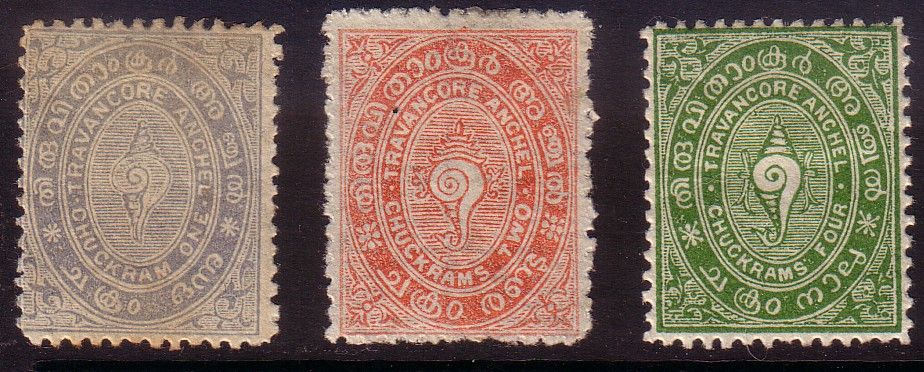 SG 1-3 Somewhat similar essays, with an R and V (initials of the ruler, Maharaja Rama Varma X) on either side of the conch shell design in the centre exist, in different colours. They seem to be quite scarce. This issue was the last before Travancore descended into bedlam. The following year, 1889, Travancore introduced two new values, and started using watermarked paper:  SG 4-5 Printings on this first watermark type continued until 1904, with numerous shades of each value; none of them worth enough to be bothered about. Between 1904 and 1920, Travancore introduced a second type of watermark, and a number of new values as well:  I don't have any quarrel with the design of the 10 Cash; I quite like it. But the 3 Chuckram must be one of the most horrible stamp designs inflicted on a suffering world. In 1906, two surcharges on the ½ Chuckram stamp were produced: ¼ (Chuckram) and 3/8 (Chuckram). These were equivalent to the 4 Cash and 6 Cash definitives, which only appeared in 1908.  SG 21-22 Gibbons lists three shades for these stamps, once again, none of them at all scarce. These surcharges were made on second watermark printings. If you want to endanger your sanity and eyesight by trying to make sense of the Travancore watermarks, it might be worthwhile checking copies of these stamps. You never know: a stray sheet from the earlier printing might have crept into the supplies for surcharging. |
|
Send note to Staff
|
| Edited by tonymacg - 05/10/2010 8:55 pm |
|
|
Replies: 920 / Views: 198,027 |
|
|
To participate in the forum you must log in or register. | |
Disclaimer: While a tremendous amount of effort goes into ensuring the accuracy of the information contained in this site, Stamp Community assumes no liability for errors. Copyright 2005 - 2026 Stamp Community Family - All rights reserved worldwide. Use of any images or content on this website without prior written permission of Stamp Community or the original lender is strictly prohibited.
Privacy Policy / Terms of Use Advertise Here |
| Stamp Community Forum |
© 2007 - 2026 Stamp Community Forums |
| It took 0.25 seconds to lick this stamp. |
 |
|
|
|


 Posted 05/09/2010 05:27 am


