| Author |
 Replies: 19 / Views: 3,656 Replies: 19 / Views: 3,656 |
|
Valued Member
United States
22 Posts |
|
|
|
First time poster...over the years I have amassed a few hundred pence issues. Most recently have been able to differentiate between Scott #1 and #15A due to the size of the design print. Now looking to do an assessment of #3/11A and #5/12A/19 and shades. I understand the mesh/no mesh situation, but is there a way to discern without magnification? I can only enlarge so much with my scanner...
Anyone offer a quick way to differentiate these issues? TIA
|
|
Send note to Staff
|
|
|
|
|
Pillar Of The Community
United States
1434 Posts |
|
|
Honestly, that's really about it I think. The stamps are differentiated by mesh/no mesh, paper thickness, and maybe minor color differences. |
Send note to Staff 
|
|
|
Valued Member
United States
22 Posts |
|
|
So can I find an example of paper with mesh to that without mesh online? I guess I'm not sure what I'm looking for... |
|
Send note to Staff
|
|
|
Pillar Of The Community
United States
1434 Posts |
|
|
Don't know of any pictures, but I did find this description: "This paper (used for Scott #1-9) has a fine cross wire mesh that can best be seen by holding the stamp edgewise towards a strong light." |
|
Send note to Staff
|
| Edited by classic_paper - 05/21/2021 12:18 pm |
|
|
Rest in Peace
7742 Posts |
|
|
Hi Dadof3 This is a 230mb study group on BNAPS that talks about Newfoundland paper differences....BUT, you have to be a member like myself to see the article...See link below..You might want to contact BNAPS at link below to see what they can do for you. Robert https://bnaps.org/ |
|
Send note to Staff
|
|
|
Pillar Of The Community
3860 Posts |
|
|
Pillar Of The Community
New Zealand
731 Posts |
|
|
Hi Dad of 3,
This is a challenging and near impossible thing to do--but a fun one. I only collect Newfoundland so have some humble thoughts to share.
First, there are multiple threads on this community board and so I would recommend searching "Pence" and related topics.
Second, as you find a challenging one--post the image and the community might help.
Third : Resources are key. Pratt is a good reference book but might be more cover focused (its a census). I like also a book by Boggs on the postal history, and he goes into fair detail for each issue. That said : they are old books relatively and have errors due to lots of more recent discoveries. Try also Walsh's NSSC, which is updated as time and facts come to light.
Lastly, there are way to many nuances to post to ascertain the differences between #1 and #15. I'll try.
The #1 stamp is from the 1857 FIRST PENCE issue. These are all ENGRAVED. NO WATERMARK. IMPERFORATE. The paper is described as white, soft, thick (though hard to tell really). It shows CROSS-WIRE MESH on the back.
Dimension is 22 x 22.5 mm. The color is listed as BROWNISH CLARET (per Walsh) but truthfully, it is difficult to tell since everyone's eye is different and well Father Time on a small piece of paper from 150+ years ago.
The other stamp (Unitrade #15, Walsh #16) is from the 1861 THIRD PENCE issue. ENGRAVED. IMPERFORATE. Mostly no watermark but occasionally these issue (1 pence to 8 pence and 1 shilling) have a STACEY WISE 1858 watermark.
The paper is listed as dull white, dense and has a crisp snap with NO MESH. Walsh also guides us that the paper has varying thickness. The color is listed as VIOLET BROWN and CHOCOLATE BROWN ad RED BROWN (but again hard to discern). Dimensions are 21.75 x 21.75mm.
So if you want to short cut--just focus on the MESH or the snap of the paper in your hands. Having multiple copies helps relatively compare the paper snap. Or use the dimensions (but so tiny). If you are lucky, there might be a watermark.
I'm assuming the other ones you mention are the 4 pence stamps. They are easier to tell a part and more color driven. But would have similar characteristics as listed above. The first one is from the FIRST PENCE issue, the other ones are SECOND PENCE and THIRD PENCE issues (similar). Colors are #5 SCARLET VERMILLION (doubt you have this one since they cost $3000+); next one ORANGE (uncommon); last one ROSE LAKE (most common one)
Good luck |
|
Send note to Staff
|
|
|
Valued Member
United States
22 Posts |
|
|
Thanks all. Tommy - would love to compare notes! I've been Newfoundland only as well...currently looking for used blocks... |
|
Send note to Staff
|
|
|
Pillar Of The Community
New Zealand
731 Posts |
|
|
Dadof3. Welcome again. please feel free to email me if you like about any questions. I don't have any used blocks otherwise I would be happy to sell them to you below market. I have tons of used singles though. Mostly I just collect covers now, and have a website dedicated to sharing scans (to all others, send me your scans and I will watermark them with your name and share on http://newfoundlandcovers.orgAlso--Dadof3 : please scan and post new topics on singular topics--its fun, we all love it and you can tap many viewpoints. I also re-freshed and old topic which has a link to my album that some other nice person has posted on the web as well, but I scanned all may pages on this community years ago. Its a near complete Mint collection. Sorry to overshare |
|
Send note to Staff
|
|
|
Valued Member
United States
22 Posts |
|
|
Tommy - since I'm a new user, I can't access the "email member" feature yet. Could you email me? |
|
Send note to Staff
|
|
|
Valued Member
Canada
265 Posts |
|
|
Tommy, Wouldnt the 5p #19 be smaller than the #12A stamp 12A dry printing 19 wet printing - paper shrinks making the stamp image smaller BUT when I measure the 12A stamp it get 21.75x21.75 the #19 stamp measures 22.25x22.25 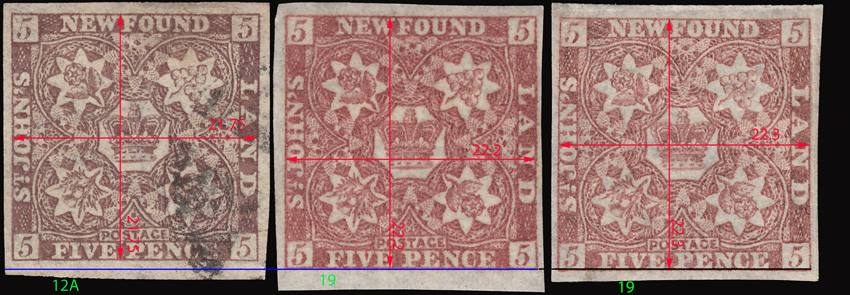 Trodent |
|
Send note to Staff
|
|
|
Pillar Of The Community
United States
3224 Posts |
|
|
For mesh/no mesh, just hold stamps to a desk lamp/light. Compare your #1s and #15As to see the difference. |
|
Send note to Staff
|
|
|
Valued Member
Canada
265 Posts |
|
|
Thanks hy-brasil
But Iam trying to differentiate between the 2nd and 3rd printings
Trodent |
|
Send note to Staff
|
|
|
Valued Member
Canada
265 Posts |
|
|
Curious. Unitrade catalog states that NFLD 12A was printed using the dry method.
Was that even and option back in 1860?
Trodent
|
|
Send note to Staff
|
|
|
Pillar Of The Community
United States
3224 Posts |
|
|
Hi, Trodent, my comment was directed to the OP, never really fully answered.
Trodent, why wouldn't the dry printing method be used in 1860? Sizing is put in wood pulp papers to prevent paper distortion during printing. It's not a new invention at all with different materials used since the beginnings of wood pulp papermaking. |
|
Send note to Staff
|
|
|
Pillar Of The Community
3860 Posts |
|
|
Replies: 19 / Views: 3,656 |
|



 Posted 05/21/2021 11:19 am


