| Author |
 Replies: 11 / Views: 1,128 Replies: 11 / Views: 1,128 |
|
|
Pillar Of The Community
721 Posts |
|
|
I really thought I was going to slog my way through all of the Portugal and colonies variations of the Ceres stamps without help - but here I am!  I've searched here, stamp world and both new and ancient Scott catalogs all with no success. I've go to be missing something simple but do not know what it is. This is perf 15X14 has the imprint and my silver coin says it is not chalky paper. Time for the experts!! Thanks for helping Paul 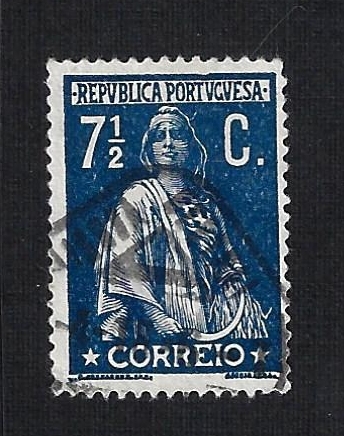 |
|
Send note to Staff
|
|
|
|
|
Bedrock Of The Community
12719 Posts |
|
|
Pillar Of The Community
Netherlands
6639 Posts |
|
|
It looks like Michel and Yvert have two 1917 stamps: 12 x 11.5 Scott 271, and 15x14. |
Send note to Staff 
|
|
|
Bedrock Of The Community
12719 Posts |
|
|
Pillar Of The Community
721 Posts |
|
|
Scott 271 is 12X11 1/2 this is 15X14. So not Scott listed and it is in Michel? |
|
Send note to Staff
|
|
|
Pillar Of The Community
Netherlands
6639 Posts |
|
|
Pillar Of The Community
721 Posts |
|
|
Pillar Of The Community
United States
1497 Posts |
|
|
2015 Scott Classic Specialized Catalogue
Portugal
7 1/2c Ceres, with imprint, deep blue, perf. 15x14, ordinary paper = Scott 242.
Not listed in the standard Scott catalog.
Robert |
|
Send note to Staff
|
| Edited by Trainwreck - 10/31/2021 5:29 pm |
|
|
Bedrock Of The Community
12719 Posts |
|
|
Pillar Of The Community
United States
2830 Posts |
|
|
I wouldn't use a silver coin to test for chalky paper. It's possible to train oneself on the appearance of the paper for chalky vs. ordinary. There tends to be a difference in the color saturation of chalky vs. ordinary paper however I am not expert enough to suggest which way is which. Short of that, a thin silver wire can be sourced from a jeweler, which is safer than a silver coin (no reeding) and which will leave a much smaller mark on the stamps. The wire should be dragged with no downward force to minimize impact to the stamp.
A few thoughts. First, chalky paper varies quite a bit. Some such paper is "chalkier" than other examples. SO some chalky papers react very strongly to the silver test, while others react very little. Second, as I understand things some of the chalk is washed away when a used stamp is soaked away from it's cover. I've also read that for some chalky papers, ALL of the chalk is removed by soaking. I have not tried to test this as I don't collect used stamps. So there are various factors that affect how a chalky stamp will respond to the silver test, and a few different ways to diagnose chalky vs. ordinary papers. |
|
Send note to Staff
|
|
|
Pillar Of The Community
United States
1026 Posts |
|
|
Afinsa 2011 says:
1917 7.5c blue shades, perf 15x14 on pontinhado (lozenge mesh) paper.
1918 7.5c blue shades, perf 15x14 on normal medium to thick paper.
1920 7.5c blue shades, perf 12x11½ on normal thin to thick paper.
1920 7.5c blue shades, perf 15x14 on satin paper thin to thick.
1920 7.5c blue shades, perf 12x11½ on satin paper thin to thick.
I don't find any other blues in that denomination. When I was working on Portugal I had the hardest time getting a translation for pontinhado. :) Note that some 'normal' paper has weak instances of the lozenges, that is from local sources, the true lozenge mesh has strong impressions and the papers were made elsewhere in Europe. They are pretty easy to tell once you have seen a few. Values in this old catalog are fairly minimal for all examples except the 15x14 satin where the used value is still under 2 euros.
I just realized I haven't finished my web pages for Portugal, though there is enough up there to see most of these examples. |
|
Send note to Staff
|
|
|
Pillar Of The Community
721 Posts |
|
| |
Replies: 11 / Views: 1,128 |
|




 Posted 10/31/2021 3:12 pm


