| Author |
 Replies: 47 / Views: 3,477 Replies: 47 / Views: 3,477 |
|
Valued Member
United States
77 Posts |
|
|
|
Hi all – What factors determine the denominations that the USPS issues? Why are there so many stamps in denominations that don't match any rates in the year the stamp was issued? Conversely, why don't they issue stamps in denominations matching the auxiliary rates?
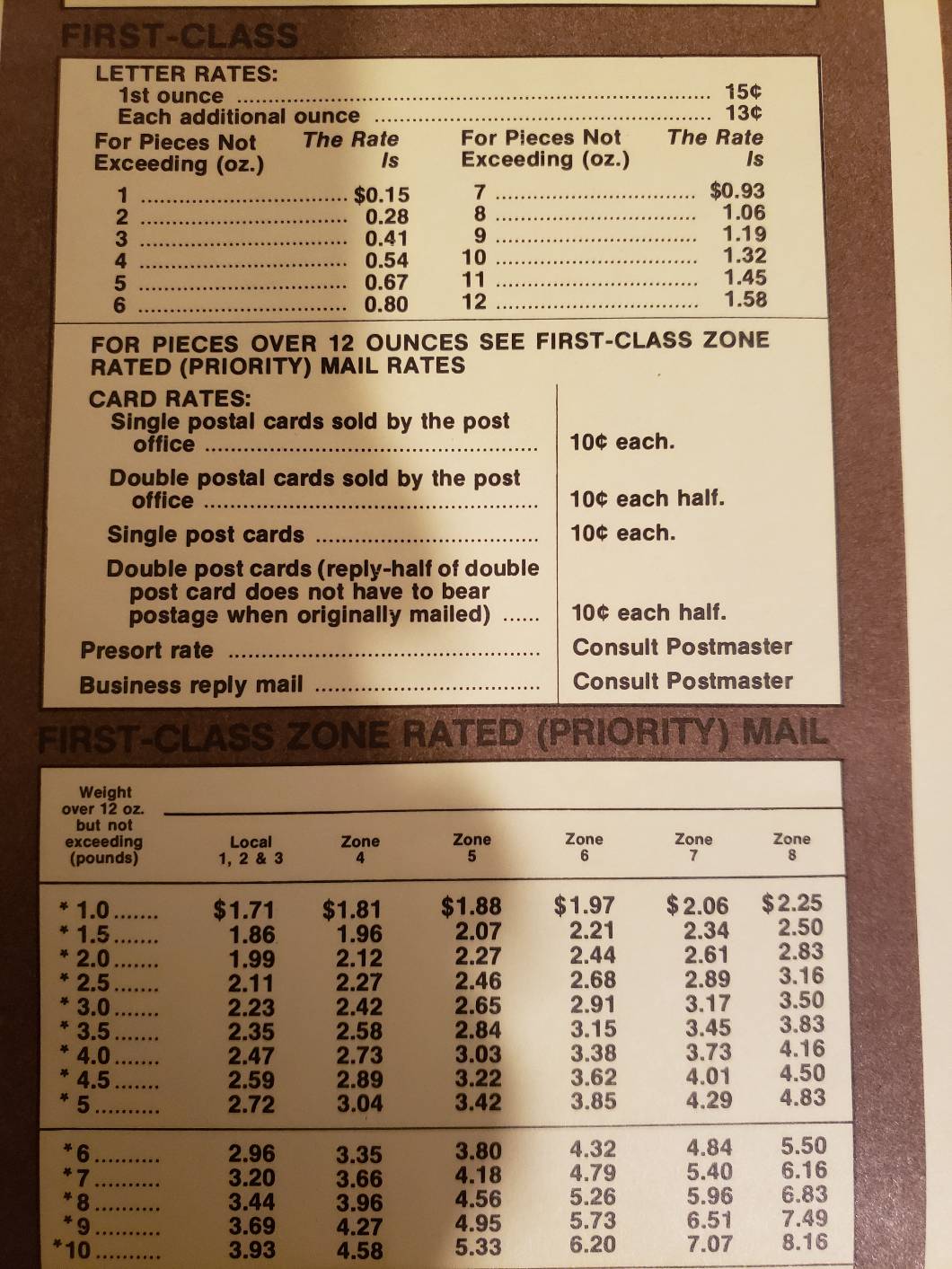
A good example is the 1980s. From 1981 to 1988, the First Class rate was 20, then 22, cents. The **Additional Ounce** rate held steady at 17 cents during that span. There was also a **Non-standard Surcharge** of 9, then 10, cents for thick or large envelopes that weighed one ounce or less.
So the relevant rates were: 9, 10, 17, 20, and 22 cents. Postcard rates were 13 and 14 cents.
But I'm seeing stamps of 3, 4, 25, 50, and 56 cents, and $1.00 and $2.00.
I see one 39 cent stamp, which makes sense for two ounces: 22 + 17 cents. But I haven't found a 37 cent stamp for the years where the base rate was 20 cents. I don't see any 9 or 10 cent stamps for the surcharge.
And I can't figure out what people would do with 25, 50, or 56 cent stamps during those years. (The First Class rate didn't reach 25 cents until 1988, but a Jack London 25 cent stamp was issued in 1986...)
Or one or two dollar stamps. Those wouldn't match Priority Mail rates – too low. And there's no combo of additional ounces that lands you at 50 or 56 cents. Why did they issue these denominations?
Thanks.
|
|
Send note to Staff
|
|
|
|
|
Pillar Of The Community
6361 Posts |
|
|
It is fairly common throughout the 20th century to have each increment of 1 cent through 10 cents available for all sorts of uses.
0.25, 0.50, $1, $2, $5 are convenient for all sorts of higher rates/fees.
The unusual denominations above the first class rate will have a direct rate application:
56 (John Harvard) = 22 + 17 + 17. |
Send note to Staff 
|
|
|
Pillar Of The Community
United States
640 Posts |
|
|
Letterpress
They were used on flats and small packages that were sent First Class mail at mainly small town post offices. Mail was fast back then within states, so why pay more for Priority Mail when sending First Class would arrive just as fast. Larger town post offices used more meter stickers, but stamps were their backup if the meter machine broke. Those denominations were used on daily postage due sheets that large firms received along with their daily mail. Postage due stamps were not always used in the 80s and 90s. Computer printouts, decks of 80-column cards, bundles of cancelled checks, and all kinds of papers were printed and mailed back then.
Some clerks would weigh it, write the postage amount in the corner, and then put stamps on it adding up to that amount.
Linus |
|
Send note to Staff
|
|
|
Valued Member
United States
77 Posts |
|
|
John Becker, good catch on the 56 cents. I don't see how $1 and $2 would help in that decade, though, given the rates. This was before there were separate, higher rates for packages and flats – First Class was First Class, same rates for all. |
|
Send note to Staff
|
|
|
Valued Member
United States
77 Posts |
|
|
Linus, flats didn't exist as a rate class yet. That didn't happen until around 2006-2007 (here's the USPS rate history spreadsheet: http://www.prc.gov/docs/63/63552/Ra...st0709.xls).Back then First Class was First Class – it didn't matter if it was a normal letter mail envelope, a "flat"/large envelope, or a package. It was the same rate for the first ounce for all of them, and the same rate for additional ounces. These days First Class flats and packages have separate, and much higher, rates than normal letter mail. Back then the only difference was that Non-standard Surcharge for flats and packages that weighed one ounce or less, which was probably rare – they almost always weigh more. So typical flats and packages would not be hit with the surcharge. FYI, the history of that surcharge before flats got their own rates is the source of the widespread overcharging for flats and padded envelopes as "packages". The myth that a bubble mailer is a package by definition comes from that time when flats and packages were treated the same with that 9 - 10 cent surcharge (if they were under an ounce). The rules for the new flat/large envelope rates easily accommodate padded mailers, but it seems to take decades for the USPS to update employee beliefs. |
|
Send note to Staff
|
|
|
Pillar Of The Community
United States
640 Posts |
|
|
Letterpress
Yes, the term "flat" is a more modern term, but there were still lots of large envelopes mailed with computer printouts, etc. during that time. In your head you are thinking of ounces for these large envelopes when you should be thinking of pounds. The $1 and $2 stamps were used a lot to move the weight of these large envelopes, as well as cardboard boxes. I was there, I saw it, I saved the stamps off of them.
Linus
|
|
Send note to Staff
|
| Edited by Linus - 11/05/2021 09:07 am |
|
|
Pillar Of The Community
6361 Posts |
|
|
Letterpress, Rest assured the USPS does not (generally) issue stamps without a purpose. re-read my post above. You may be overthinking all this - especially about the non-standard surcharge, which is an extremely small amount of the mail stream. Looking at first class letter mail, in this era (1980s-2000s) the USPS was generally doing stamps for the first, second and third ounce rates. Rates beyond 3 ounces took multiple stamps, which is one of the more common uses of the $1 and $2 stamps. Solo $1 and $2 rates just don't really exist in this era with the crazy odd-cent letter rates. The Scott catalog is a bit misleading/confusing by the grouping of both the Transportation coils and the Great Americans series. If one groups these sets by issue date and examines them in groups according to the rate periods, they make more sense. I would strongly recommend obtaining a copy of the Beecher/Wawrukiewicz "U.S. Domestic Postal Rates" book, if you do not have it already. It will pay for itself rapidly. "Flat" has been a mail term for a long time. Here it is defined in the "Glossary of Postal Terms", publication 32, January 1981 edition: 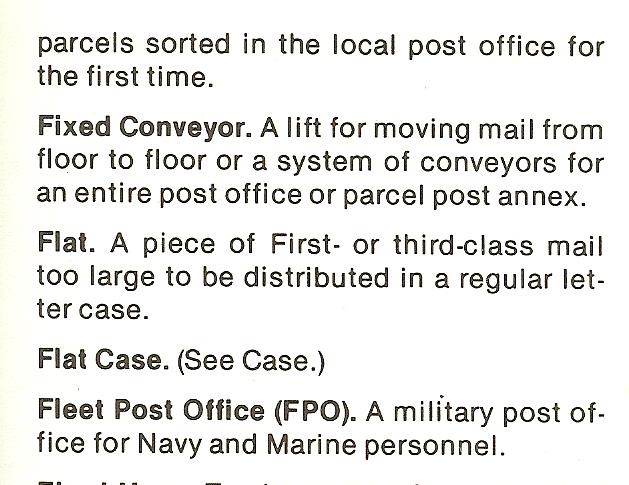 |
|
Send note to Staff
|
| Edited by John Becker - 11/05/2021 10:59 am |
|
|
Pillar Of The Community
6361 Posts |
|
|
Consider these examples of the utility of higher denomination stamps for heavy flats: During the 29 cent rate period (Feb 3, 1991-Dec 31, 1994), with 23 cent for each additional ounce: June 2, 1993, up to 7 ounces = 1.67, elegantly paid with the minimum number of current definitives. March 6, 1994, up to 8 ounces = 1.90, again the utility of basic higher denominations. 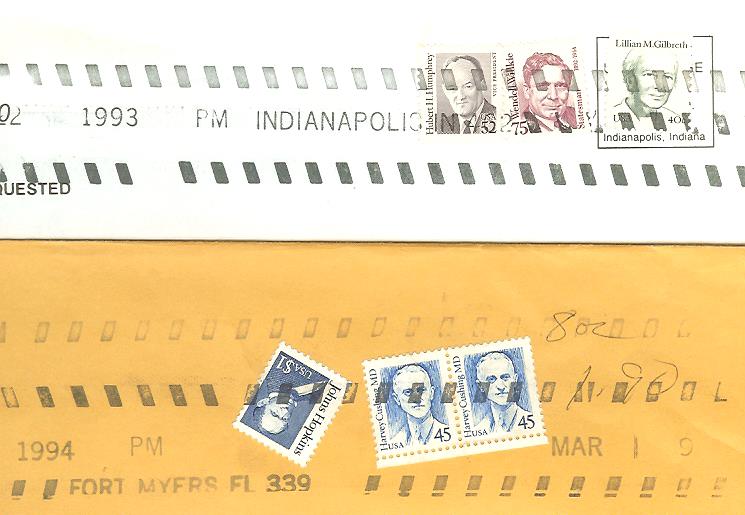 And during the 32 cent rate period (Jan 1, 1995-Jan 9, 1999), with 23 cents for each additional ounce: March 6, 1995, up to 8 ounces = 1.93, a bit messy. 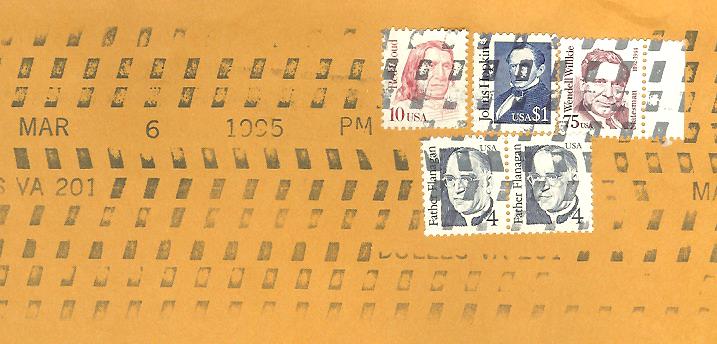 And lastly, here is a solo 56 cent John Harvard on a 3 ounce flat dated Feb 6, 1987 rated at 56 = 22+17+17, used during the 22 cent rate period (Feb 17, 1985-Apr 2, 1988). 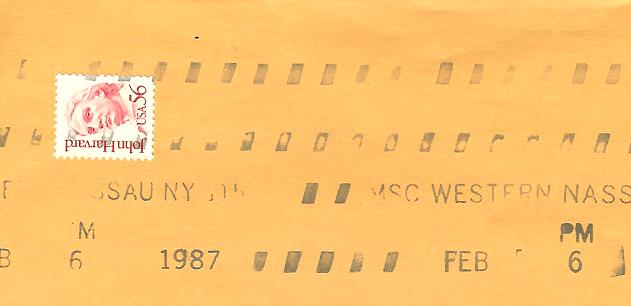 (All images here cropped from full-sized envelopes.) |
|
Send note to Staff
|
|
|
Pillar Of The Community
United States
4445 Posts |
|
|
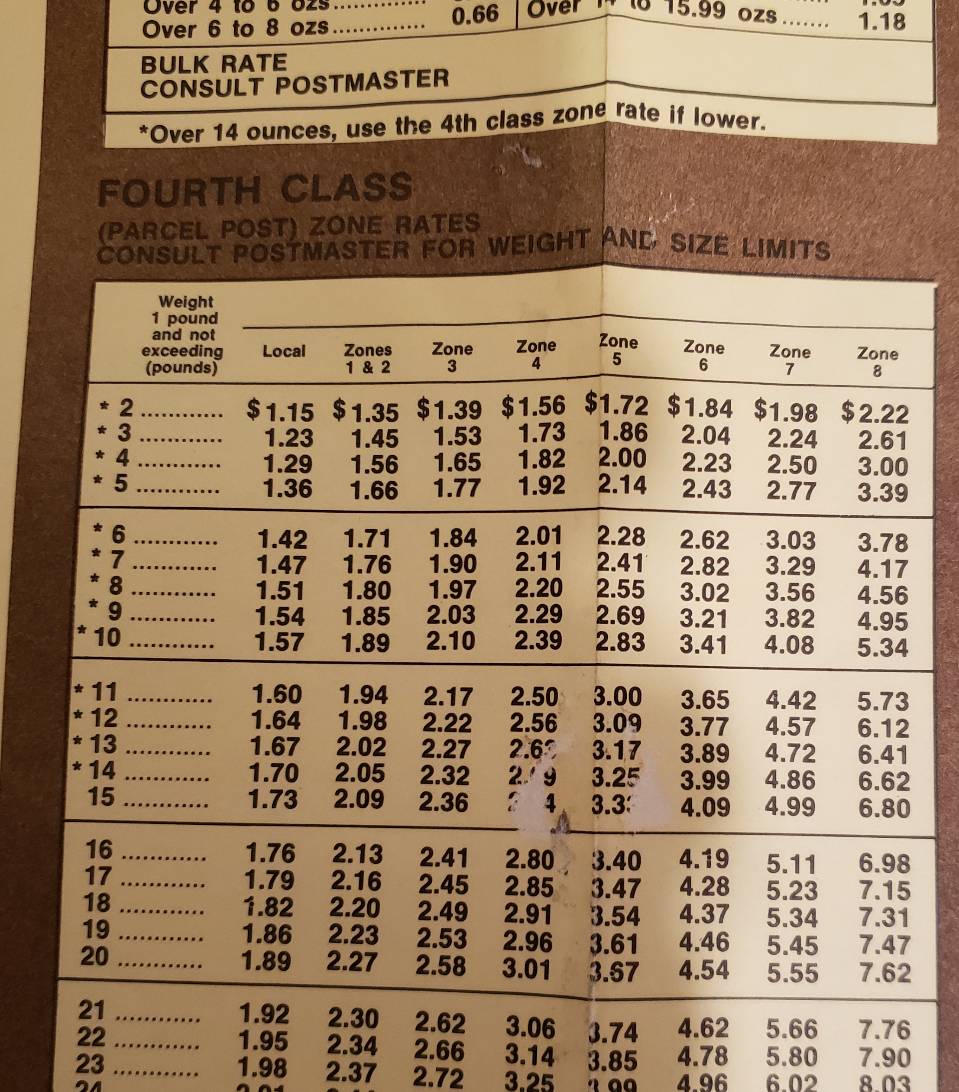
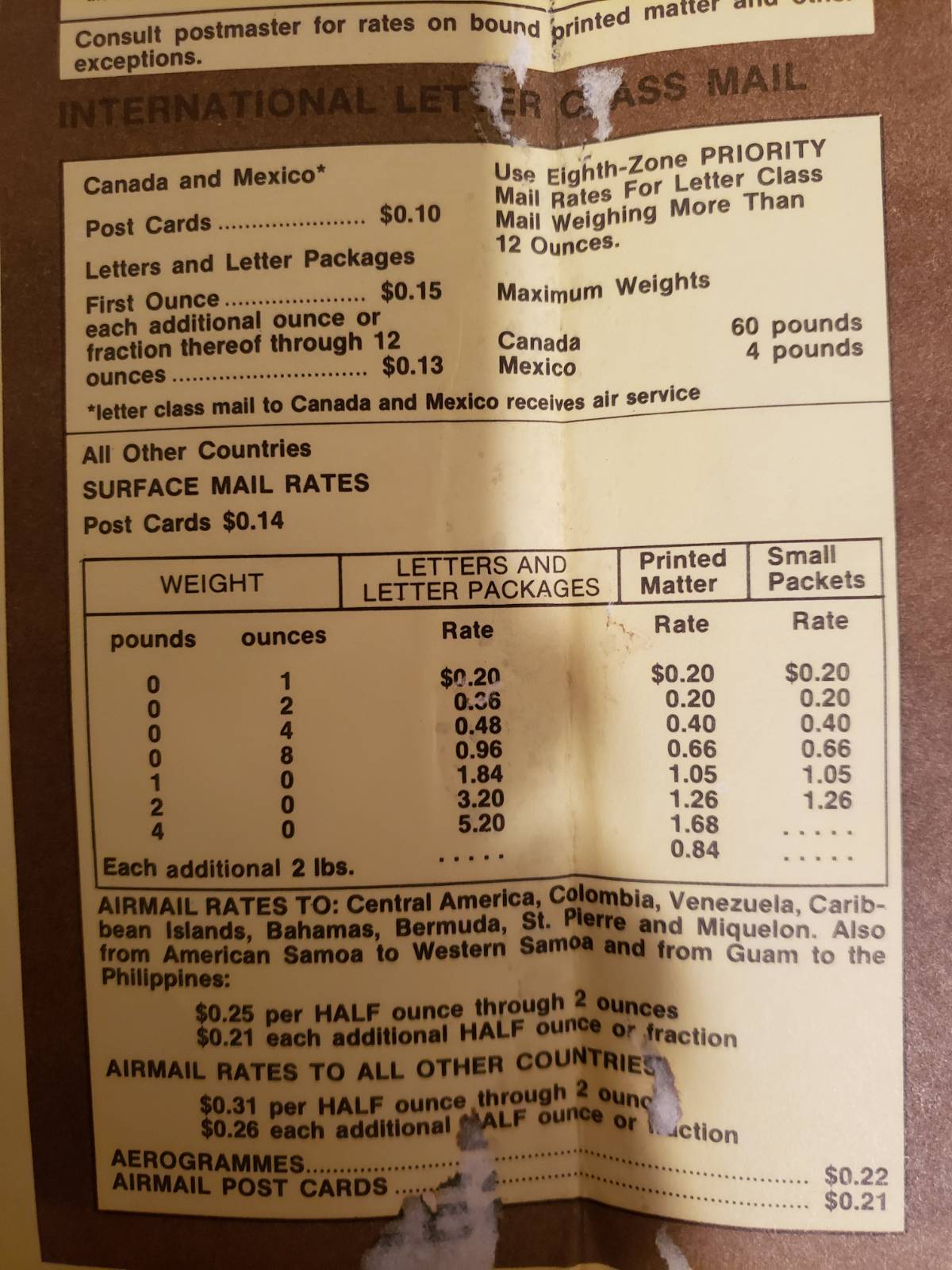
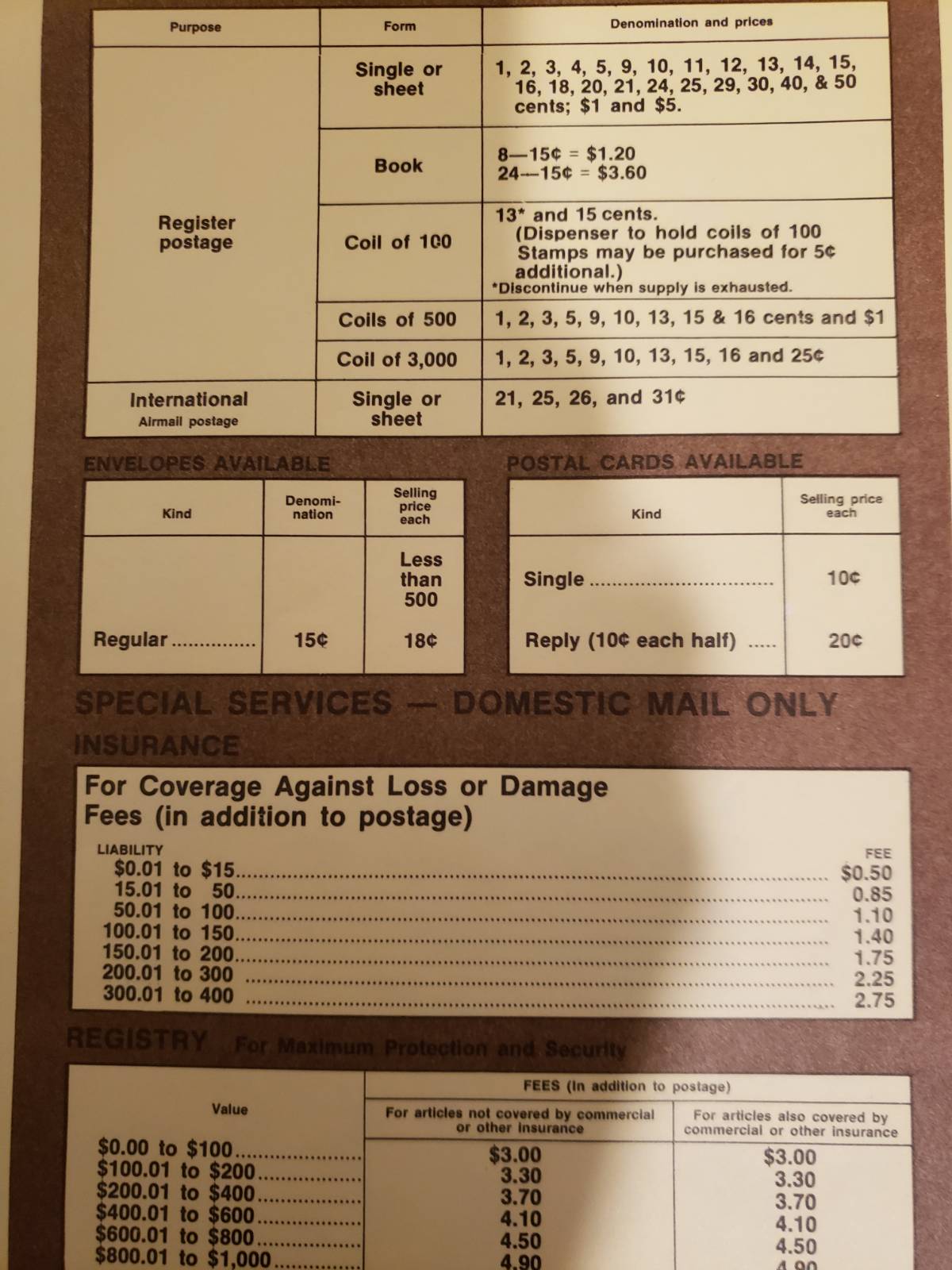
What is missing from this discussion is other than plain first class, for example and not to be fully inclusive, certified, registered, return receipts, restricted delivery requirements, merchandise return, C.O.D., third class matter, library and media rates, special handling, special delivery (into 1997), parcel post AKA 4th class (regular and special with various names), airmail including international airmail, international package services, M-mail, domestic and international express mail, certificates of mailing, bulk postage due on BRM, all of which added to the cost of first class matter or required higher postage rates than first class matter. All required payment affixed, meters or stamps. Permit mail being the exception.
|
|
Send note to Staff
|
|
|
Pillar Of The Community
6361 Posts |
|
|
And the USPS won't issue stamps for every every possible rate/fee combination from the above list. Hit the high points with a modest number of solo-rate stamps and the rest are made up with combinations. Just like coins and currency - they are produced in logical increments and we get change back at the grocery, etc. |
|
Send note to Staff
|
|
|
Pillar Of The Community
United States
4445 Posts |
|
|
Quote:
Or one or two dollar stamps. Those wouldn't match Priority Mail rates – too low. And there's no combo of additional ounces that lands you at 50 or 56 cents. Why did they issue these denominations? Here below both $1 and $2 are appropriate: 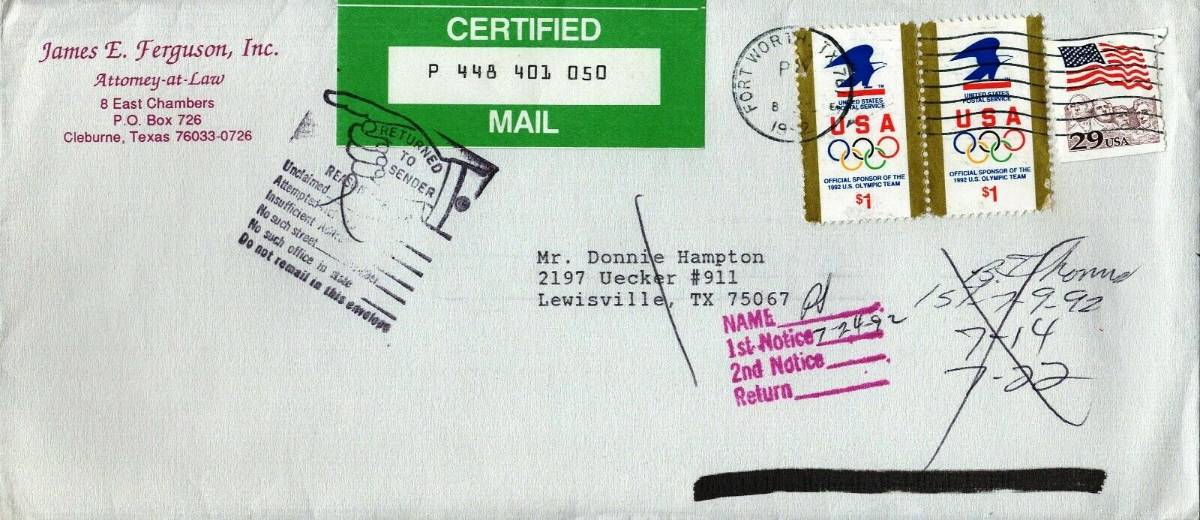 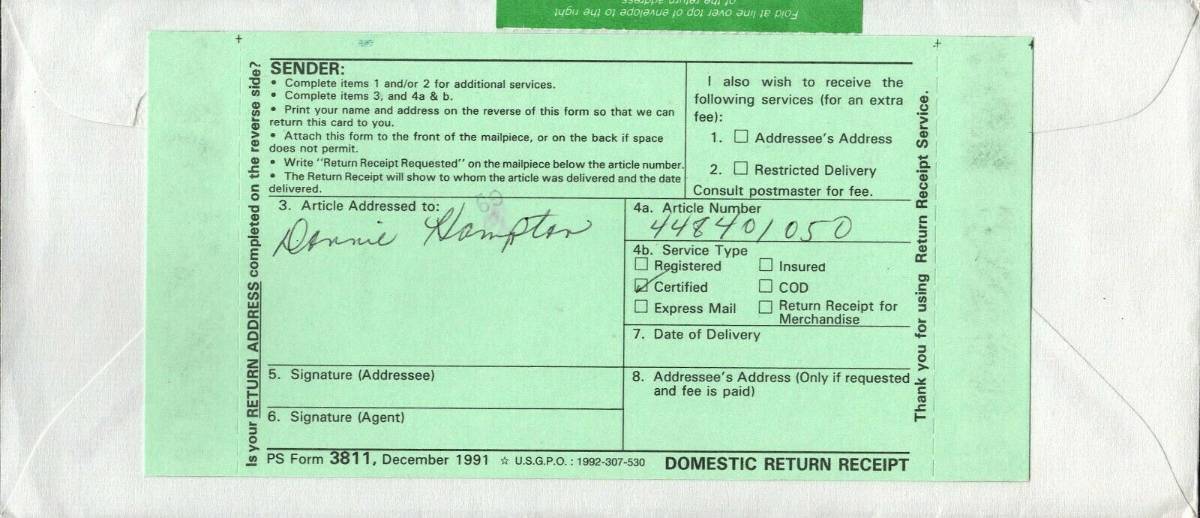 |
|
Send note to Staff
|
|
|
Pillar Of The Community
6361 Posts |
|
|
Certified 1988 0.25 first class letter 0.85 certification fee 0.90 return receipt fee 2.00 total - a coincidence matching a stamp's denomination. 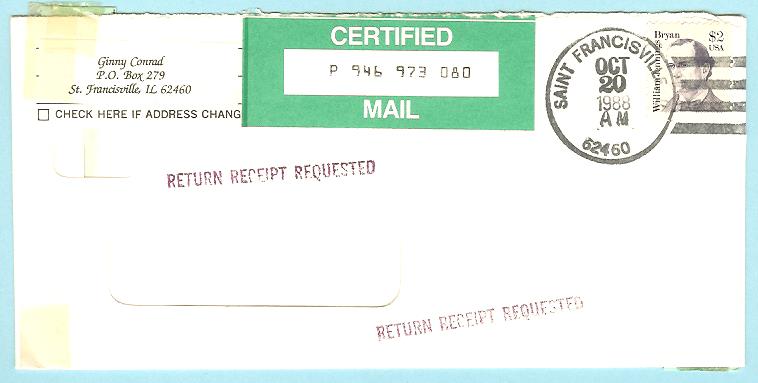 Certified 1996 0.32 first class letter 1.10 certification fee 1.42 total, typical use of $1 stamp with other lesser stamps. 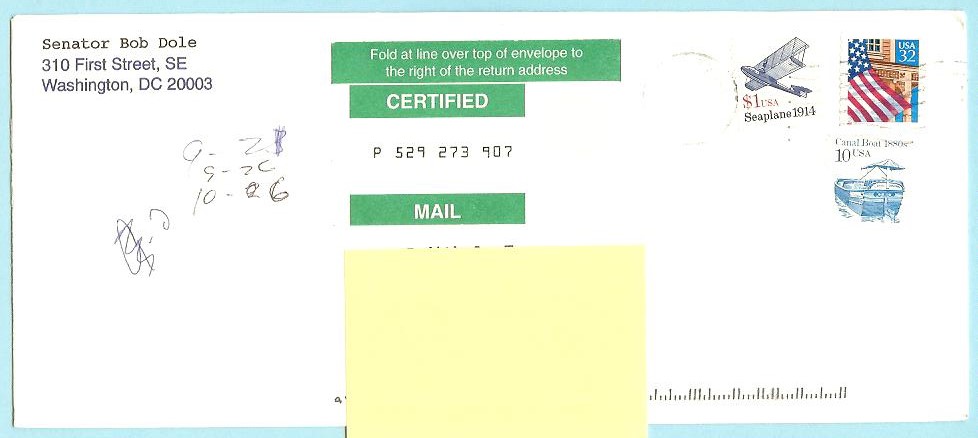 Special delivery 1988 0.22 first class letter 2.95 special delivery fee 3.17 total 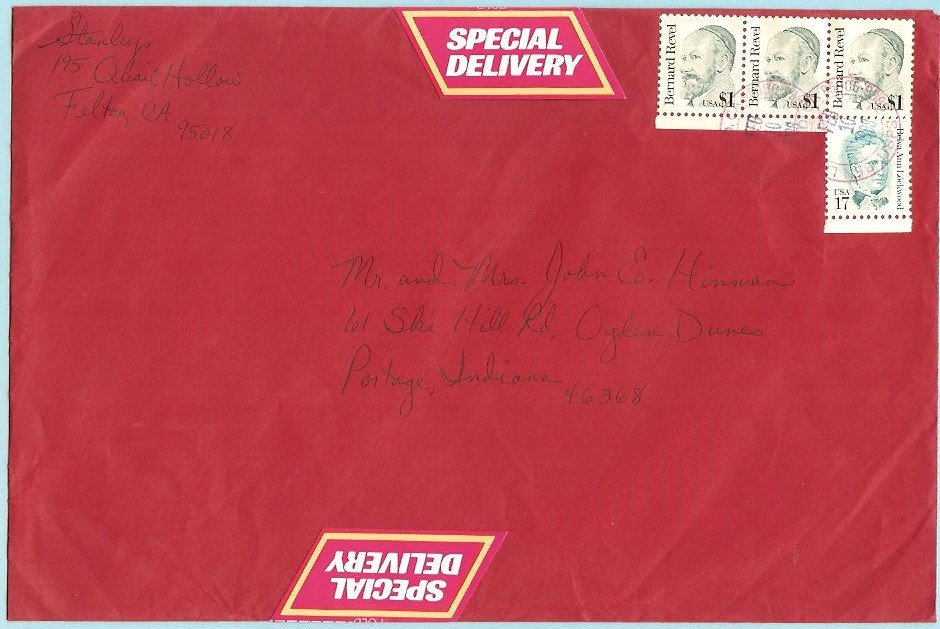 All typical uses of the era. |
|
Send note to Staff
|
| Edited by John Becker - 11/05/2021 1:50 pm |
|
|
Valued Member
276 Posts |
|
|
Re the flat surcharge during the early 1980s, the 9c and 10c Americana definitives were still available. Heck, the series was still expanding in 1981 with the 12c issue, #1594. |
|
Send note to Staff
|
|
|
Valued Member
United States
268 Posts |
|
|
Valued Member
276 Posts |
|
|
Nice chart, Gibby. 1980 was the year there were bits of four definitive series active at once with coils from Liberty and Prominent Americans, several Americana, and the Great Americans' 19c Sequoyah. By focusing on ideals rather than individuals, the Americana series was different enough that I wish there had been more whole number issues within it. |
|
Send note to Staff
|
|
|
Pillar Of The Community
6361 Posts |
|
|
The USPS has had some hiccups with rate changes. In early 1978, anticipating a rate increase, the USPS issued a 16 cent stamp (Scott 1599 & 1619 on March 31, 1978) and a 29 cent stamp (Scott 1605 on April 14, 1978) for the upcoming new 1- and 2-ounce rates. To make a long story short. Plans changed. The "A" stamps were quickly released on May 22, 1978, in sheet, coil, booklet, and stamped envelope versions; with the "U.S. domestic rate" John Hancock postal card issued a few days earlier. Effective May 29, 1978, the USPS got the 13 cent extra ounce rate they expected, but only 15 for the first ounce. Saved by the "A" stamp, they quickly issued a 15 cent stamp (Scott 1598 & 1618C issued June 30, 1978) and a 28 cent stamp (Scott 1604 on August 11, 1978). Finding the 16 and 29 cent stamps used near their issue date is challenging since they overpaid their original intention - and they remained on sale for a long time afterwards. 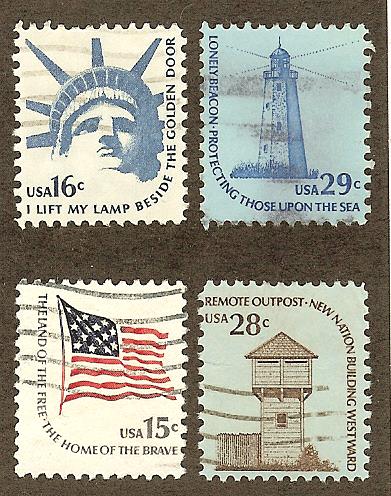 |
|
Send note to Staff
|
|
|
Replies: 47 / Views: 3,477 |
|




 Posted 11/04/2021 11:26 pm