Stamp Community Family of Web Sites
Thousands of stamps, consistently graded, competitively priced and hundreds of in-depth blog posts to read


Stamp Community Forum
 
Username:
Password:
Save Password
Forgot your Password?

This page may contain links that result in small commissions to keep this free site up and running.

Welcome Guest! Registering and/or logging in will remove the anchor (bottom) ads. It's Free!

Why Don't Denominations Match Postage Rates Or Useful Combinations?

Previous Page | Next Page    
 
To participate in the forum you must log in or register.
Author Previous TopicReplies: 47 / Views: 3,316Next Topic
Page: of 4
Pillar Of The Community
United States
4276 Posts
Posted 11/06/2021   8:03 pm  Show Profile Bookmark this reply Add Parcelpostguy to your friends list  Get a Link to this Reply
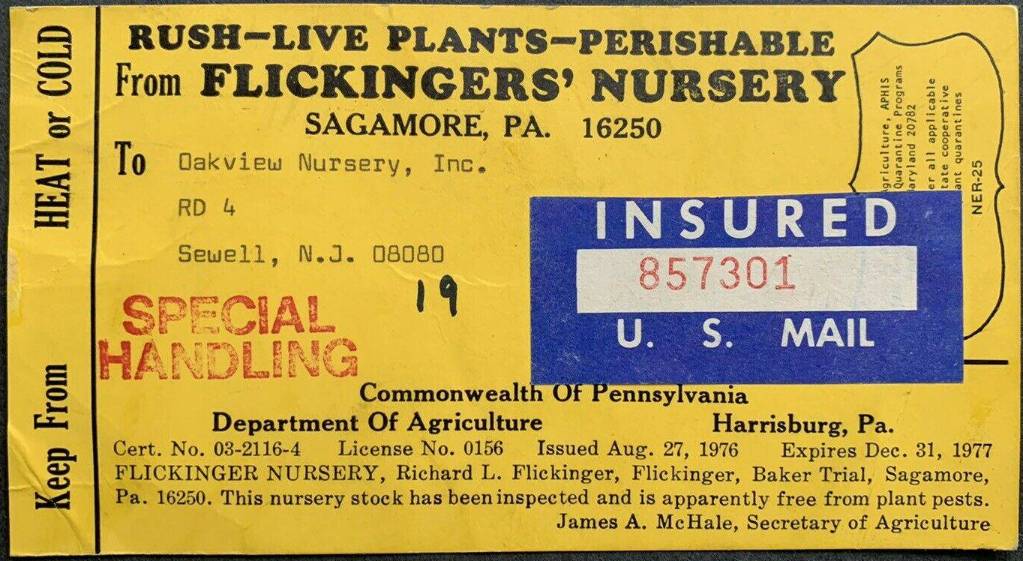
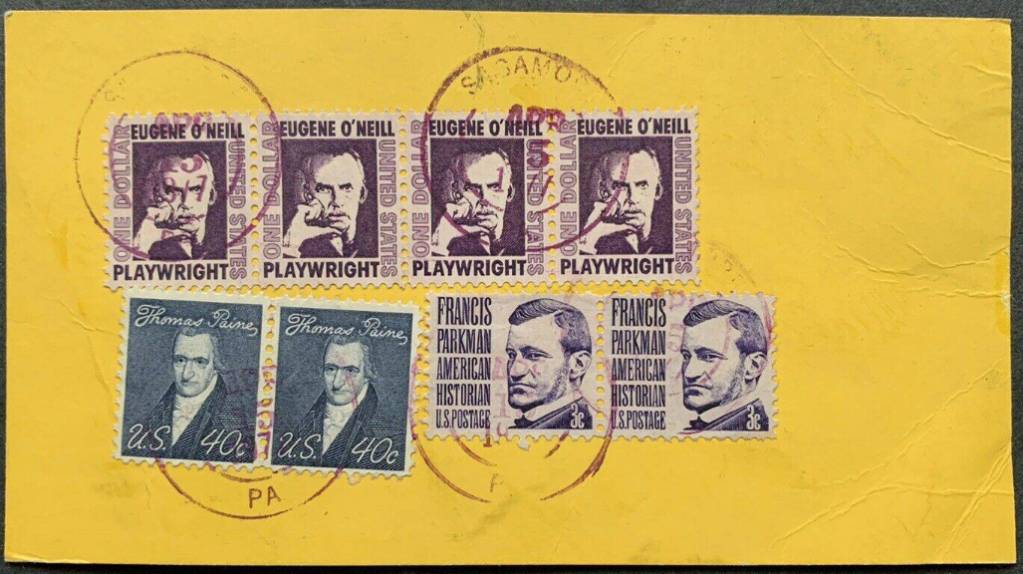
I didn't want post this with the certified cover until I owned it which only occurred an hour or so ago. Since some items posted after my certified cover included rating, I will do so here:

The $4.86 covers only three possible exact ratings:

It is a Zone 3 Parcel Post Item containing Planting Matter

Special Handling fee was $1.00 for an item over 10 pounds. That leaves $3.86.

1) $1.20 Insurance fee for $150-$200 value and $2.66 for 25lbs to Zone 3.

2) $0.80 Insurance fee for $50-$100 value and $3.06 for 30lbs to Zone 3.

3) $0.40 Insurance fee for $15 or less value and $3.46 for 35lbs to Zone 3.


Send note to Staff  Go to Top of Page
Valued Member
United States
77 Posts
Posted 11/07/2021   6:57 pm  Show Profile Bookmark this reply Add Letterpress to your friends list  Get a Link to this Reply
Linus and John Becker: Regarding flats, I was only referring to the separate rate class for them, which was introduced around 2006 or 2007. I wasn't arguing anything about the use of the term flat or the existence of large envelopes/flats before that. I assume flats have existed forever, and I think the USPS's first dedicated flats sorting machine was rolled out in the 1980s.

On the term itself, I think it's fairly bad choice at this point because of the collision with "flat rate", which is a pervasive concept at the USPS and all other carriers. Searching for "flat rates", as in the rates for flats, is likely a doomed effort or needlessly messy. It's also not a physically distinctive characteristic of large envelopes, and they should probably take the opportunity to roll out a clean, systematic terminology and rate structure. They have terrible naming right now, like Priority Mail Express in addition to Priority Mail – way too long and ponderous compared to the classic Express Mail, and too much overlap with Priority Mail.
Send note to Staff  Go to Top of Page
Valued Member
United States
77 Posts
Posted 11/07/2021   7:03 pm  Show Profile Bookmark this reply Add Letterpress to your friends list  Get a Link to this Reply
John Becker, where did you get those amazing photos of mailpieces? Those are fantastic.

By the way, do you know when the USPS starting printing postage on mailpieces at the counter? I assume it depended on computerization, but I'm not sure. For irregular postage amounts, they weigh, print, and affix, and I'm curious when that started.

And how did they handle Priority Mail before they issued Priority Mail stamps? The first PM stamp I know of was the 1989 Moon Landing anniversary one, the $2.40. But PM existed for over a decade before then.
Send note to Staff  Go to Top of Page
Pillar Of The Community
6326 Posts
Posted 11/07/2021   8:24 pm  Show Profile Bookmark this reply Add John Becker to your friends list  Get a Link to this Reply
Lots of questions to answer!

The images I have posted are all scanned from my collection.

In 1996 I wrote a 40 page monograph for the Machine Cancel Society "An Introduction to Flats Machine Cancels", or some such title, which cataloged what we knew then. The summary being that there were some individual experimental attempts to make canceling machines to handle flats beginning in the late 1950s and 1960s, but nothing was really successful until the early 1970s. This is of course different from a flats *sorting* machine, which came somewhat later.

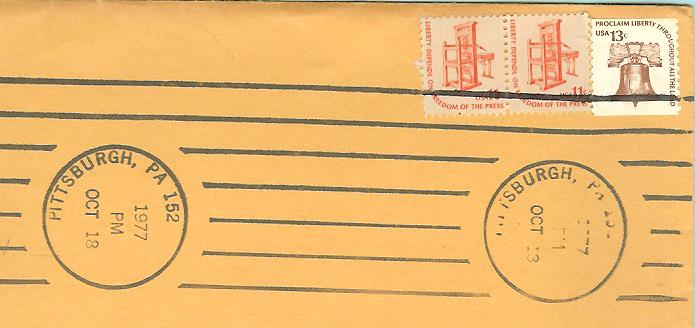
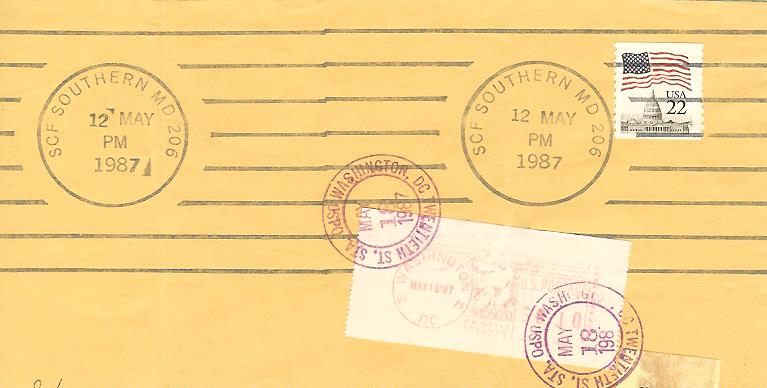
A few more examples:
3 ounce use from 1977, a fairly early flats canceling machine, neatly showing the 13/11/11 discount for the additional two ounces.


1 ounce flat dated May 12, 1987, with 0.10 USPS meter tape dated May 18, 1987, collecting the surcharge as postage due.


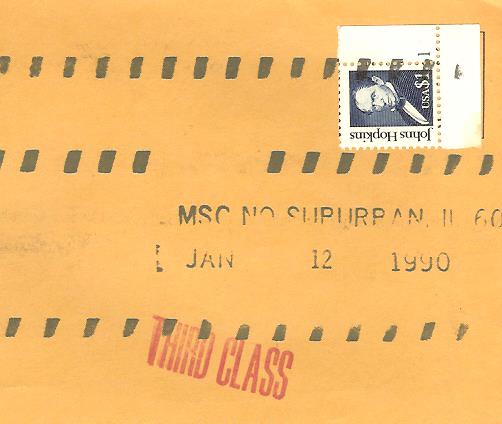
Jan 12, 1990, single piece 3rd class, 4<x<6 ounces, rate of $1 paid exactly with a solo use.


Personally, to avoid confusion with the "flat" vs "flat rate" terminology, I stick to the Beecher & Wawrukiewicz books and don't even try the internet. The B&W book neatly explains the history of both Priority Mail and Express Mail from the experimental stages forward as well as the rates for multi-ounce mailings typical of flats. As you noted, it goes back quite a ways.

The $2.40 stamp: Prior to the issuance of the $2.40 stamp (Scott 2419 on July 20, 1989), patrons had their Priority Mail franked with meters or a combination of stamps. The same is true of Express Mail before Scott 1909 in 1983. Keep in mind that these stamps are valid for ALL postage and fee purposes and are NOT restricted to Priority or Express Mail, they just have the denominations for convenient solo use. Also note they are given regular Scott numbers rather than some alphabetic prefix, like airmail or special delivery stamps. So the 2.40 stamp is technically NOT a "Priority Mail stamp", etc.

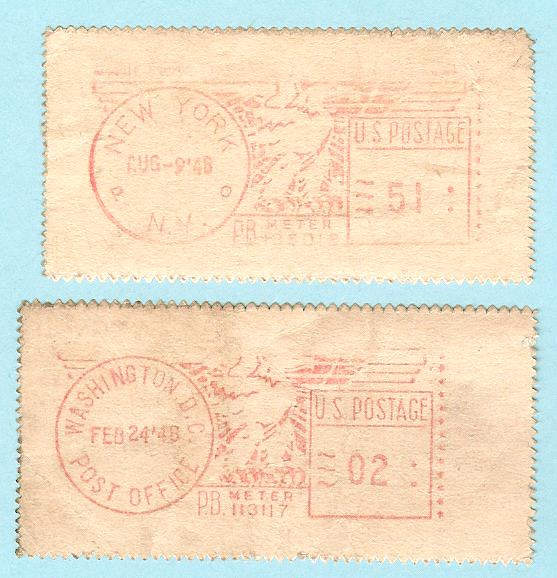
Meters have been in post offices for decades before computerization. The post office origin is typically recognized by some notation in the dial. Especially today, they make daily accounting so much easier. Here are two from the 1940s:
Send note to Staff  Go to Top of Page
Valued Member
United States
77 Posts
Posted 11/07/2021   10:38 pm  Show Profile Bookmark this reply Add Letterpress to your friends list  Get a Link to this Reply
Thanks Becker. I didn't know that people collected the whole mailpiece. That's very interesting. What is it called? Is it a subcategory of philately?

I'm very interested in the design history of the Express Mail and Priority Mail envelopes, typically flat rate envelopes, as well as private sector counterparts like FedEx, UPS, DHL, Airborne Express, Emery, Roadway/RPS, Purolator, etc. Those mailers are like stamps in function, or at least they displace stamps, and they're sometimes striking. But it's hard to even find photos of the different mailers from the early 1980s and thereafter. I've seen a couple of stray mailers on ebay, but it's slim pickings.
Send note to Staff  Go to Top of Page
Valued Member
United States
77 Posts
Posted 11/07/2021   10:42 pm  Show Profile Bookmark this reply Add Letterpress to your friends list  Get a Link to this Reply
Oh, by the way why are so many of the stamps applied so haphazardly? They're not even upright, and some looked like they were on the left side of the mailpiece. And what's with the sheet margin strips still attached? These are just random mailpieces? Is it common for people to apply stamps this way?
Send note to Staff  Go to Top of Page
Pillar Of The Community
United States
4276 Posts
Posted 11/08/2021   02:22 am  Show Profile Bookmark this reply Add Parcelpostguy to your friends list  Get a Link to this Reply
Letterpress, you are at the wonderful beginning stage where one does not know enough to begin to understand what one doesn't know BUT, you want to learn.

Whole mail piece collecting is called cover collecting (as in collecting the item that covers the contents).

When one begins to add the study of rates and fees, that is called postal history. That would include the information about the design and development of services and items you mentioned.

Stamp positioning doesn't really matter, it idea is to get the stamp(s) on the mail piece. Severing the selvage (sheet margins as you called it) from the stamps is just more work, why bother? Most mail is not love letters where a good visual impression is desired. However around the turn of the last century, certain stamp placement carried meaning between folks.

You ask about "express mail" without knowing that phrase can be found written on envelopes in the in the 1830s and even exists in cancellations later in the 19th century as shown below.
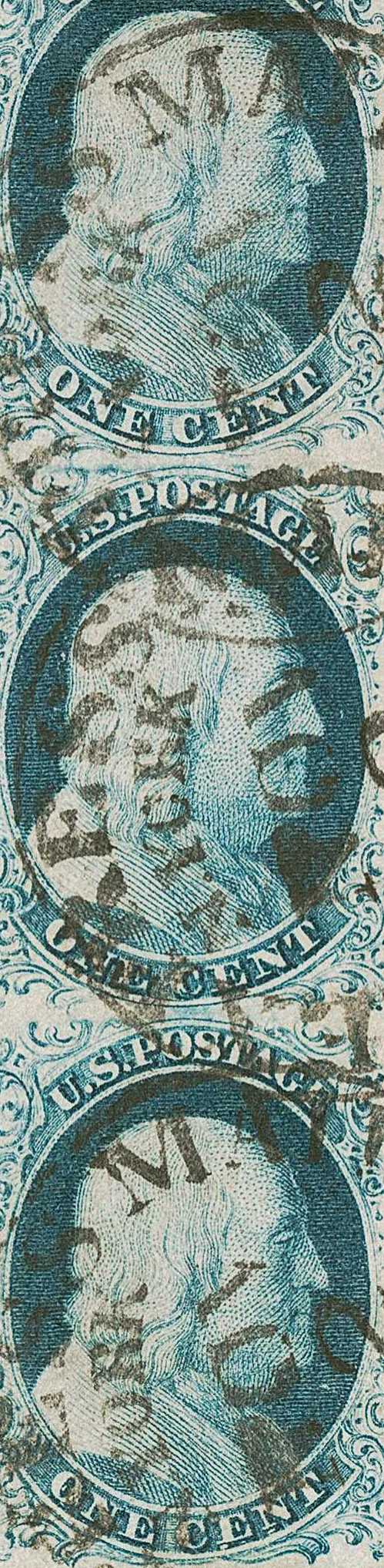


This is a trimmed for posting here, copy of the image of Lot 1061, sale 1245 in the Siegel Auction Sale of Nov. 16, 2021.

My educated guess is that since the term "express mail" had been in the public domain for over a century, the USPS recently came up with the name Priority Express and federally registered it as a trademark to replace "Express mail." As to the 1968 start of Priority, only airmail items 7 ounces or more were mandatory Priority Mail, but no such marking was required. For first class matter a minimum weight was required and one had to specifically request the service. Priority was designed to replace Air Parcel Post which had expanded from regular Parcel Post. Regular parcel post introduce the zone system when parcel post started 1-1-1913. The zones are used for Priority and Priority Express mail. Eight zones and local existed unchanged for over 100 years until "Zone 9" arrived for raising the cost to certain small USA land specks surrounded by Ocean.

Mail handling and requirements also changed for the post office due to external evens such as the Unabomber, who by the way tended to use coil versions of the Eugene O'Neill $1.00 stamps shown on my bright yellow insured special handling mailing tag in an above post. Anthrax mail also caused changes.

The full title of the books John Becker mentioned are:

U.S. Domestic Postal Rates, 1872-XXXX by and Anthony S. Wawrukiewicz Beecher, Henry W. with the "XXXX" date varying by Edition, first second or third. This will explain lots of questions, and I mean a lot.

U.S. International Postal Rates, 1872-1996 by Anthony S. Wawrukiewicz & Henry W. Beecher. This explains both incoming and out going mail rates, well except for the parcel post and air parcel post rates. Those are found in a CD from the American Philatelic Society. The third edition of the domestic rate book includes a section updating many international rates as well.

Lastly, going back to your original question, there is a series of stamps, the Presidential Issue or Prexies which contained all the dead presidents up to 1938. The first 22 were denominated in the order of office. Washington 1 cent, Adams 2 cent, Lincoln 16 cent, Johnson 17 cent, Cleveland 22 cents (he was both the 22nd and 24th POTUS), then Harrison is 24 cents, with no 23 cent prexie issued. Then set continues with 25, 30, 50 cent values and 1, 2, and 5 dollar values. Franklin at 1/2 cent, Martha Washington at 1.5 cents and the White House at 4.5 cents completed the series.

At the time the series was issued, some denominations had a postal purpose and many did not. This is the basis for what is called "solo" collecting; finding a single denomination stamp exactly paying the postage and fees for the item it is attached to. Some are easy to find some very rare and a solo $5 Coolidge is yet to be found (there is one used with a meter stamp as the closest as well as a single stamp but it does not pay the commercial rate due exactly). The only exception is the 1/2 cent Franklin as there was no fee and rate that cost exactly 1/2 cent. That said it is found as being paper clipped or attached just by the selvage (sheet margin in your words)to a mail piece as 1/2 cent change when the transaction require postage due in the amount of 1/2 cent. You pay the penny, a 1/2 cent due is affixed and you get a 1/2 cent Franklin back as change.

Now I will let another handle your other questions and comments.
Send note to Staff  Go to Top of Page
Edited by Parcelpostguy - 11/08/2021 02:25 am
Pillar Of The Community
6326 Posts
Posted 11/08/2021   09:31 am  Show Profile Bookmark this reply Add John Becker to your friends list  Get a Link to this Reply
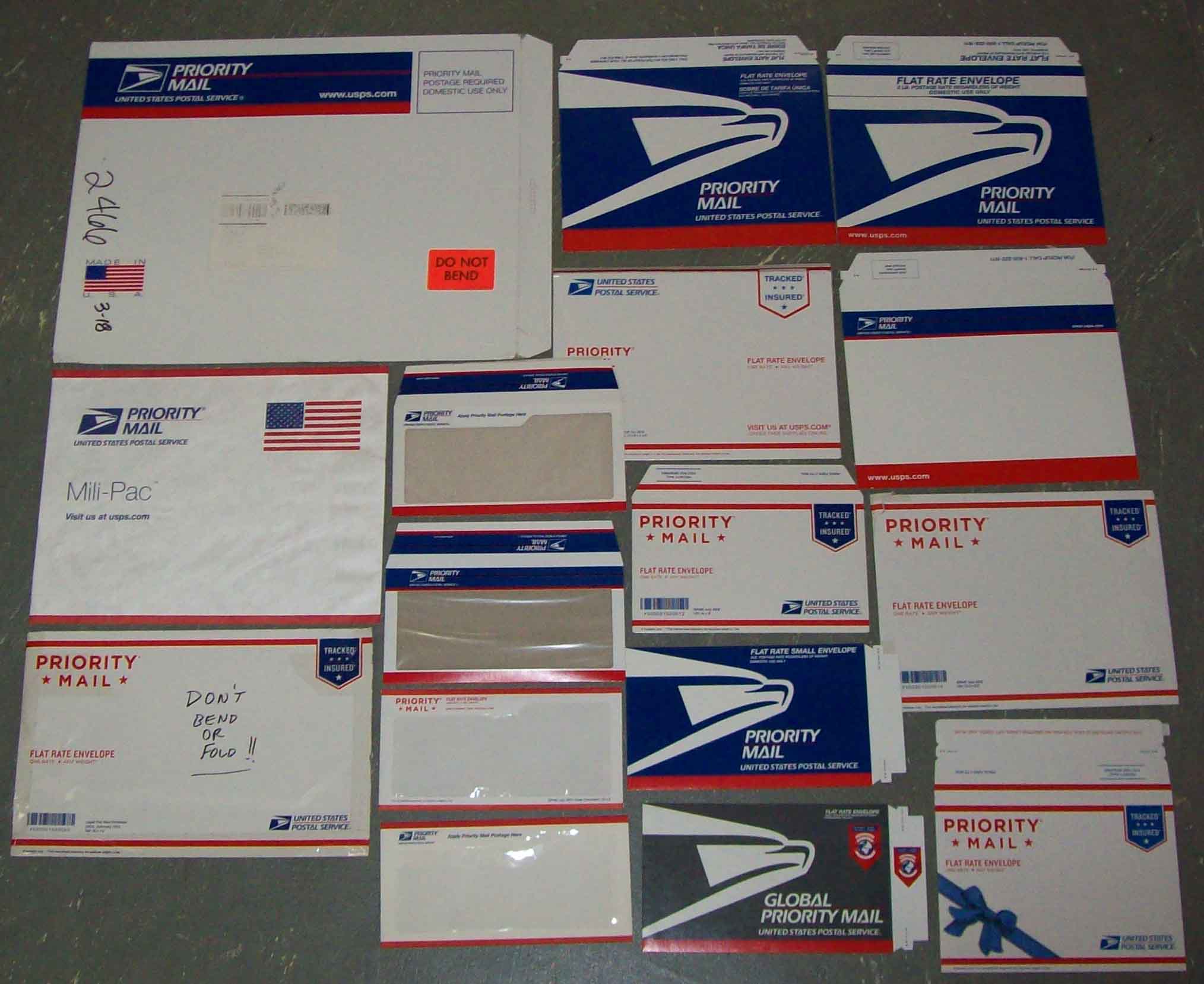
The USPS has produced a large number of paperboard/Tyvek envelopes and corrugated boxes for Priority and Express Mail. Here is a small sampling of Priority Mail envelopes that were handy. The large one in the upper left is a whopping 17" x 21", used in 2004. The Mil-Pac envelope below it is Tyvek.


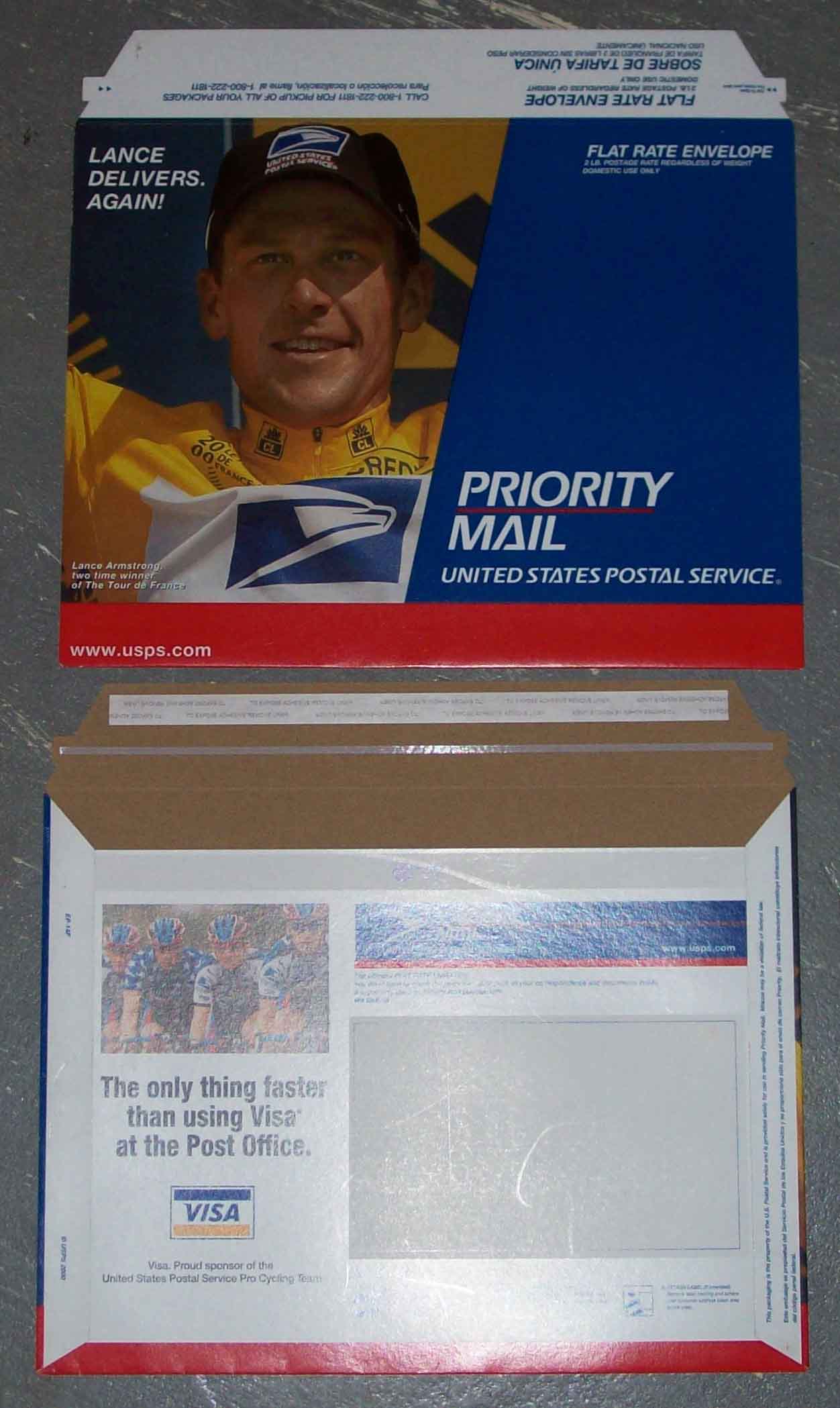
One of my favorites is the Lance Armstrong edition!


A similar grouping could be made of the Express Mail envelopes.

I know of nobody who collects the packages/envelopes from the competing carriers, but no doubt there are some.
Send note to Staff  Go to Top of Page
Edited by John Becker - 11/08/2021 09:39 am
Valued Member
United States
77 Posts
Posted 11/08/2021   10:55 am  Show Profile Bookmark this reply Add Letterpress to your friends list  Get a Link to this Reply
By the way, Parcelpostguy, I love that mailpiece, the Special Handling one. Why are the stamps on the other side? I thought the USPS DMM required the postage on the same side as the recipient address.

I assume the address was typed with a typewriter, since it was a bit too early for daisywheel printers driven by PCs. The typeface/font is unusual, at least to me. It's not the typical Courier style of IBM Selectrics and so forth, but some kind of Humanist style, and the numerals look like the MICR or OCR typefaces that banks use on checks. There must have been a typewriter brand back then that offered this typeface.
Send note to Staff  Go to Top of Page
Pillar Of The Community
6326 Posts
Posted 11/08/2021   10:59 am  Show Profile Bookmark this reply Add John Becker to your friends list  Get a Link to this Reply
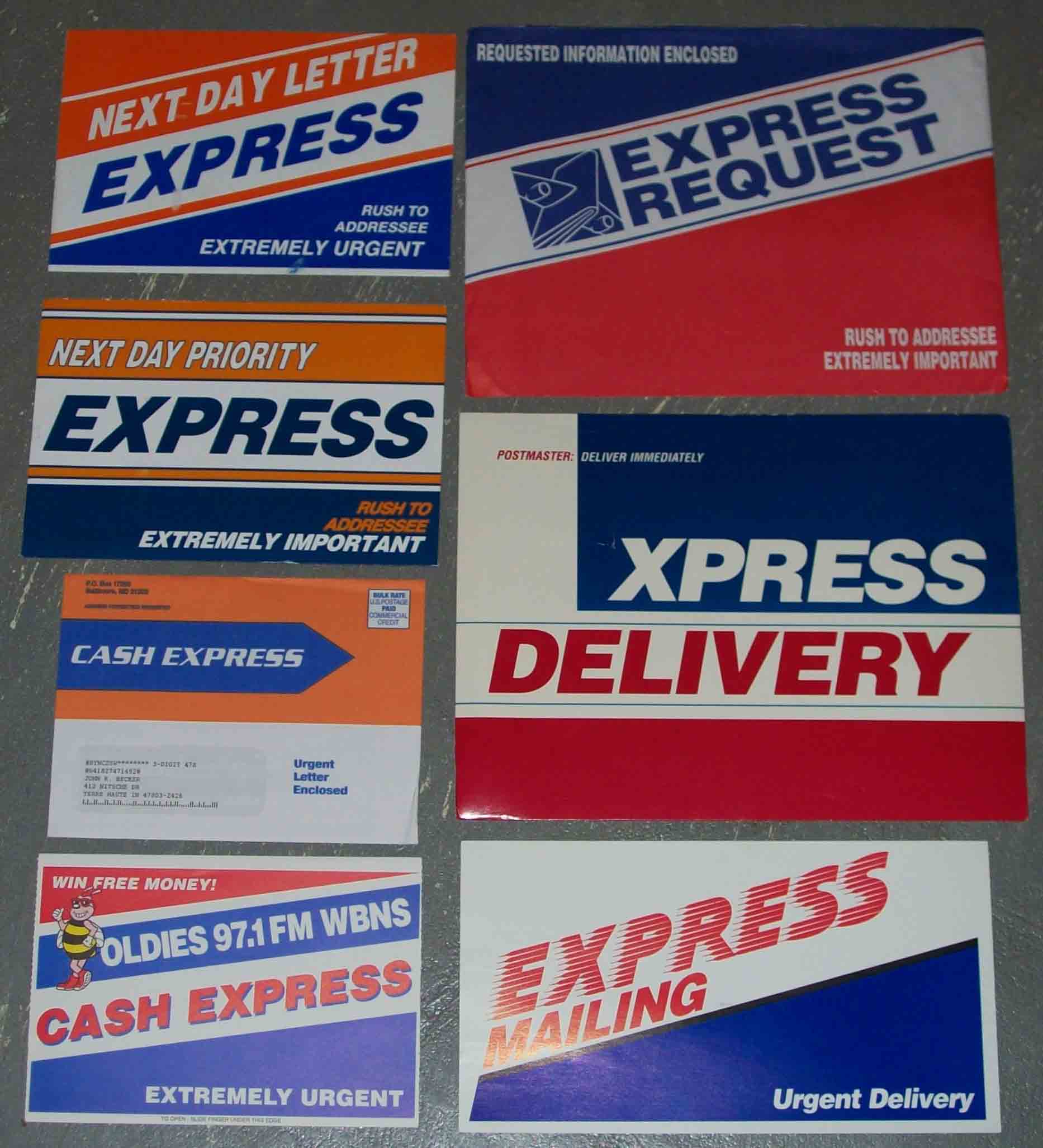
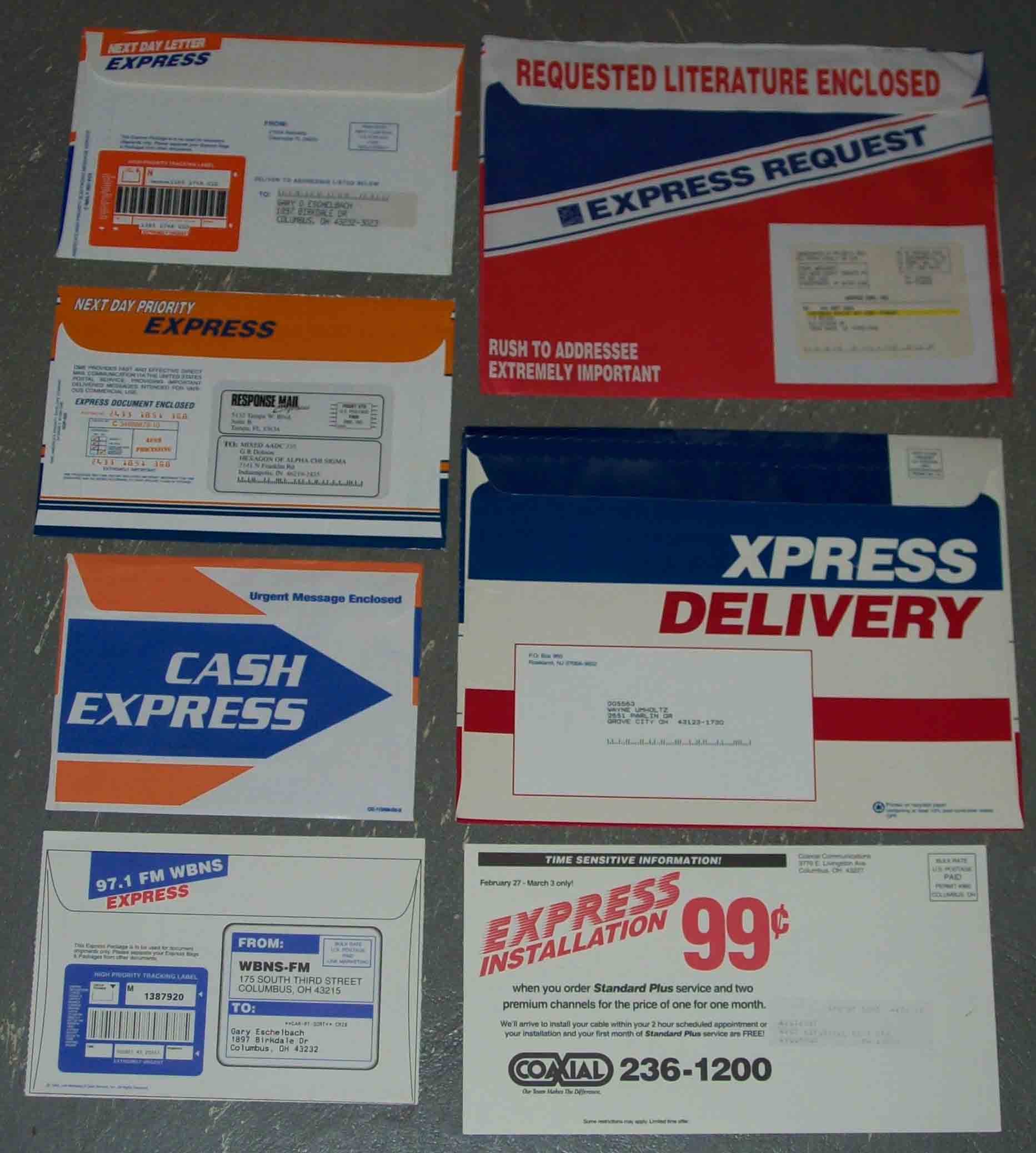
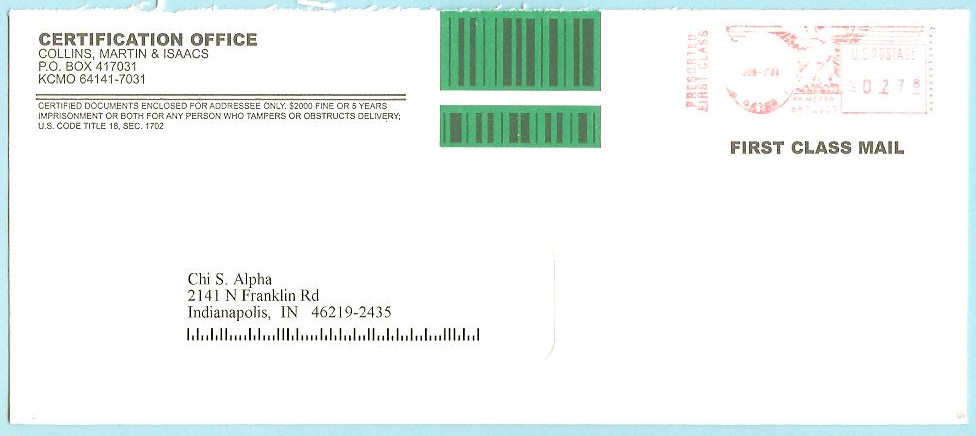
To run onto a related tangent. I have been tossing these envelopes into a special pile for a number of years ... Not competitor carriers, but actual USPS-carried mail.

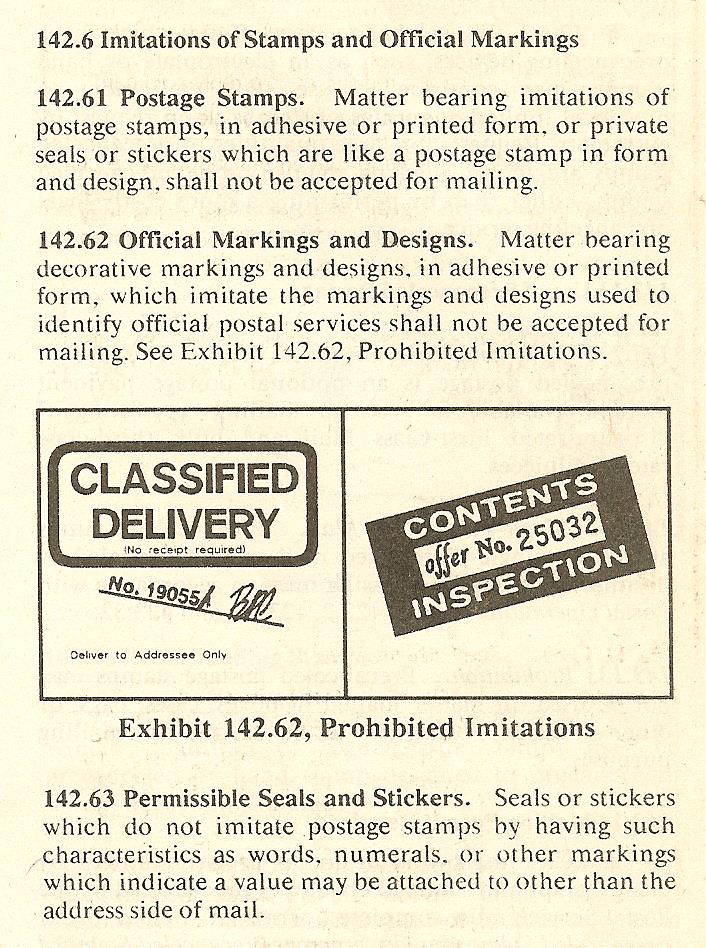
The USPS has a provision about mail pieces which mimic other classes of mail. Here, from the February 24, 1991 issue of the "Domestic Mail Manual, Issue 38", note the central paragraph:


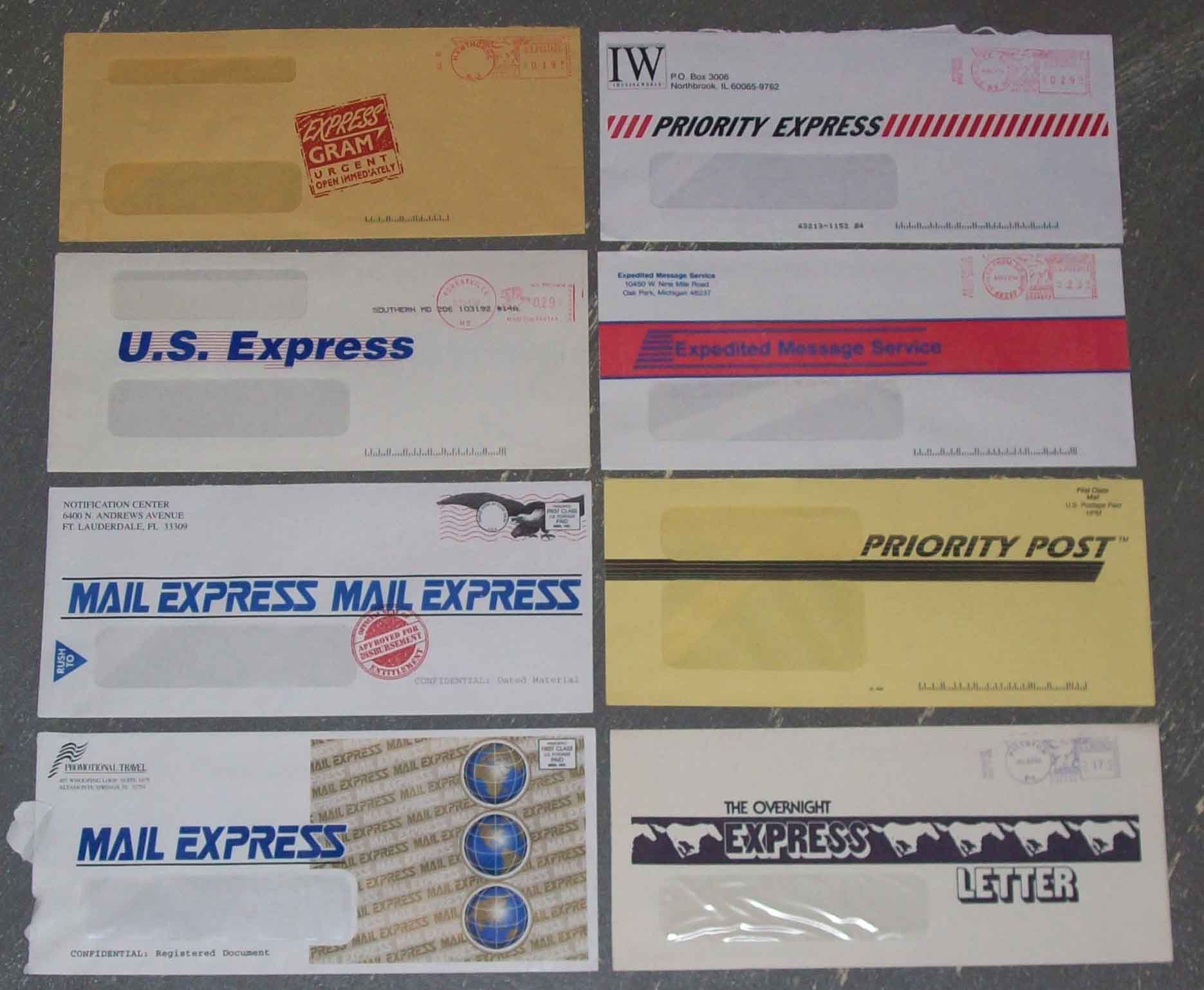
Yet here are some with "Priority" or "Express":


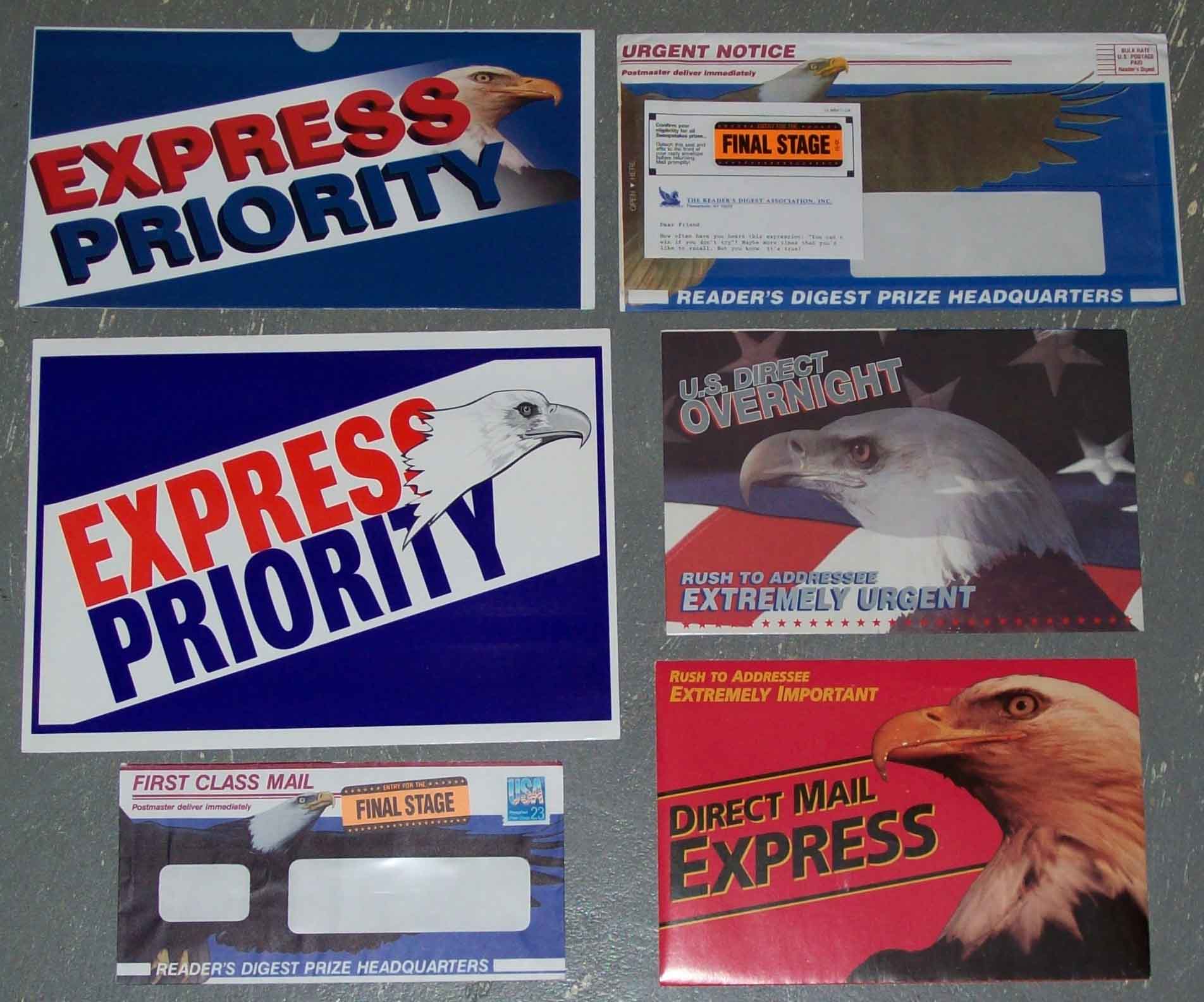
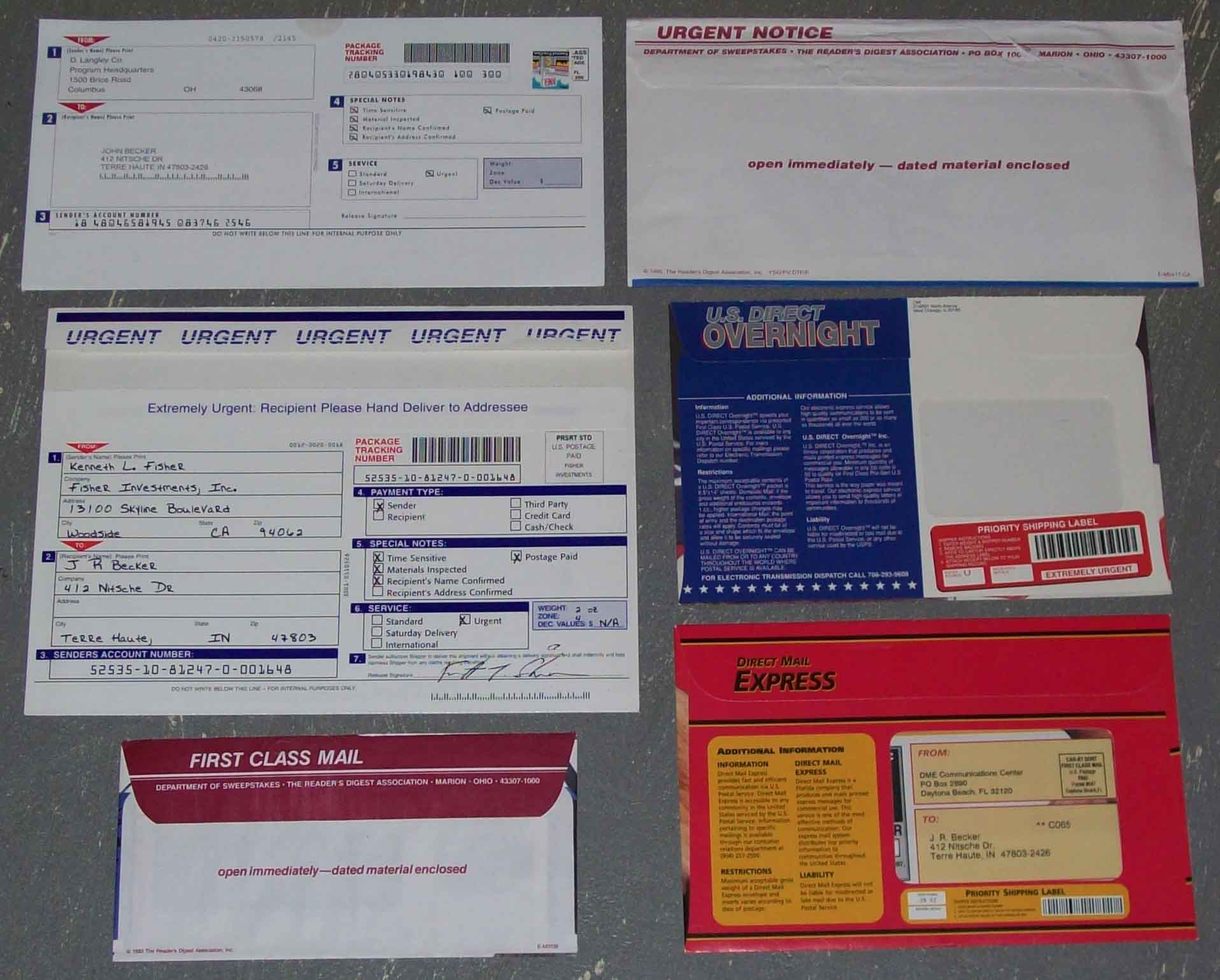
A group with eagles (front and back). The middle right one even has a red bar-coded label under the window - to mimic registered mail!


A group with large wording (front and back). The lower left one even has a blue-bordered bar code to mimic insured mail! I suspect they get away with these designs by using orange ink instead of red.


And one with a green-bordered bar code to mimic certified mail:


And all of these were accepted for mailing as various levels of first and third class mail. Collectible? Yes. Survival rate of this "junk Mail" is naturally quite low. Too cheap for dealer stock or ebay listing.

Back to flats ...
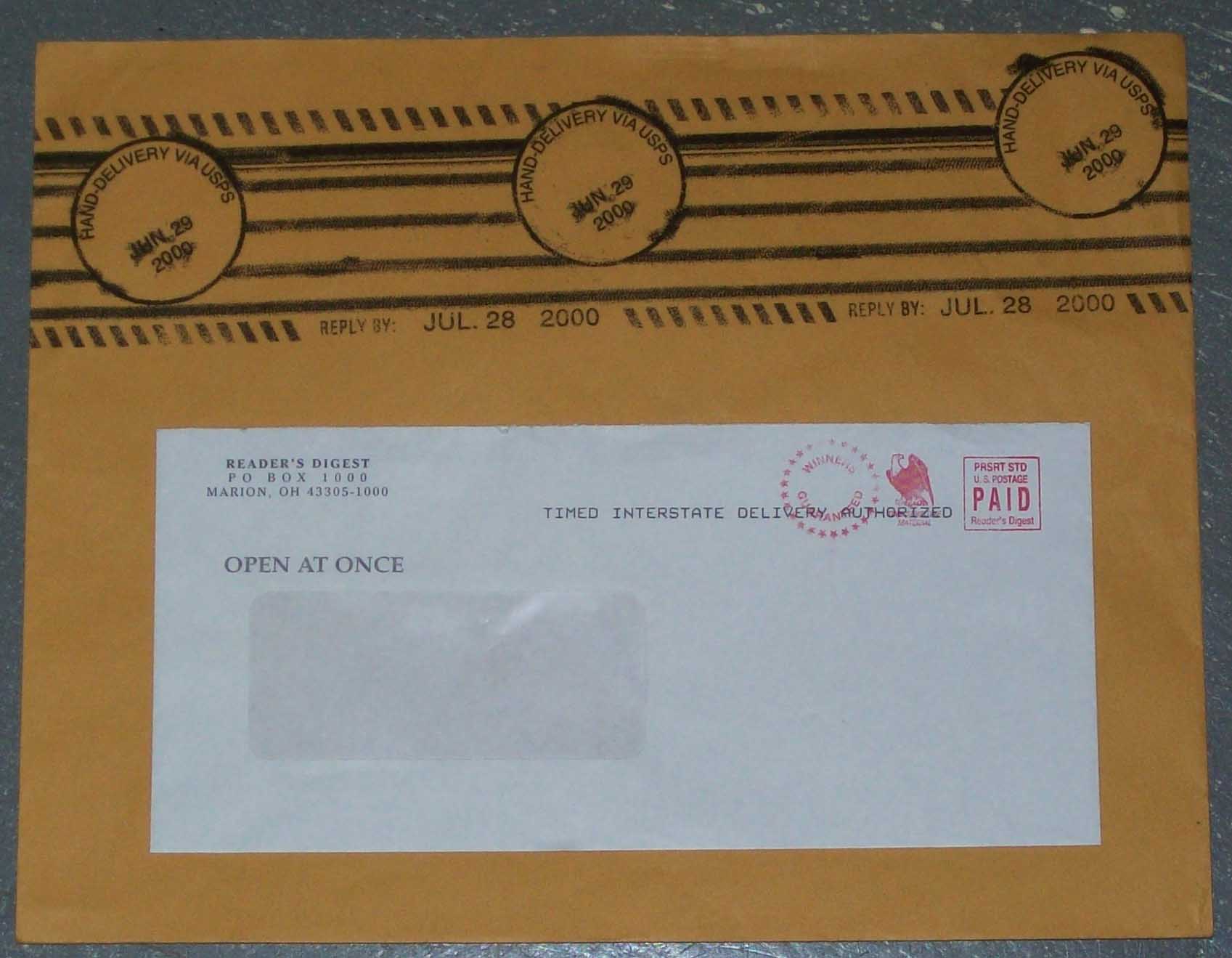
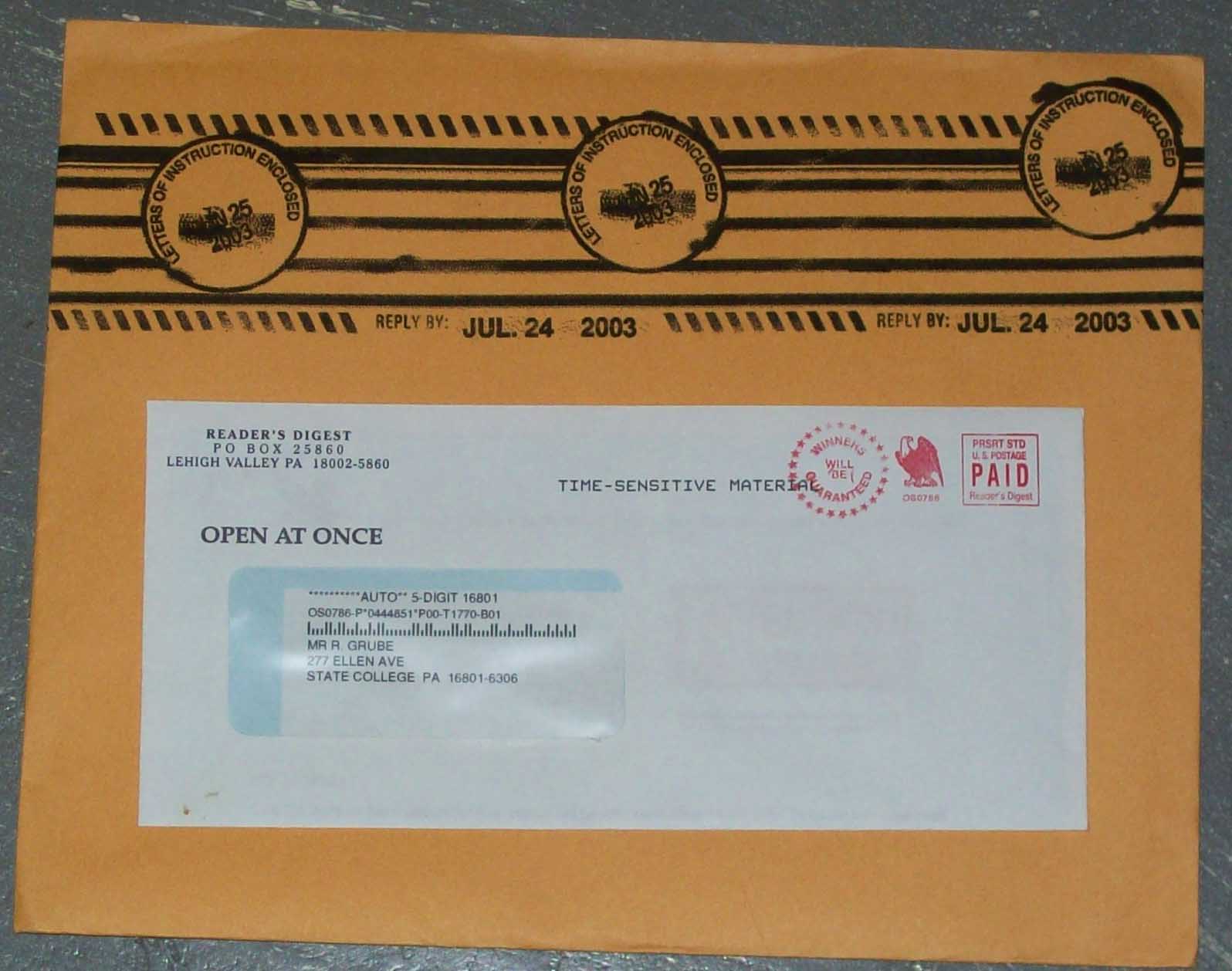
Here are two similar "presort standard" rate mailings from Readers Digest with fully faked flats machine cancel with their own rim wording and partially rotated date. They even applied a pseudo single-line black spray message over the permit of "Timed interstate delivery authorized" and "Time-sensitive material"!


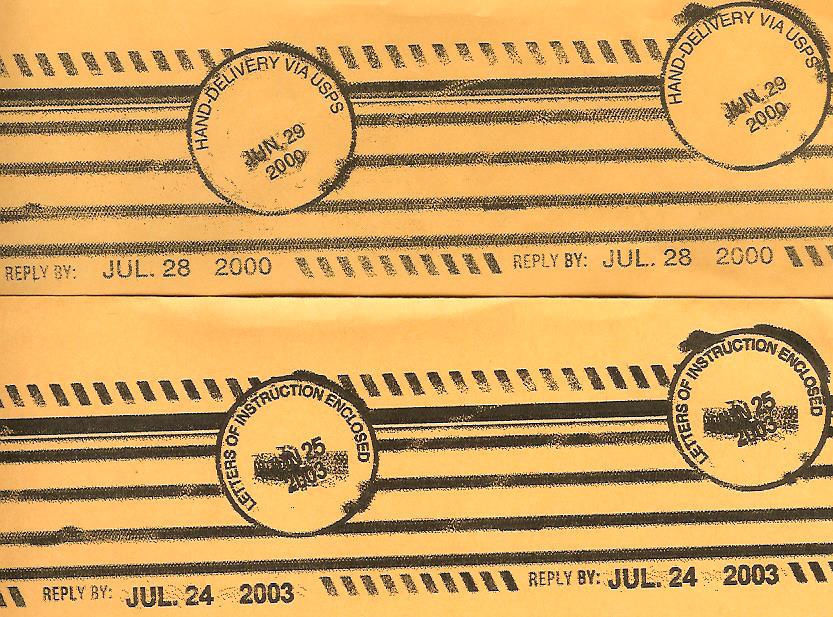
And a closeup of the two pseudocancels, which were printed on the paper before the envelopes were made since the cancel extends slightly over the edge and onto the back side!


The contents of the second RD envelope pertain to a sweepstakes contest. Not sure how is was allowed to be mailed?

Send note to Staff  Go to Top of Page
Edited by John Becker - 11/08/2021 11:06 am
Valued Member
United States
77 Posts
Posted 11/08/2021   11:09 am  Show Profile Bookmark this reply Add Letterpress to your friends list  Get a Link to this Reply
Thanks John, do you know when those solid blue envelopes were released? Are these your collection?

With the modern solid white envelopes (no windows), the release date is printed next to the barcode, though I can't make them out in these photos.

When was the Armstrong one released? I think there might be a © 2000 bit on it, on the left, but I'm not sure.
Send note to Staff  Go to Top of Page
Pillar Of The Community
6326 Posts
Posted 11/08/2021   11:34 am  Show Profile Bookmark this reply Add John Becker to your friends list  Get a Link to this Reply
This is more of an accumulation than a collection.
Yes, they all have product numbers and dates on them.

Solid blues:
Top center: EP-14F September 1999 (and copyright USPS 1995 notice)
Top right: EP-14F January 2001
Small one near bottom: EP-14B January 1998

The Lance Armstrong envelope is EP-14F dated 2000, so neatly between the other two EP-14F's
Send note to Staff  Go to Top of Page
Pillar Of The Community
United States
4276 Posts
Posted 11/08/2021   12:49 pm  Show Profile Bookmark this reply Add Parcelpostguy to your friends list  Get a Link to this Reply

Quote:
Why are the stamps on the other side?


No room on the address side of the tag. Multiple tags were needed at times to contain all the postage affixed. As tag were attached to one side of a package or mail item, the whole tag address and stamps are on the same side.

IBM Selectric I and II had a type face named "OCR" as did the III but the III was produced after the tag was mailed. High end Selectrics did more than just type and IBM more than make typewriters.

John Becker has shown a wide selection of priority and express envelopes. What he hasn't shown are the examples upon which postage was preprinted such as Star Wars and Presidential aircraft.
Send note to Staff  Go to Top of Page
Pillar Of The Community
6326 Posts
Posted 11/08/2021   1:04 pm  Show Profile Bookmark this reply Add John Becker to your friends list  Get a Link to this Reply
Star Wars, etc.
True, I made no attempt to be complete, just a quick showing of some free lobby-dispensed items. Those envelopes with preprinted postage are Scott-listed and fall into another category in my mind.
Send note to Staff  Go to Top of Page
Valued Member
United States
77 Posts
Posted 11/08/2021   2:08 pm  Show Profile Bookmark this reply Add Letterpress to your friends list  Get a Link to this Reply
By the way, where can I find the Beecher & Wawrukiewicz book, Third Edition? There is apparently a Third Edition, but I can barely find scattered First and Second Editions. Why is this book so scarce?
Send note to Staff  Go to Top of Page
Page: of 4 Previous TopicReplies: 47 / Views: 3,316Next Topic  
Previous Page | Next Page
 
To participate in the forum you must log in or register.

Go to Top of Page

Disclaimer: While a tremendous amount of effort goes into ensuring the accuracy of the information contained in this site, Stamp Community assumes no liability for errors. Copyright 2005 - 2026 Stamp Community Family - All rights reserved worldwide. Use of any images or content on this website without prior written permission of Stamp Community or the original lender is strictly prohibited.
Privacy Policy / Terms of Use    Advertise Here
Stamp Community Forum © 2007 - 2026 Stamp Community Forums
It took 0.22 seconds to lick this stamp. Powered By: Snitz Forums 2000 Version 3.4.05