| Author |
 Replies: 47 / Views: 3,479 Replies: 47 / Views: 3,479 |
|
|
|
Pillar Of The Community
United States
4445 Posts |
|
|
Quote:
By the way, where can I find the Beecher & Wawrukiewicz book, Third Edition? First sales are conducted by the American Philatelic Society (APS) to anyone and at a lower price for members. Some libraries have it and you could check your local library if it is there or available through inter-library loan. After market sellers, such as those who carry philatelic books can have it as well. I don't see the third edition on ebay except rarely. DO NOT pay the four figure prices asked at Amazon. Those are just beyond belief and for the 1st edition hardback. |
Send note to Staff 
|
| Edited by Parcelpostguy - 11/08/2021 2:45 pm |
|
|
Valued Member
United States
77 Posts |
|
|
John, I don't understand those RD mailings. What is the relationship between the white business envelope on top and the larger Kraft flat underneath? Are they attached, or is the white business envelope not actually an envelope but just a sheet of paper that looks like an envelope?
The messy ink on top of the flats is impressive – how did they print that? Did someone design an offset printing plate to look like a hand stamped cancel and all that other razzle-dazzle? Reader's Digest veered into strange forgery territory here, with a lot of effort going into, what, deceiving recipients in a such a way that bumped up opening rates?
"The contents of the second RD envelope pertain to a sweepstakes contest. Not sure how is was allowed to be mailed?"
Aren't they both sweepstakes mailings? What's the significance of a sweepstakes with respect it to being allowed to be mailed? Aren't they legal. (I'm actually surprised that Reader's Digest had a sweepstakes, and with all this borderline forgery – I thought they were just a magazine (and one I enjoyed).)
What does the text under the eagles say? It looks like six characters, so not a ZIP code. |
|
Send note to Staff
|
|
|
Valued Member
276 Posts |
|
|
I suspect anyone who mailed as much as RD had got to bend the rules. Re RD sweepstakes, think Publisher's Clearinghouse with more nagging and smaller prizes. |
|
Send note to Staff
|
|
|
Pillar Of The Community
6361 Posts |
|
|
Readers Digest: Yes, I agree, a lot of work to increase the chance of being opened. The July 2003 cover has contents, so I'll describe that one. It is a #10 legal sized envelope containing a cover letter and simulated check. It is marked "prsrt std", which would make it a first class letter. Under the eagle is OS0786, which means nothing postally as far as I know. The kraft envelope is entirely printed materials, thus I believe rated as 3rd class mail. I see no problem with any of the contents. The unusual part (and why I shared it) is a simulated graphic very similar to an official postmark in its style and positioning. Mail can be very interesting even when it does not have an adhesive stamp on it! I will go down the rabbit hole a bit more to say that 1st/3rd class double envelopes have been around for a more than a century. (Essentially the same as a parcel with first class letter enclosed - the letter could have been in an envelope glued to the outside of the box.) Here is one made with two envelopes glued together noted on the back as a "Karolton Uni-Mailer-7x10", making a very nice piece of Defense Issue postal history. The larger pouch is unsealed and has no contents now. 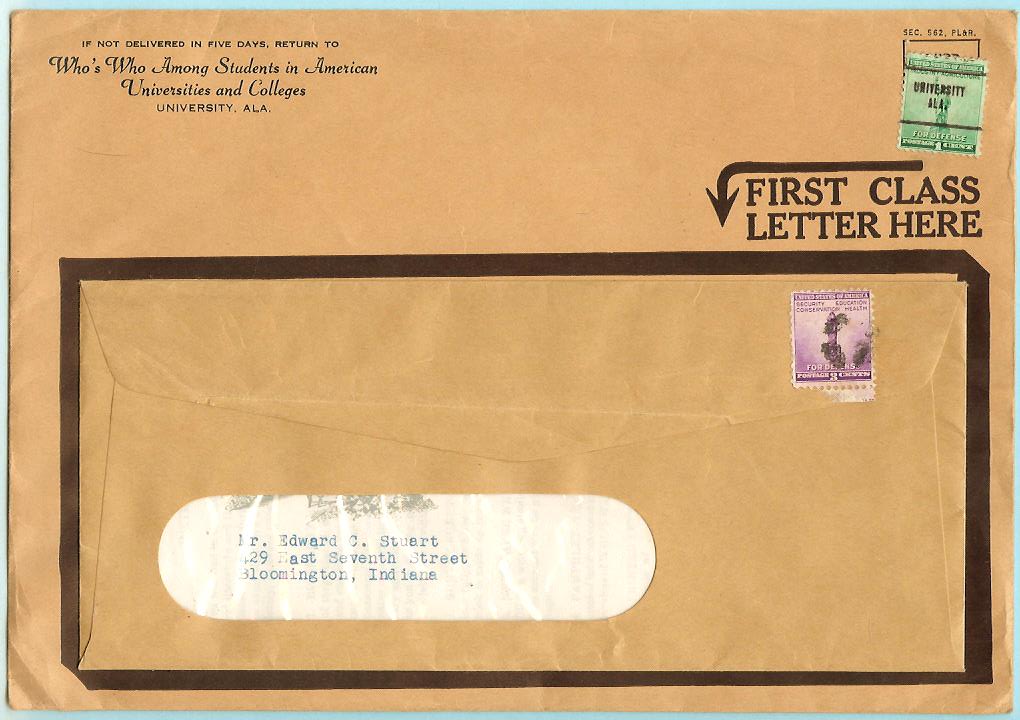 |
|
Send note to Staff
|
|
|
Valued Member
United States
77 Posts |
|
|
By the way, this reminded me of something I've wanted to dig into: Did the IRS used to send everyone pre-printed envelopes to send their tax returns in? Or was it just an adhesive label? On old Form 1040s I see instructions to place the "IRS label" over the area where people would otherwise write or type their name, address, SSN, etc.
What kind of envelopes did the IRS send out? Were they postage paid or did you have to eat into your stamp inventory? I think I saw one at one point searching online, but I can't find it. I was confused because it looked like a normal #10 business envelope – could people fit their returns in a letter-sized envelope like that, if they had multiple Schedules, a business or something? Seems like it would be tight, and related to the original topic, it would probably weigh over an ounce, right? Maybe even over two ounces, if we're talking 8+ sheets of paper + a roughly 0.2 ounce envelope + several smaller sheets like W-2, 1099s, a check, etc. (A sheet of 20 lb bond is supposed to weigh 0.16 ounces, though they're often a bit over, and 24 lb bond should weigh 0.192 oz. Some #10 envelopes weigh almost a quarter oz for some reason – they must be using heavier paper.) I assumed people would want to use proper flats/large envelopes (aka "Manila" envelopes to some people) for anything over three pages or so. |
|
Send note to Staff
|
| Edited by Letterpress - 11/08/2021 7:46 pm |
|
|
Pillar Of The Community
6361 Posts |
|
|
I am pretty sure the IRS envelope is a #12, which is 11" x 4-3/4".
And requiring the user to apply postage. |
|
Send note to Staff
|
|
|
Valued Member
United States
77 Posts |
|
|
That's a strange size, since you'd still need to fold the forms into thirds since 4¾ inches is too short for bifold. It doesn't really buy you anything compared to #10. |
|
Send note to Staff
|
|
|
Valued Member
276 Posts |
|
|
I recall an adhesive label the IRS wanted the taxpayer to put on the first page of Form 1040, but not one for an envelope. I suspect at varioss times the IRS provided envelopes of various sizes, and I seem to remember some with an open window. I don't recall any IRS postage-paid reply envelopes. |
|
Send note to Staff
|
|
|
Valued Member
United States
77 Posts |
|
|
By the way, I'll put together a spreadsheet soon of the stamp releases by year and the postage rates in those years, from 1981 - 1989 or so. I'm curious about why I thought there were so many mismatches or strange denominations, given that people here pointed out more matches than I remember seeing. I think one issue is that I underestimated the role of stamps issued in prior years, and how those stamps continued to be produced and sold for many years after their introduction. That whole aspect is a black box to me. |
|
Send note to Staff
|
|
|
Valued Member
276 Posts |
|
|
Maybe someone could post an image of a Philatelic Sales Division order form circa 1980. It would list all the definitives then available, for example, I believe Liberty's 25c Revere coil was first issued in dry gum around that time. |
|
Send note to Staff
|
|
|
Pillar Of The Community
6361 Posts |
|
|
Valued Member
United States
77 Posts |
|
|
Thanks John. Were the 1970s dark? I don't see any catalogs for that decade. |
|
Send note to Staff
|
|
|
Moderator

United States
12330 Posts |
|
|
Gathering and compiling these takes time and we are still seeking copies of those which are missing.
Don |
|
Send note to Staff
|
|
|
|
Pillar Of The Community
6361 Posts |
|
|
I will echo Don. Once expired, these catalogs essentially become junk mail and the survival rate is very, very small. Then it takes collectors to save them for years and volunteer to make them available, etc.
I need to send these to Don for posting, but those 11/30/1976 and 3/31/1977 are labeled "stamps available and philatelic order list" and are merely fold-out brochures. |
|
Send note to Staff
|
|
|
Valued Member
276 Posts |
|
|
AFAIK, USPS released no philatelic catalogs during the 1970s. During that period, USPS issued only foldable brochures that were essentially large order forms on one side, instructions on the other. Since the forms were large, IIRC they had room for things like postage dues, which are absent from catalogs before and after that era.
John, I'd like to see the scans of those forms you have from 1976 amd 1977. I had saved several but tossed them during a cleanup some 20 years ago.
|
|
Send note to Staff
|
|
|
Replies: 47 / Views: 3,479 |
|




 Posted 11/08/2021 2:38 pm


