Quote:
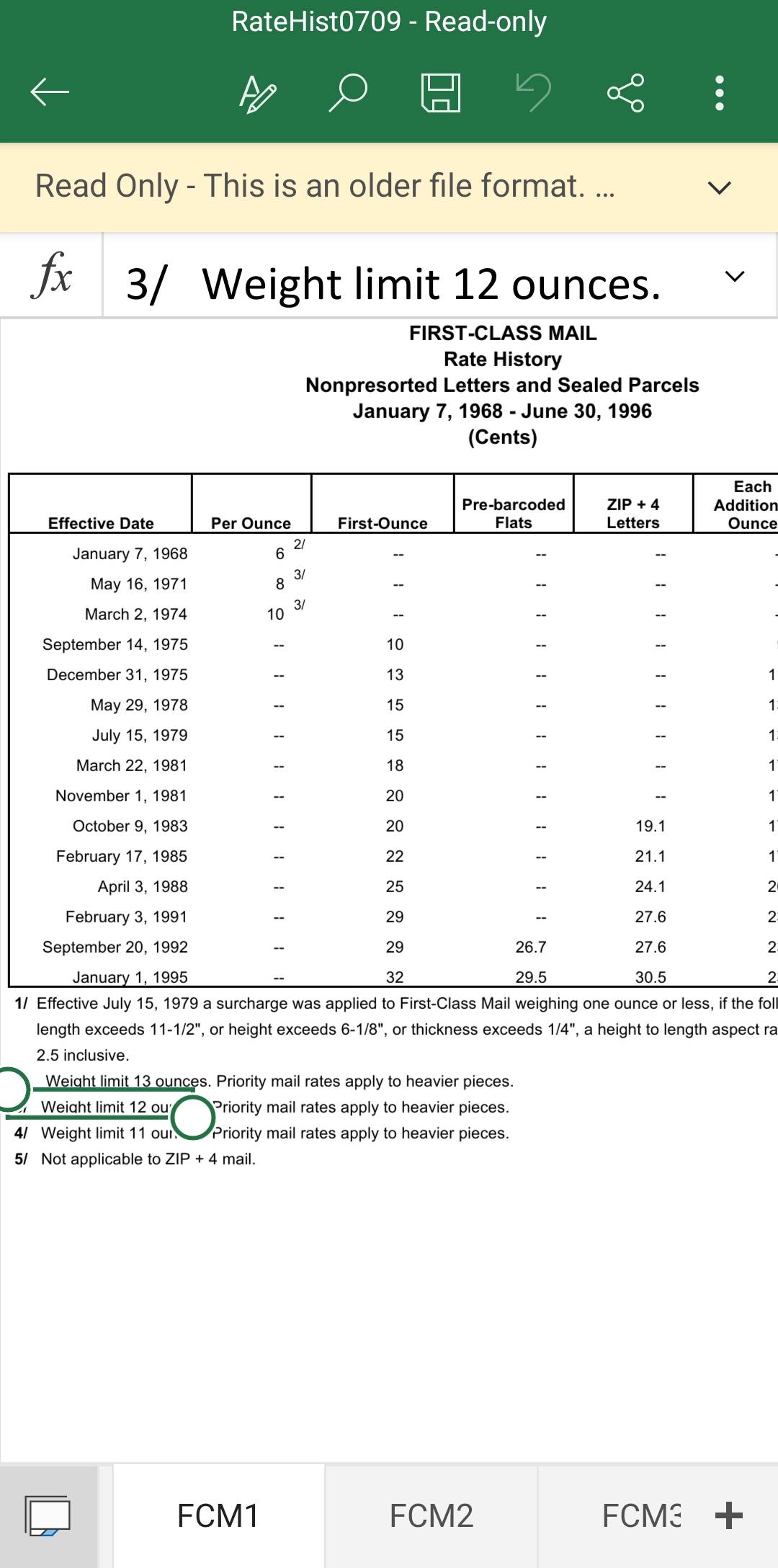
The first class weight cut off was over 13 ounces
and I also told you that at the start of Priority, airmail over 7 ounces was forced into priority. "Start" references a specific point in time; not a time period or time range.
If you look at your rate history posting, Letterpress, you see the start of priority being listed as January 7, 1968 with a foot note number 2 next to it. If you read foot note number 2, it lists the weight 13 ounces. I stand correct. January 7, 1968 was the start of Priority Mail.
That said, all of this information is in B&W's Rate book 3rd edition with the relevant regulations, laws and orders cited. Those as I have said previously can be read up in Stampsmarter.com in the section of the digital library of postal guides; or if it is not in the monthly or annual, the daily guides and PL&R (Postal Laws and Regulations) can be found here:
http://www.uspostalbulletins.com/Do be aware, there have been rates and regulation followed but no published. Additionally if a mailer was large enough by volume, they could get special treatment arranged with the post office. Netflix and LL Bean come to mind as businesses as do mailed in ballots and tax returns, all get special treatment.
If you are looking for specific documented rules for each and everything the USPOD and USPS did and does, you will be disappointed.
For example when Parcel Post started 1-1-1913, the weight limit was 11 pounds. Soon for nearby zones the limit was raised to 50 pounds. At the time, you will not find a regulation granting permission to mail child weighing 50 pounds or less. However, once children weighing 50 pounds and less began being mailed (postage was less that train fare on the same trains) regulations were developed to prohibit that practice. When parcel post began there was no limit on what could be sent by a mailer until a bank, brick by brick was mailed. After that time a limit of packages and or total weight sent by a mailer in one day was implemented.
When UN postage was selling at 30-40% of face value, many large mailers in the New York area would make massive mailing at the UNPA NY Office. Eventually the UNPA installed severe limits on what could be sent by one mailer per day. Selling stamps was a cash cow for the UN, having to suddenly provided services for those stamps cost the UNPA money as no new stamps were sold by the UNPA to cover the costs the new mail volume created.
Even "airmail" did not mean the mail piece was to be carried by an airplane. What it mean was that the mail piece was to be carried on an airplane except if ground (train, truck, ship and etc.) provided quicker service. When the majority of first class mail routinely went by air, domestic airmail service postage rates were cancelled.
All that said, as pointed out by John Becker, if you do not ask an exceedingly specific question, you will only receive a general answer, perhaps a very specific but still general answer.
Here is a simple, on its face question for you. If a post office was located within the city limits was it a city post office? The answer? Not always as some post offices in a city were not city post offices, rather they were part of the Railway Postal Office (RPO) system which were not considered as part of a city post office. No, I am not referring to the train mail-cars, but the brick and mortar built on the ground non-moving terminal RPO Offices.
Here is an interesting read:
https://about.usps.com/who-we-are/p...-history.htm pointing out that some classes of mail were designed to supplement other classes.





 Posted 11/21/2021 9:43 pm