| Author |
 Replies: 43 / Views: 18,508 Replies: 43 / Views: 18,508 |
|
Pillar Of The Community
2664 Posts |
|
|
|
Hi,
I wanted to start a toning thread where we could discuss toning only. Foxing , rusting mildew have been covered this one is only for Toning.
Is toning contagious does it affect value what can we do to avoid it. your experiences etc.
Thanks
|
|
Send note to Staff
|
| Edited by spock1k - 04/21/2010 10:12 am |
|
|
|
|
Pillar Of The Community
2664 Posts |
|
|
Toning - Seek out stamps with clean, original undisturbed gum. A very light even tan is ok, but where you see spots leave it alone. Should it be a scarce stamp that you just must take custodianship of, you could isolate it . Provided it is stored out of humidity the rust spores should remain dormant
another confusing statememnt that I hope K will fix when he sees it |
Send note to Staff 
|
|
|
Pillar Of The Community
2664 Posts |
|
|
ok am going to bump this thread so K can see it and give us a class on toning |
|
Send note to Staff
|
|
|
Pillar Of The Community
United States
6756 Posts |
|
|
Keep in mind that toning/foxing/tropicalstains are often used interchangeably among many collectors. The groups I usually hang around tend to differentiate between the 3. foxing -- primarily caused by acid content of paper reacting with moisture (typical signs: brown/yellowish blotches propagating from stamp edge or hinge mark; when on both front/back sides, will usually see them in the same area because it permeates through the stamp quickly) tropical stains (mildew) -- caused by mildew (typical signs: brownish blotches that may appear anywhere; spreads quickly to other stamps; usually only on 1 side of stamp, but when on both front/back, is not necessarily in the same spot) OK, for toning, my collector circles tend to use this term for the overall browning of a stamp due to pro-longed exposure to the elements (sunlight, heat, air...). This is also partially related to the acid content, where something like sunlight has speeded up the process and made it more uniform by introducing a factor such as heat. It affects the paper permanently and basically impossible to remove without obvious damage to the stamp. Usually by the time you see it, it has affected both sides of the stamp. 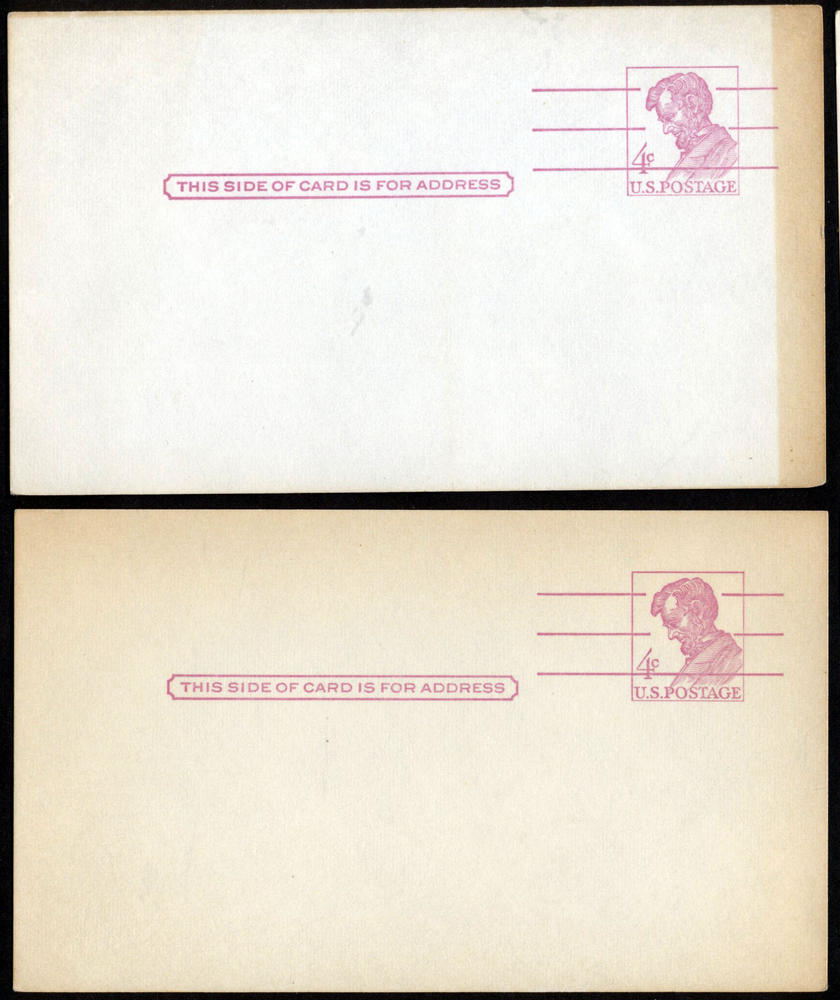 In the example above, the bottom card is completely toned. The card at top, you see certain sections of the card toned (right side, and top edge). This most likely occurred because the card was left for a few months near a window exposed to sunlight; but there was something else covering most of the card, so that only the right side and top edge were exposed to sunlight. I hope others will make additional posts, as I realize there really isn't a "fixed" definition for these terms. |
|
Send note to Staff
|
| Edited by khj - 04/21/2010 10:59 am |
|
|
Pillar Of The Community
2664 Posts |
|
|
wait wait is toning contagious and can I keep toned stamps in my collection. unless you want me to spend a sleepless night please answer in the next 83 minutes. thats when bed time is. thanks |
|
Send note to Staff
|
|
|
Pillar Of The Community
United States
6756 Posts |
|
|
I've never had a problem with toned stamps subsequently affecting other stamps. That's using the definition above. Others may have a different experience. However, most collectors I know consider toned stamps to be a major defect.
Tropical stains (mildew) does affect other stamps, because it is an active process once it starts. It does not require direct stamp to stamp contact to spread. The mildew spores can travel through air.
Foxing (due to acid content) is also an active process, driven by the acid in the paper and the moisture in the air. It usually does not trigger foxing in other stamps except by prolonged direct contact. Sometimes you see a page with a large number of stamps with foxing. They were all likely stained at the same time, it was not something that spread from stamp to stamp. |
|
Send note to Staff
|
|
|
Pillar Of The Community
2664 Posts |
|
|
ok thanks now I can sleep in peace
by the wa what happens if I stamp is slightly toned there are different shades of toning some stamps you cant even amke out are toned unless you see a white copy do those also lose value?
also how far can the spores travel in air how many meters or feet before you can say they are safe I have my mildew stamps in a different room about 20 feet away from ym collection and there is no direct line of sight. and the spores would have tot ake three turns before they reach this room can they amke the journey
|
|
Send note to Staff
|
|
|
Pillar Of The Community
United States
6756 Posts |
|
|
It would be wise to state any toning that might be on the stamp, even if it is not obvious in the scan. When the buyer gets the stamp, they will very likely notice the toned paper when they put it in their album next to other stamps.
I do not know how far the spores travel.
I neglected to mention, the other kind of toning occurs from a chemical reaction with plastics. It causes a sort of yellowing of paper, not really browning. It's a very light even toning. This is why you have to be careful when you select a stockbook or stockpages. It's rarely a problem now, but it is a problem with some older stockbooks/stockpages from more than 2 decades ago. Sometimes you will notice the strips have also started to yellow slightly. Avoid those at all cost. They will damage the stamps in the long run. I rarely see those stockpages/stockbooks anymore, but they do pop up every once in a while in old collections/accumulations. They usually have no brand name imprinted or a obscure manufacturer. |
|
Send note to Staff
|
|
|
Pillar Of The Community
2664 Posts |
|
|
yes yes yellowing not browning thats the toning we were talking about. hooray you know my questions even before I ask them. golly I got a stamp that is 80 years old today and one earlier and all of those had this light yellow toning that you just spoke of. no harm in keeping them I guess is there?
i am spock so how can he read my mind? |
|
Send note to Staff
|
| Edited by spock1k - 04/21/2010 11:39 am |
|
|
Pillar Of The Community
United States
6756 Posts |
|
|
Quote:
i am spock so how can he read my mind? I knew you were going to post that.  k |
|
Send note to Staff
|
|
|
Pillar Of The Community
2664 Posts |
|
|
but that light yellow toning is safe isnt it? nothing to differentiate it fromt he regular toning I can keep it with my collection and not worry? |
|
Send note to Staff
|
|
|
Pillar Of The Community
United States
6756 Posts |
|
|
I wouldn't worry about it. If it's relatively uniform overall toning, it's not something that should spread. It relies on continue exposure to the elements (e.g., sun) or continued contact with the material (e.g., chemical softener in plastics).
Regarding the different shades of yellow. That I really don't know. It is probably dependent on the stamp paper itself, and what or how long it was exposed. If it's sunlight, I can tell you the pale yellow will eventually turn into brownish with additional sunlight. |
|
Send note to Staff
|
|
|
Pillar Of The Community
United States
6756 Posts |
|
|
As a general rule, however, I would not put a stamp stained (in ANY way) in direct contact with another stamp. Better safe than sorry. |
|
Send note to Staff
|
|
|
Pillar Of The Community
2664 Posts |
|
|
so is stored in an album direct contact? its not touching other stamps but its next to them? |
|
Send note to Staff
|
|
|
Pillar Of The Community
United States
6756 Posts |
|
|
No, that should be fine for stamps that are simply toned. At least I've never had any problems with that. If anyone else has a different experience, please post. |
|
Send note to Staff
|
|
|
Moderator

United States
4788 Posts |
|
|
Replies: 43 / Views: 18,508 |
|




 Posted 04/21/2010 03:23 am


