|
Medical Revenue Stamps of the Indian Princely State of Travancore
Travancore was the southernmost Princely state in India during the British rule. It enjoyed its own powers of issuing stamps and coins in silver and copper. The indigenous postal system that prevailed in the state was known as "Anchal"(Spelt Anchel also). Anchal took birth in the middle of the eighteenth century. Letters were handed over to runners who ran in relays to take them to the respective destinations. It was primitive and was used for official purposes. After the introduction of postal stamps in 1840, there existed two parallel systems, the Anchal for articles to be sent mostly inside the state and the British post for sending them both inside and outside the state. From the year 1888-89, the state began printing stamps of its own colloquially known as "Anchal stamps". The stamps bore the picture of a "conch" or "Sangh", the dynastic crest of the Travancore ruling family. By 1932, other pictures and the bust of the ruling king began to feature on the stamps. As the rates of sending articles used to change frequently, the stamps got surcharged quite often. They were all used for postal purposes either for private or for official purposes.
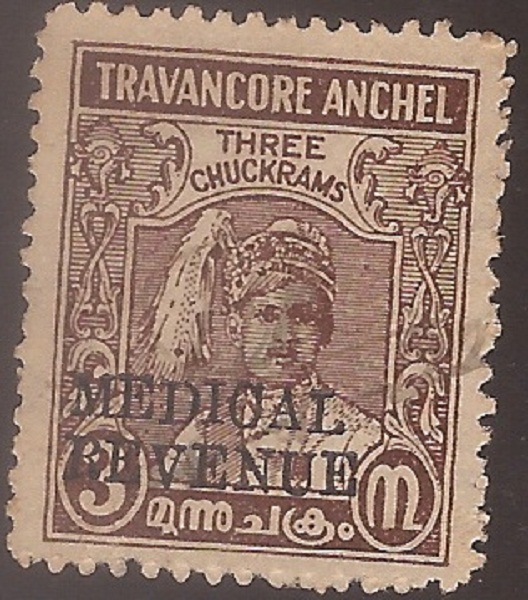
World War II triggered a financial crunch for the state owing to certain unforeseen expenditure. As Travancore was an ally of the British, they were obliged to support the Allied forces financially. This created a huge fiscal deficit and affected the fund flow to the service sector. Major activities in the service sector were under the Health and the Education Departments. In order to make both the ends of medical service provisions meet, revenue collection from the public was resorted to. Postal stamps were overprinted "MEDICAL REVENUE" and used for fiscal purposes!
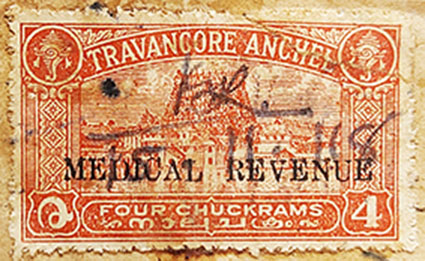
Two types of stamps are known to have been overprinted so. They were the issues first brought out in 1939 in connection with the 27th birth day of the then raja Sree Chithra Thirunal Balaramavarma. The commoner one in brown colour had a face value of "3 Chukrams" and the other rarer one in red a value of "4 Chukrams". (vide infra). Overprinting began in ME.1116 (1940-41) and ended in M.E1123 (1947-48) as the state of Travancore ceased to exist, following its merger with the state of Cochin not too long after India became independent. The official calendar of Travancore was in Malabar Era that commenced from CE.825. As M.E began around August- September, its year count falls either 824 or 825 shorter than the C.E year. M.E 1116 began on Friday the 16th of August 1940 and ended on 15th August 1941.
Overprinted stamps amounted to roughly 9% of their postal-use counterparts of the same time-span of issue. A total of less than six lakh numbers have been issued.
Medical Revenue stamps were issued neither regularly nor in equal volumes. The issues came out only during five years between 1940 and 1948.
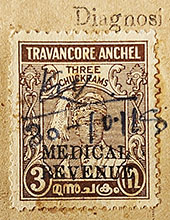
The overprinted stamps were sold through the public sector health care institutions of the state where common villagers attended to seek medical assistance. Buying the stamp was optional. They were affixed on the out-patient tickets issued to the attendees and cancelled by signing with ME date. The brown stamp illustrated has the date "30-10-118". 118 means ME 1118. Tenth month of the ME calendar is "Edavam". The date corresponds to 14th of June, 1943. That stamp has the bust of Maharaja Sree Chithra Thirunal Balaramavarma (ruled 1931-1949). The red stamp cancelled on 15-11-118 (29th of June 1943) shows picture of the famous Sree Padmanabhaswami Temple located in Thiruvananthapuram, the then capital of Travancore and later of the state of Kerala. Two conch shells shown above represent the dynastic crest of the ruling family. These out-patient tickets used to be collected back from the patients and kept in the health care institution. The ticket number were written on a piece of paper and given to the patient to be brought if he chose to revisit. The patients enjoyed a choice of either to buy another stamp or refrain from doing so during the subsequent visits.
The value of the illustrated stamps as stated above is three Chukrams for the brown stamp and four Chukrams for the red. Value appears on the stamps both in Hindu-Arabic numeral and Malayalam numeral. Malayalam is the mother tongue of people of erstwhile Travancore and now the state of Kerala. The value expressed is in the indigenous monetary system prevalent at the time. It was like this,
16 Cash = 1 Chukram, 4 Chukrams = 1 Fanam (Panam), 3½ Fanam = ½ Rupee, 7 Fanams = 1 Rupee.
Cash was the smallest unit coined. Cash and Chukram were copper coins. Panam and half rupee were silver coins. Rupee was not coined by the state, but was used as a notional unit. British Rupee was in use, valued at 7 Fanams and a half Chukram. Interestingly, copper coins of British India were not current in Travancore.
It is unusual for India to use postal stamps for fiscal purposes. These over-printed stamps make one of two such occasions, the other being in 1971. (That was in connection with the fundraising to support the refugees from Bangladesh. 5 Paise stamps were overprinted "Refugee Relief" for that purpose. An exclusive set of "Refugee Relief stamps" with a face value of 5 paise were also issued. In addition an imprint of the same design was affixed on inland letter blanks). The major difference is that it was optional in the case of the Medical Revenue over-prints while Refugee Relief over-print/stamp was a compulsory addition to the postal service expenses in 1971.
|





 Posted 12/17/2021 10:58 am