Cour Internationale de Justice The Cour Internationale de Justice (International Court of Justice) is the principal judicial organ of the United Nations. It settles legal disputes submitted to it by states and provides advisory opinions on legal questions referred to it by other UN organs and specialized agencies. This court that resides in The Hague should not be confused with the International Criminal Court that can prosecute individuals, and that also resides in The Hague.
At the Paris Peace Conference of 1919, the League of Nations was established as a worldwide intergovernmental organisation aimed at maintaining peace and collective security. Article 14 of the League's Covenant called for the establishment of a Cour Permanente de Justice Internationale. This would be responsible for adjudicating any international dispute submitted to it by the contesting parties, as well as to provide an advisory opinion upon any dispute or question referred to it by the League of Nations.
The Dutch PTT issued stamps overprinted "COUR PERMANENTE DE JUSTICE INTERNATIONALE" for the exclusive use on official mail sent from the court. World War II brought on the demise of this court. Already during the war, the allied powers discussed establishing a new international court after the war. On 31 January 1946, the judges of the Cour Permanente de Justice Internationale resigned. Subsequently, the United Nations established the Cour Internationale de Justice.
On 10 February 1947, the Dutch PTT issued stamps overprinted "COUR INTERNATIONALE DE JUSTICE" for the exclusive use on official mail sent from the court. Cancelled-to-order stamps were made available to collectors. Two stamps in a new design by Jan van Krimpen were issued on 1 August 1950. The design was based on the current "Van Krimpen" design for low-value permanent stamps that had been introduced in 1946.
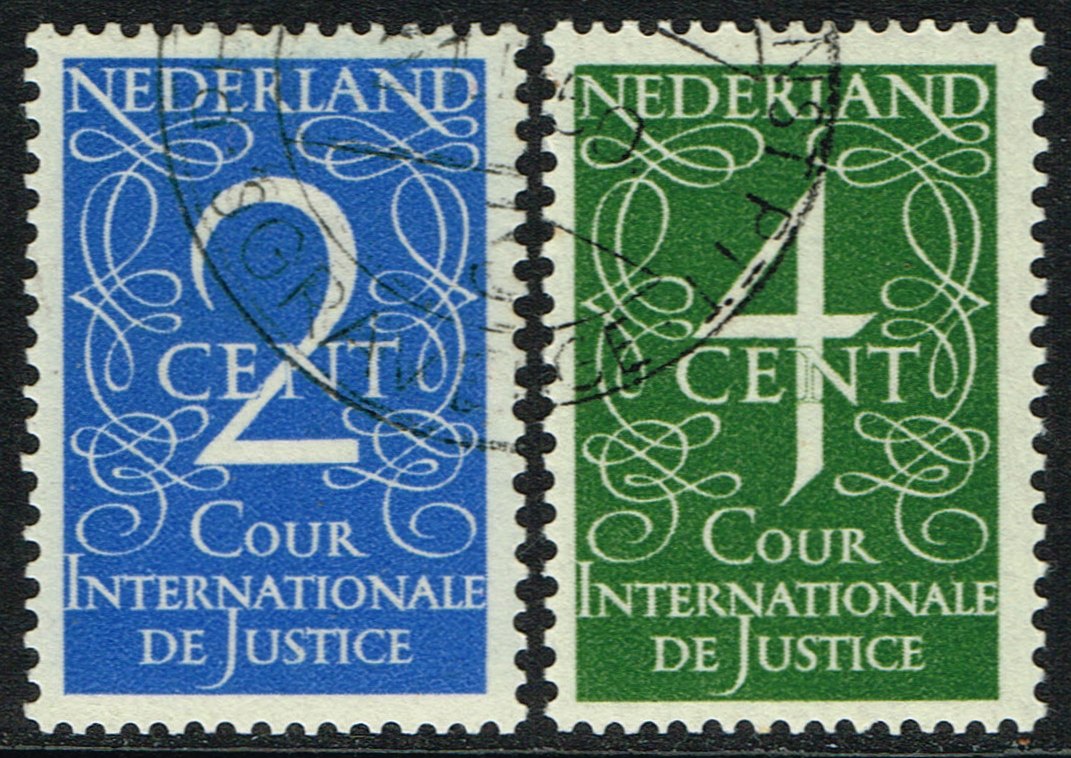 1950, Cour Internationale de Justice, Van Krimpen designs
The two stamps issued for the Cour Internationale de Justice (NVPH D25 – D26) had a vertical format, rather than the horizontal format of the Dutch stamps. The top two-thirds of the stamps follow the design of the Dutch stamps, except for the different shape of the numerals and the word 'CENT' that overlaps the numerals. This word was moved upward to make space for word 'COUR.'
The bottom third of the stamp shows the inscription 'COUR INTERNATIONALE DE JUSTICE'. The word 'COUR' is flanked by the mirrored bottoms of the arabesques that now end in the intertwined letters 'CJ.'
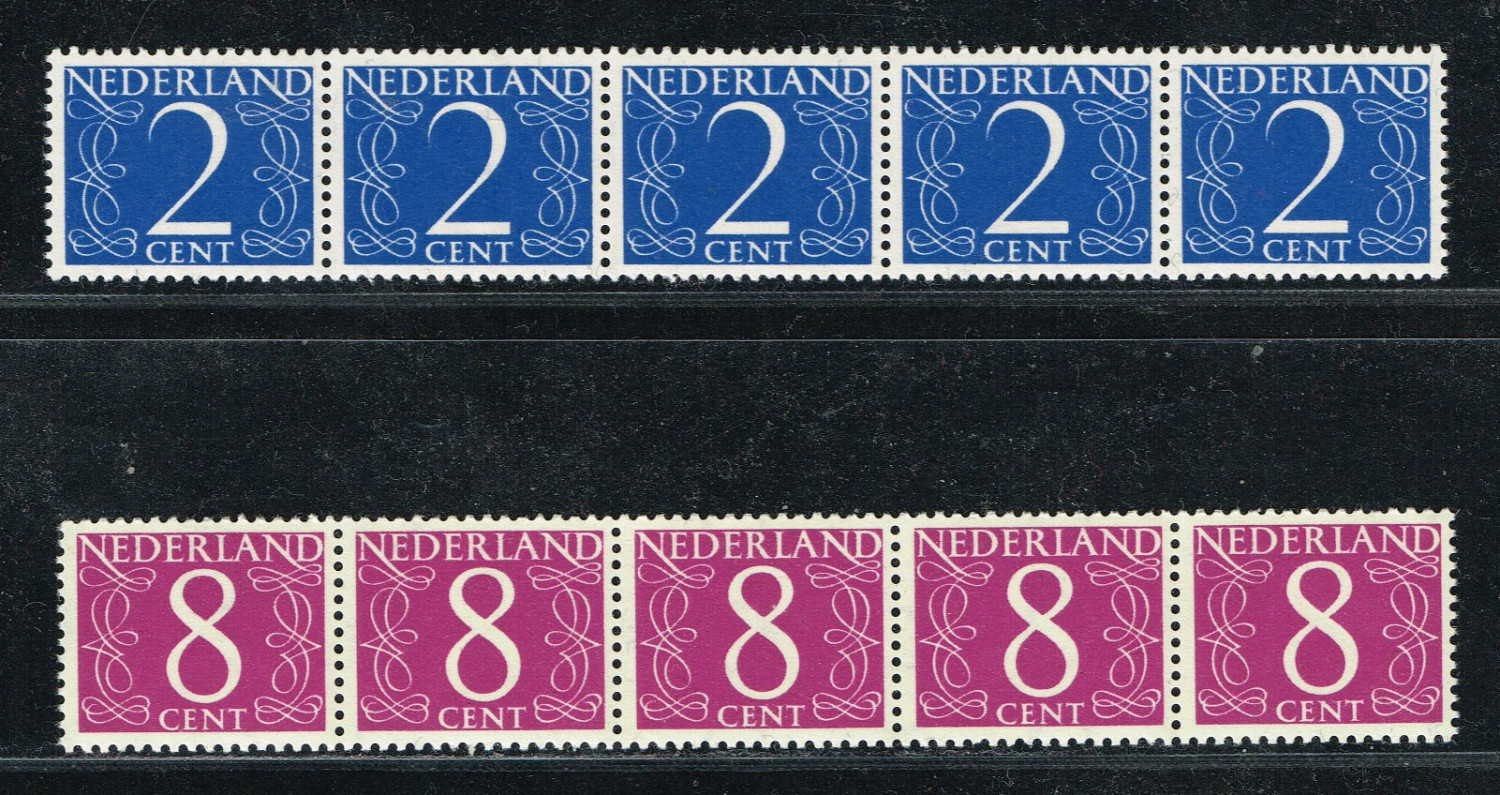
The stamps with face values of 2 cent and 4 cent were issued in the same colours as the contemporary Dutch stamps.





 Posted 04/11/2022 8:18 pm