| Author |
 Replies: 12 / Views: 1,072 Replies: 12 / Views: 1,072 |
|
|
Valued Member
Canada
30 Posts |
|
|
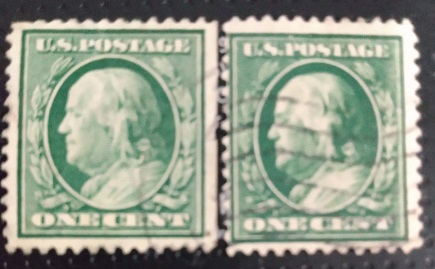 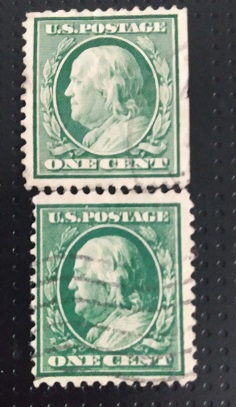 The info says this stamp was only made on a flat plate with a few exceptions but the one cent design was not one of the exceptions as far as I can see what I think is one of the stamps is wider tan the other and one has the fresh look of a flat plate printing and the other is grainy like the rotary press printing but im confused |
|
Send note to Staff
|
|
|
|
|
Valued Member
Canada
30 Posts |
|
|
I know this is far from the correct way to show the stamps but im hoping it will give a basic idea
|
Send note to Staff 
|
|
|
Bedrock Of The Community
12757 Posts |
|
|
Flat press vs rotary press is a matter of design size, not paper size. Rotary press stamps were printed using curved plates as opposed to flat plates. There is just so much to discuss when it comes to the basics.
I highly suggest going to Stamp Smarter and reading your brains out in conjunction with looking at your stamps. |
|
Send note to Staff
|
|
|
Pillar Of The Community

United States
1498 Posts |
|
|
This design was issued in both sheet & booklet format. I don't recall the details, but I believe the booklet & sheet stamps were printed on paper whose grain ran in different directions. This resulted in different rates of shrinkage while the sheets were drying ... and hence slightly different physical dimensions.
Added: There's an excellent chance that your stamp with one straight edge is from a booklet.
Added: Had to look this up to make sure I (maybe) got it right. The paper grain on booklet stamps of the era ran horizontally while that for sheet stamps ran vertically. The stamps were produced on moistened paper … and said paper, while drying, shrank 4 times more across the grain than with the grain. Consequently, booklet & sheet stamps will have slightly different physical dimensions based on the type of paper (booklet or sheet) used.
Note that, in 1928, in an attempt to be frugal some sheet stamps were printed on special booklet paper. While philatelists were well aware of the resulting size difference in sheet & booklet stamps, Scott only added the special booklet issues to their catalogue in 2020. As I recall, there were 11 such stamps. The special booklet stamps are slightly scarcer than their sheet counterparts and therefore have a higher (usually about 2x) catalogue value. |
|
Send note to Staff
|
| Edited by JLLebbert - 04/08/2022 4:51 pm |
|
|
Pillar Of The Community
6363 Posts |
|
|
Both of these are flat plate stamps.
The difference is indeed sheet (taller & skinnier) vs booklet (shorter & wider), due to paper grain as noted above. The Scott catalog is not helpful with regard to these since they do not differentiate sheet vs booklets stamps in enough detail, thus creating the exact situation you found. |
|
Send note to Staff
|
|
|
Bedrock Of The Community
12757 Posts |
|
|
All of the paper discussion is awesome, educational and informative but I think the main issue here was what makes the rotary and flat plate printings different. I am curious if Lori read up on this and understands a bit better? |
|
Send note to Staff
|
|
|
Pillar Of The Community
6363 Posts |
|
|
rogdcam,
I'm confused. Why do you insist upon bringing irrelevant rotary printings into this thread when the two stamps in question are both flat plate printings? Fully understanding the Washington/Franklins is like eating a whale, it is best to take it one small bite at a time. |
|
Send note to Staff
|
|
|
Bedrock Of The Community
12757 Posts |
|
|
Well John, I brought up rotary and flat because the OP's very first post was: Quote:
The info says this stamp was only made on a flat plate with a few exceptions but the one cent design was not one of the exceptions as far as I can see
what I think is one of the stamps is wider tan the other and one has the fresh look of a flat plate printing and the other is grainy like the rotary press printing
but im confused If you feel that I misspoke somehow or have any issues with my comment I apologize. It was not criticism towards you at all. Just the opposite in fact. I was asking the OP if they had some clarity now regarding flat vs. rotary etc.. Are we good? |
|
Send note to Staff
|
|
|
Pillar Of The Community
6363 Posts |
|
|
My point was to keep it simple. It was very easy, as the rest of us had replied, to quickly dismiss the rotary aspect as not applying to this design at all. You think it is important. I do not. We may have to disagree, but I see the rotary discussion as fogging the issue. |
|
Send note to Staff
|
|
|
Bedrock Of The Community
12757 Posts |
|
|
John - I was asking the OP a question. I am not even sure what this back and forth is about. It has nothing to do with you. Am I allowed to ask the OP a question? Quote:
I see the rotary discussion as fogging the issue. Noted. I will ask you next time before I post. |
|
Send note to Staff
|
|
|
Pillar Of The Community
6363 Posts |
|
|
Lori,
First, welcome to the Family. Second, you'll note that the family sometimes bickers. Such is the case here. I humbly apologize for your thread having gone astray.
As noted by several of us, your two stamps are both flat plate printings, one from a booklet, one from a sheet, manufactured with the dampened paper turned 90 degrees during the printing thus creating the slight difference in final size when the paper is dried for gumming and perforating, as you discovered.
In my opinion, since this thread dealt specifically with the differences between 2 flat plate stamps, I thought it best to keep this thread on-point. The idea that Rogdcam's introduction of rotary printings and suggesting "the main issue here was what makes the rotary and flat plate printings different" is a complete misunderstanding of your original question. It is certainly not the "main" issue, but apparently he disagrees.
Lori, I also concede to you that I missed Rogdcam's sentence of "I am curious if Lori read up on this and understands a bit better?" as a direct question.
Bottom line, in my opinion, to understand your two stamps shown here, I would re-read the posts made here so far, paying attention only to those directly pertaining to flat plate printing. Then when you have a question about stamps printed by other methods, they can be addressed separately. Good luck! -John |
|
Send note to Staff
|
|
|
Pillar Of The Community
United Kingdom
8632 Posts |
|
|
I had imagined that prescriptions were the province of doctors, not participants in online fora. |
|
Send note to Staff
|
|
|
Bedrock Of The Community
12757 Posts |
|
| |
Replies: 12 / Views: 1,072 |
|



 Posted 04/08/2022 2:53 pm


