Quote:
It is hard to tell from eye-balling the stamps if this is a colour shift, at least for me. I cannot see how the black colour is shifted anywhere else on the stamp, which it would be if there was a shift.
Well, I was wrong. There are colour shifts.
This may all fit nicely into the plating of these booklets mentioned above but . . .
Quote:
one where there are only two long hairs outside the frame and one where two long and two short are outside
guess what, there is a way to sort the stamps out a little bit just by eye. This makes it fun for the collector who doesn't really want to scan every stamp he has at 800 to 1200 dots per inch and study them.
There are two general 'types' with variations between and outside of those pictured below.
I choose two booklets and made scans at 600 dpi of portions of stamp 2-3 and stamp 2-4, second row, last two stamps.
From booklet 020341:
Tail touches frame . . Blue belly . . Green Belly and Fin
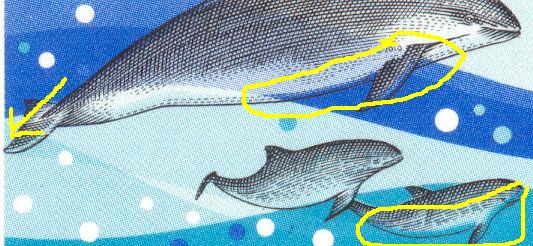
From booklet 091657:
Tail free of frame . . Bare belly . . Green Fin Only
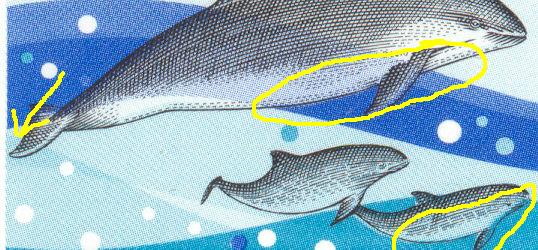
From booklet 020431:
Baby touches green wave (or Blunt green wave) . . Short two-haired tail
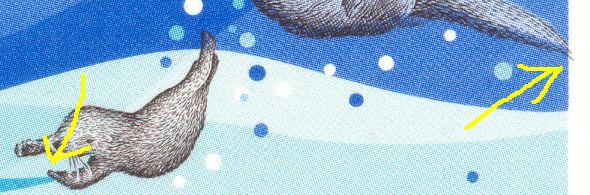
From booklet 091657:
Baby free of green wave (or Pointy green wave) . . Long three-haired tail
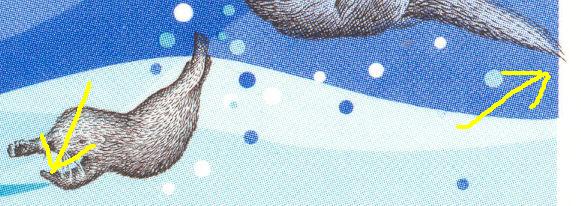
There are, generally, stamps where all the animals seem shifted to the left and the others where the animals seem shifted to the right. I have one booklet where the baby porpoise's belly has a wide white space between the water and the baby.
So, really, these are not constant varieties that can be named for catalogue purposes, (perhaps?) but . . . they are easy to see and collect, no good eye-sight or scanner needed.
Lastly, because I have not studied a lot of booklets yet, just posted my first findings, there may be a way to plate the stamps roughly by animal and wave position, if only to say this stamp came from plate 1 and this from plate 3. Then you would go deeper into the exact positioning of dots after that. if you wanted to. (?)





 Posted 09/11/2010 04:22 am


