A further note about the light and dark: some booklets seem to be not so dramatically visible as that pictured above. Some are closer to each other in depth of shade. I want to get some used ones and see what I can see with them also.
Another interesting oddity perhaps. Visible to the naked eye or, with poor eye-sight, a 4x to 8x magnifier!
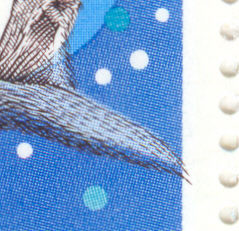
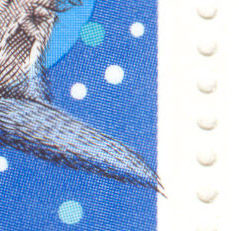
These are the Harbour Porpoise's mother's tails (try saying that fast a few times!) from the booklet with serial number 039867. Interesting stuff happens in the 3x,xxx area seemingly.)
Scanned at 600 dpi, sorry for my poor aligning skills.
Row 1, column 1 and column 3
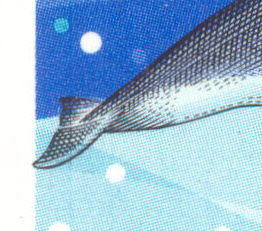
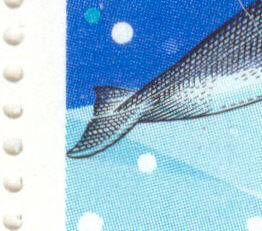
Row 2, column 1 and column 3.
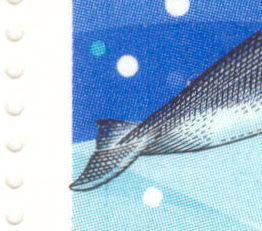
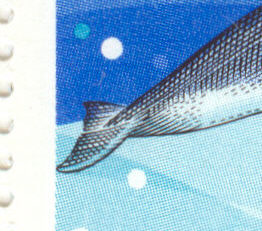
On the left-hand two stamps the porpoise's tail sticks out past the frame edge, on the right-hand two stamps it does Not stick out.
Does this (and the post above about green waves) suggest that the stamps were printed not only with cylinders 1 and 2 and plates but with further types reduction to left and right blocks on each booklet?
Or perhaps, since I have not ventured too deeply into the plating aspect yet (counting dots of colour) this will become more apparent when the plates are known?
I personally would like to tell these stamps apart, one from another, by more visible means than dots, which requires the eyes of a teenager or a good scanner and the patience of Job.
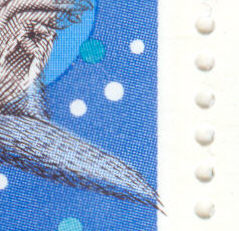
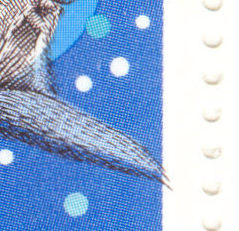
On this same booklet (039867) the Sea Otter's mother's tail's hairs extending beyond the frame edge would be thought to be moved towards the left on the left-hand stamps, if the porpoise's had been. But they have seemed to stay pretty well the same as the right hand stamps.
Row 1, column 2 and column 4:
Row 2, column 2 and column 4:





 Posted 10/20/2010 10:35 pm


