Hi folks,
I have a cover, pictured below, that I'd like some help with please.
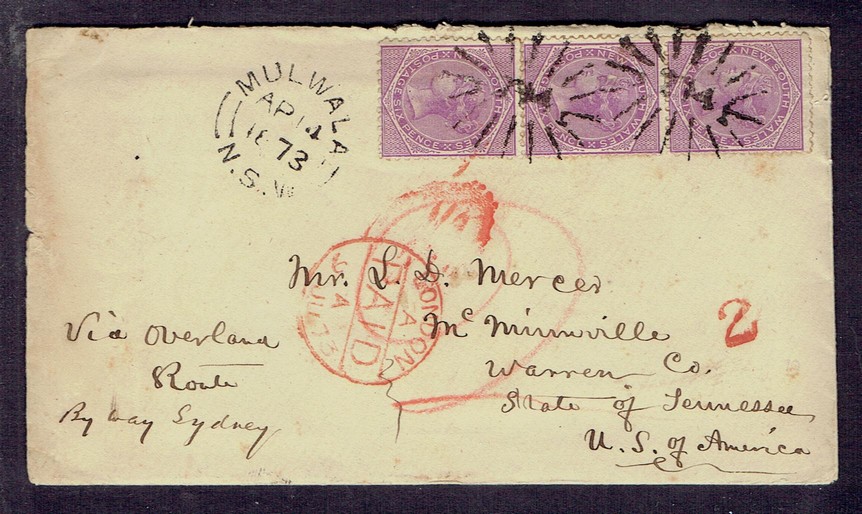
The letter was described as a triple rate letter but I don't think this is correct.
The letter with contents weighs 6.24 grams, or less than 1/4oz, but of course there may have been an enclosure, but I don't think there was.
In April 1873 there was no service from Sydney to San Francisco (the rate was 6d per 1/2oz, and was again when the service was reinstated), so any mail to the USA was routed via Great Britain, either via Brindisi or Southampton direct. The rates were 11d and 8d per 1/2oz respectively.
The letter bears 1'6 postage. This overpays the via Brindisi rate by 7d or the Southampton direct rate by 10d. A double rate letter by the Southampton route would still be overpaid by 2d.
The London datestamp proves that the letter was sent via Brindisi, as the ship arrived in Southampton 5 days later.
I believe the '2' in red is an accountancy mark, applied in London, that would indicate the British PO is claiming 2 cents from the US Post Office.
How is this charge calculated?
Is it by each letter or the
weight of each letter? If it was a double rate letter would it have received a '4' cents handstamp?
My hunch is that the letter has simply been overpaid, the stamps perhaps applied before the envelope was lodged at the Post Office.
Any thoughts, particularly in regards to the accountancy handstamp, would be much appreciated





 Posted 10/15/2022 01:21 am