Stamp Community Family of Web Sites
Thousands of stamps, consistently graded, competitively priced and hundreds of in-depth blog posts to read


Stamp Community Forum
 
Username:
Password:
Save Password
Forgot your Password?

This page may contain links that result in small commissions to keep this free site up and running.

Welcome Guest! Registering and/or logging in will remove the anchor (bottom) ads. It's Free!

Portugal 1960 Issue - Question

 
To participate in the forum you must log in or register.
Author Previous TopicReplies: 10 / Views: 1,696Next Topic  
Valued Member
Canada
378 Posts
Posted 05/23/2010   7:19 pm  Show Profile Bookmark this topic Add Tony Vella to your friends list Get a Link to this Message


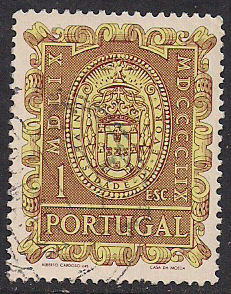
Here is a 1960 Portugal issue showing the official seal of the University of Évora commemorating the 400th anniversary of the university.
On the left, in Roman numerals it shows the year the univ. was established (1559) and on the right it shows the 400th anniversary (1959).
Now, as I was taught, 1959 in Roman numerals is:
1000 = M
900 = CM (100 less than 1000)
50 = L
9 = IX (1 less than 10)
1959 = MCMLIX

I have never seen 900 shown as DCCCC; I have never seen/noticed a quad in Roman numerals, e.g. XXXX or CCCC or MMMM, etc. as a matter of fact. Any ideas? Thanks in advance.
Send note to Staff
--
Tony Vella
Ottawa, Ontario, Canada
Edited by Tony Vella - 05/23/2010 7:27 pm

Valued Member
United States
333 Posts
Posted 05/23/2010   11:50 pm  Show Profile Bookmark this reply Add lucky to your friends list  Get a Link to this Reply
Hi Tony,

I think this is the breakdown you need.
For 1959:

M=1000
D=500
CCCC=400 (C=100 X 4)
L=50
IX=9

and for 1559:

M=1000
D=500
L=50
IX=9

Hope this helps.

Lucky
Send note to Staff  Go to Top of Page
Rest in Peace
Canada
6750 Posts
Posted 05/24/2010   12:12 am  Show Profile Bookmark this reply Add Puzzler to your friends list  Get a Link to this Reply
I have never seen that type of breakdown either Tony.
Perhaps it is a way they did it in Portugal in 1559 so they did it that way to make it seem more revered and older somehow?
Send note to Staff  Go to Top of Page
Valued Member
Canada
378 Posts
Posted 05/24/2010   01:17 am  Show Profile Bookmark this reply Add Tony Vella to your friends list  Get a Link to this Reply
Hi Lucky.
As I mentioned in my original post I have never seen a quad (same letter four times consecutively) in Latin numbers.
The fourth is always represented by one less than the next whole.
Why Portugal is different in this instance is what I find intriguing.
Take for example 1 to 10 - four is one less than five and nine is one less than ten:
I, II, III, IV, V, VI, VII, VIII, IX, X.
I couldn't imagine 44 (XLIV) as XXXXIIII.
If you should come across a quad anywhere on the NET I should love to see it. Perhaps there would be an explanation.
Send note to Staff  Go to Top of Page
--
Tony Vella
Ottawa, Ontario, Canada
Rest in Peace
Canada
6750 Posts
Posted 05/24/2010   02:37 am  Show Profile Bookmark this reply Add Puzzler to your friends list  Get a Link to this Reply
Taken from part of an article on Wikipedia about Roman Numerals
http://en.wikipedia.org/wiki/Roman_numerals

IIII and IV

The notation of Roman numerals has varied through the centuries. Originally, it was common to use IIII to represent four, because IV represented the Roman god Jupiter, whose Latin name, IVPPITER, begins with IV. The subtractive notation (which uses IV instead of IIII) has become the standard notation only in modern times. For example, Forme of Cury, a manuscript from 1390, uses IX for nine, but IIII for four. Another document in the same manuscript, from 1381, uses IX and IV. A third document in the same manuscript uses IX and a mix of IIII and IV. Constructions such as IIIII for five, IIX for eight or VV for 10 have also been discovered. Subtractive notation arose from regular Latin usage: the number 18 was duodeviginti or “two from twenty”; the number 19 was undeviginti or "one from twenty". The use of subtractive notation increased the complexity of performing Roman arithmetic, without conveying the benefits of a full positional notation system.
An inscription on Admiralty Arch, London. The numeral translates to 1910.

Likewise, on some buildings it is possible to see MDCCCCX, for example, representing 1910 instead of MCMX â€" notably Admiralty Arch in London. The Leader Building in Cleveland, Ohio, at the corner of Superior Avenue and East 6th Street, is marked MDCCCCXII, representing 1912 instead of MCMXII. Another notable example is on Harvard Medical School's Gordon Hall, which reads MDCCCCIIII for 1904 instead of MCMIV. In Dubrovnik, Croatia, a commemorative inscription marking the 1000th anniversary of King Tomislav’s coronation (Croatia’s first King), appears as DCCCCXXV - MDCCCCXXV instead of CMXXV - MCMXXV (925 -1925).
Send note to Staff  Go to Top of Page
Rest in Peace
Canada
6750 Posts
Posted 05/24/2010   02:39 am  Show Profile Bookmark this reply Add Puzzler to your friends list  Get a Link to this Reply
Gives you a bit of a jog though, to see something you thought was one way and is represented in another. You think, well, that is just wrong. It doesn't fit in your understanding of the world.

Fascinating Tony. Thanks for asking. I learned something.
Send note to Staff  Go to Top of Page
Valued Member
Canada
378 Posts
Posted 05/24/2010   08:53 am  Show Profile Bookmark this reply Add Tony Vella to your friends list  Get a Link to this Reply
Thanks very much, Puzzler, never too old to learn something new.
I had never seen such Latin numerals before.
As Tacitus and Sherlock Holmes were wont to say:
Omne ignotum pro magnifico.
Send note to Staff  Go to Top of Page
--
Tony Vella
Ottawa, Ontario, Canada
Pillar Of The Community
Australia
2027 Posts
Posted 05/24/2010   09:40 am  Show Profile Bookmark this reply Add jubilee to your friends list  Get a Link to this Reply
The notation can be found on many, many buildings, and it's the only place I've seen this type of notation
Send note to Staff  Go to Top of Page
Pillar Of The Community
United States
576 Posts
Posted 05/24/2010   8:39 pm  Show Profile Bookmark this reply Add cgrotha to your friends list  Get a Link to this Reply
Tony is so right. You're never to old to learn something new. And the really great thing is that a lot of us can learn the same new things over and over and over again.
Send note to Staff  Go to Top of Page
Pillar Of The Community
Canada
737 Posts
Posted 05/25/2010   09:39 am  Show Profile Bookmark this reply Add Ryan to your friends list  Get a Link to this Reply
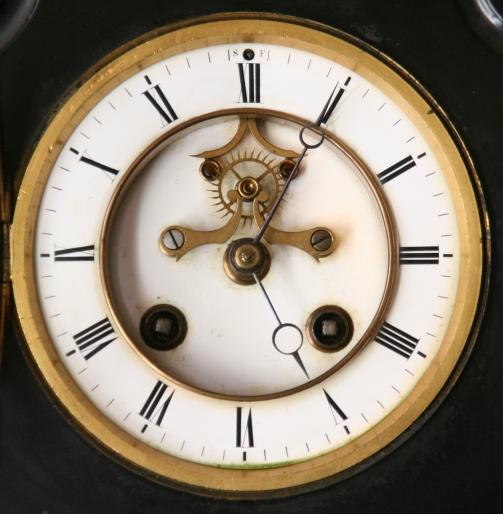
I have seen "IIII" often on clock faces that use Roman numerals. In fact, this web page largely deals with examples of clocks that use Roman numerals without using "IIII".

http://www.web40571.clarahost.co.uk...lockface.htm

Ryan


Send note to Staff  Go to Top of Page
Valued Member
Canada
378 Posts
Posted 05/25/2010   09:55 am  Show Profile Bookmark this reply Add Tony Vella to your friends list  Get a Link to this Reply
Hi Ryan. On this particular clock, it makes me wonder why nine is shown IX and not VIIII.
Simply to limit the maximum number of digits to four doesn't seem very logical, does it?
Send note to Staff  Go to Top of Page
--
Tony Vella
Ottawa, Ontario, Canada
  Previous TopicReplies: 10 / Views: 1,696Next Topic  
 
To participate in the forum you must log in or register.

Go to Top of Page

Disclaimer: While a tremendous amount of effort goes into ensuring the accuracy of the information contained in this site, Stamp Community assumes no liability for errors. Copyright 2005 - 2026 Stamp Community Family - All rights reserved worldwide. Use of any images or content on this website without prior written permission of Stamp Community or the original lender is strictly prohibited.
Privacy Policy / Terms of Use    Advertise Here
Stamp Community Forum © 2007 - 2026 Stamp Community Forums
It took 0.23 seconds to lick this stamp. Powered By: Snitz Forums 2000 Version 3.4.05