| Author |
 Replies: 365 / Views: 66,051 Replies: 365 / Views: 66,051 |
|
|
|
Bedrock Of The Community
Australia
38679 Posts |
|
|
The Rama Varna Hostel were the
rooms of the Maharaja's College, Ernakulam.
Now moved to Travancore.
|
Send note to Staff 
|
|
|
Pillar Of The Community
Australia
3547 Posts |
|
|
Bedrock Of The Community
Australia
38679 Posts |
|
|
I am surprised you have any tongue left to bite Tony  That's what makes you such a nice fella. |
|
Send note to Staff
|
|
|
Bedrock Of The Community
Australia
38679 Posts |
|
|
I often like to illustrate the gifts India has given us.
"Catamaran"
Kattu = to tie
Maram = a type of wood (in Tamil Nadu south east coast)
The Catamaran: First discovered by a fellow who was born about
5 Km from where I grew up.
Mr. William Dampier. Pirate and explorer.
|
|
Send note to Staff
|
|
|
Pillar Of The Community
Australia
3547 Posts |
|
|
After the postings elsewhere concerning 'gallivat', I was moved to try to chase down the derivation of 'gallivant'. It appears the origin of 'gallivant' is uncertain, but that it's first attested in English from about 1811. Now, I wonder ... |
|
Send note to Staff
|
|
|
Valued Member
India
159 Posts |
|
|
Hi Tony & rod222 Interesting information..  in the discussions and surprised by the knowledge you both have about our places. Sadly, many of our present generation subjects, who have left and settled elsewhere have not kept up with the older links. I was lucky by the fact that even though being born and brought up in Mumbai, six years of my schooling was in Kerala and I passed my 10th standard in malayalam medium. May I write something about Malayalam words - in fact this is a tough language in India with plenty of tongue twisters. A slight change in the pronunciation will make the situation (a)normal - what it meant (b)humorous or (c)end up in a brawl.....  Now about rod222's "Catamaran" Really it should be "Kaatu" (meaning - wind) and "maaraan" (meaning - to change) - the combination of both words may have grown into "Catamaran" - maybe something to do with changing the sails according to the wind direction...... I am not sure since I am not an expert.  . At the end of this I will mention about the interesting story of how the word "Cashewnut" was formed - it is commonly mentioned in Kerala. Kattu - means ... - stole Maram - means tree or wood - used for any location... Now the "Cashewnut" (commonly available in Kerala, Goa etc..). The story is supposed to have taken place in Kerala. A foreigner - we had British rule remember - went to the market and happened to see a native trader selling his wares in which there were "cashewnut" - seeing this item for the first time he asked the native - "What is this thing you are selling ?". The native did not understand English and thought that he was being asked about the price. So he told "Kaashinu ettu" meaning eight for one Kaashu. The foreigner told him "OK, OK - so this thing is called Cashewnut yeah! - great..."  Thus formed the name "Cashewnut". In Malayalam we call it "Cashuwandi". . I hope this para was not so long. These type of stories are many - not only with words in malayalam and english. There is another one with malayalam and tamil words. With your permission I shall narrate it later......... Regards and Thanks Thomas |
|
Send note to Staff
|
|
|
Pillar Of The Community
Australia
3547 Posts |
|
|
A nice story about the 'cashew nuts', Thomas!
Speakers of other languages often get agitated about the numbers of English words that invade their own languages. (It's a regular complaint in an online Indonesian language and translation group I belong to.) The people who complain so loudly forget that English is one of the greatest borrowers of words from other languages. If all the non-Anglo-Saxon words were banned from modern English, we'd have a pretty hard time of it communicating - and not just about catamarans and cashew nuts. |
|
Send note to Staff
|
|
|
Bedrock Of The Community
Australia
38679 Posts |
|
|
Bored minds must think alike [quote][After the postings elsewhere concerning 'gallivat', I was moved to try to chase down the derivation of 'gallivant'. It appears the origin of 'gallivant' is uncertain, but that it's first attested in English from about 1811. Now, I wonder ... /quote] I thought exactly the same thing, pondered it for a while, and gave up thinking my thought process was extravagant. |
|
Send note to Staff
|
|
|
Bedrock Of The Community
Australia
38679 Posts |
|
|
Thomas, loved the Cashew nut yarn :) In the true spirit of "Chinese Whispers" perhaps I was just passing on misinformation...... 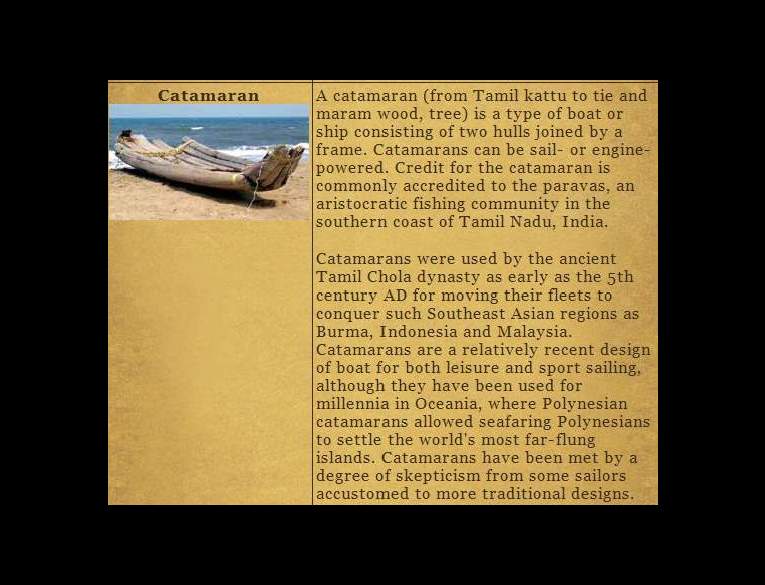 |
|
Send note to Staff
|
|
|
Valued Member
India
159 Posts |
|
|
Hi rod222 Read the attachment in your post and you are correct... In Tamil "kattu" means "tie". Please do not take offense on my explanation from a malayalee point of view and if you have felt so, I apologise. But being a Mallu myself, "kattu" is "stole" in malayalam and "kettu" is "tie"... . For example if you search for House boats in Kerala tours etc. you can find the word "kettuvallam" http://en.wikipedia.org/wiki/Kettuvallam. The problem of different meanings for the same words in our South part of India are also many. In Tamil the word for "snake" is "paambu" which is the same in Malayalam. But the word for "yes" in Tamil is "aama" and this means "tortoise" in Malayalam. So there was this Malayalee doctor in his hospital and a Tamil patient came running saying "Doctor! Doctor! A paambu bit me - please help me". The doctor asks "A paambu bit you?" and the patient says "aama"... The doctor (a malayalee) is confused - he asks "an "aama" bit you"? The patient says "no.. no.. a paambu bit me". The doctor says "OK.. a paambu bit you right?" The patient says "aama"... Regards Thomas |
|
Send note to Staff
|
|
|
Bedrock Of The Community
Australia
38679 Posts |
|
|
No apology required Thomas, none of us are perfect, always enjoy your posts and contributions. Language always has points of curiosity. I think Donna recently used "Segways" in her commentary, I have never heard of that word before in my life  As we speak, I am watching Australia vs Sri Lankan cricket  |
|
Send note to Staff
|
|
|
Valued Member
10 Posts |
|
|
Thomas
Your Kalletumkara specimen of 2nd Raja 3A is a very nice specimen
Regards
Tom
New member first post ever. |
|
Send note to Staff
|
|
|
Pillar Of The Community
Australia
3547 Posts |
|
|
Welcome Tom!
Do tell us a bit about yourself. Do you collect Cochin, too? If you do, please show us some of your collection. There are several of us here who would love to see what you have.
Tony |
|
Send note to Staff
|
|
|
Bedrock Of The Community
Australia
38679 Posts |
|
|
More gifts from India, to the English Language.
A litte Story :
Tommy Tucker was an army private,
at a skirmish in Northern India he was hit
by a Dum Dum bullet (a hollow nosed bullet),
He was repatriated to a Bungalow in Eastern India,
His wounds were serious, and after some weeks He was
going DooLally (off his mind) in hospital,
he was dressed in a suit of Calico, and sent home to England.
-----------
Expanding bullets were given the name Dum-dum, or dumdum, after an early British example produced in the
Dum Dum Arsenal, near Calcutta, India by Captain Neville Bertie-Clay.
Bungalow The term originated in India, deriving from the Gujarati bangalo, which in turn derives from the
Hindustani bangla, meaning "Bengali" and used elliptically for a "house in the Bengal style". Such houses were
traditionally small, only one story and thatched, and had a wide veranda.
Deolali, India, former site of a British Army transit camp
Deolali transit camp itself
"Gone Doolally", "doolally tap", or "doodle alley" - a phrase meaning to 'lose ones mind', derived from the
boredom felt at the Deolali British Army transit camp. 'Tap' may refer to the Urdu word tap a malarial fever,
therefore doolally tap refers to 'camp fever'.
Calico originated in Kozhikode, India (also known as Calicut) during the 11th century. It was mentioned in Indian
literature by the 12th century when the writer Hemacandra described calico fabric prints with a lotus design. By the
15th century calico from Gujarat made its appearance in Egypt. Trade with Europe followed from the 17th century
onwards. It was one of the first fabrics to be mass made during the Industrial Revolution in Britain, especially by
entrepreneurs like Richard Arkwright.
|
|
Send note to Staff
|
|
|
Pillar Of The Community
Australia
3547 Posts |
|
|
English is a wonderful ragbag of borrowings from other languages. It would be much easier to put together a list of languages English hadn't borrowed words from than languages it had.
Eighty or so years ago, the Australian musician Percy Grainger, and some others, tried to promote the idea of ridding English of all except the good old, native Anglo-Saxon words. He took this to silly lengths: he re-named the 'piano' (a horrid Italian word) a "keyed-hammer-string", and he never used a 'telephone' (all Greek) but a 'far talk thing'.
I say thank goodness for all these foreign words. They make life so much easier.
And we will all soon be speaking pidgin English anyway. Japanese friends tell me that two giant Japanese retail chains, Uniqlo and Rakuten, have now decreed that all internal communications in those organisations will henceforth be in English. |
|
Send note to Staff
|
|
|
Replies: 365 / Views: 66,051 |
|




 Posted 11/02/2010 12:01 pm


