| Author |
 Replies: 17 / Views: 1,554 Replies: 17 / Views: 1,554 |
|
Valued Member
Finland
59 Posts |
|
|
There are several varieties of this stamp. The fraction is 4 mm high and "2" has a straight foot, so it obviously is #85 in SACC.  |
|
Send note to Staff
|
|
|
|
|
Pillar Of The Community
Netherlands
6635 Posts |
|
|
Are you telling us, or is there an implied question in your post?
What other stamp would it be if not so obvious 4 mm high and with a straight foot? |
Send note to Staff 
|
| Edited by NSK - 02/23/2023 10:41 am |
|
|
Valued Member
Finland
59 Posts |
|
|
I usually try to avoid too strict expressions, so there was "obviously". And I also gave a chance to someone to correct me if I was wrong. |
|
Send note to Staff
|
|
|
Pillar Of The Community
Netherlands
6635 Posts |
|
|
Judging by the straight foot of the '2' in the fraction rather than a 'curled' foot, the candidates would be SG 85, 86, or 88, issued 13 February 1877.
The identification depends on the height of the fraction. These are 4½ (SG85), 4 (SG86), or 3½ (SG88) mm. From your picture, it is not possible to determine the height.
From this and another of your post, it looks like the SACC and SG catalogues have roughly parallel numberings. If it is 4 mm high, SACC 85 would be SG 86.
|
|
Send note to Staff
|
|
|
Valued Member
Finland
59 Posts |
|
|
I measured the height with a ruler and a magnifying glass. You can determine the height from the image with knowing that the perferation is 14. |
|
Send note to Staff
|
|
|
Pillar Of The Community
Netherlands
6635 Posts |
|
|
I assumed you measured correctly.
Perforations are rounded. So will be the heights of the fractions. Therefore, you cannot measure it from that knowledge.
And that is ignoring all kinds of distortions that may occur from scanning |
|
Send note to Staff
|
| Edited by NSK - 02/23/2023 11:46 am |
|
|
Bedrock Of The Community
Australia
38679 Posts |
|
|
The only way I find I can measure ½ mm, (accurately) on a postage stamp,
is to lay an engineer's steel rule on the stamp, apply slight pressure,
and use a magnifying glass, to line up the mm etchings.
|
|
Send note to Staff
|
| Edited by rod222 - 02/23/2023 5:11 pm |
|
|
Pillar Of The Community
United States
775 Posts |
|
|
Quote:
The only way I find I can measure ½ mm, (accurately) on a postage stamp, Here are two methods I use to measure accurately, both using my computer. I use Pixelmator but many other graphics programs will work just as well. If you scan at 600 or 1200 dpi you can accurately measure to 0.10 mm, without eye strain. 1. Scan the stamp and a transparent ruler together. Using a graphics program cut the ruler out and make the transparent parts of the ruler transparent. Overlay on the stamp to measure. 2. Scan the stamp and use the graphics program built-in ruler. |
|
Send note to Staff
|
|
|
Valued Member
Finland
59 Posts |
|
|
If the perforation is 14, then there are 14 perforations in 2 cm, and the distance between two is 1.429 mm. Then 4 mm equals to 2.8 perforations, 3.5 mm #8594; 2.45, and 4.5 mm #8594; 3.15. The differencies are big enough to easily see them.
I don't think that a scanner makes any distortion unlike a camera would do, and the phone cameras are the worst because of a very small diameter in the lens. |
|
Send note to Staff
|
|
|
Pillar Of The Community
Canada
1462 Posts |
|
|
Quote:
The only way I find I can measure ½ mm, (accurately) on a postage stamp,
is to lay an engineer's steel rule on the stamp, apply slight pressure,
and use a magnifying glass, to line up the mm etchings. My steel perf gauge has measurements to .5 mm on the edge so do the same with it - brilliant design. |
|
Send note to Staff
|
|
|
Valued Member
Finland
59 Posts |
|
|
Wouldn't you say that the height is more than 2.45 and less than 3.15 perforations? I would say that it is very close to 2.8 perforations (4 mm). It is that simple... 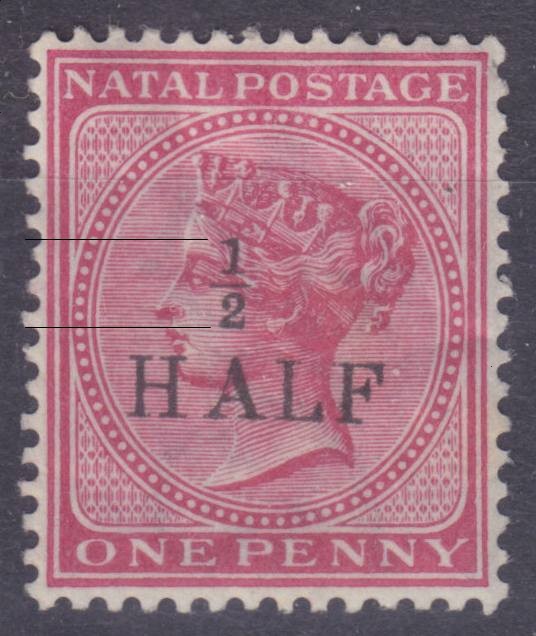 |
|
Send note to Staff
|
|
|
Bedrock Of The Community
Australia
38679 Posts |
|
|
Pillar Of The Community
United States
4164 Posts |
|
|
Valued Member
Finland
59 Posts |
|
|
Yes I know it. The relative difference between 13½ and 14 is 3.6%, while the relative difference between 3.5 and 4.0 is 12.5%. |
|
Send note to Staff
|
|
|
Pillar Of The Community
United States
7102 Posts |
|
|
If I had to double-check an auction listing image, I'd compare the relative heights of the fraction and "HALF" against other settings. Thankfully, we have someone with the stamp and a rule, and don't have to resort to guesswork or estimations.
Robson Lowe's Encyclopedia doesn't add much, if anything, to Gibbons Commonwealth for this.
E.W. Mann's writings on the Victorian postage stamps of Natal were published as a series in London Philatelist. No. 580, Volume 49, April, 1940, addresses this issue. There are a few interesting points to add here, for posterity.
The underlying stamp was printed in sheets of 240, with gutters separating four panes of 60.
We all know that the fraction and "HALF" were added in separate actions. Gibbons thinks that there were settings of 60, 6x10, for each. Mann theorizes that the fraction was added first, and was deemed to be insufficient for the purposes, resulting in the addition of "HALF" as a second step ("reinforcing" the fraction, in his words).
He also states that the fraction was a setting of 6x10, but allows that "HALF" may have been done in a larger setting. Perhaps it's later scholarship that has Gibbons stating that both were 6x10?
Mann describes six main types of the fraction, and four subtypes. The first six rows were all SG85, which seemingly accounts for the lower catalogue value. The remaining four rows were made up of two to six varieties (e.g., Row 7 was all different, with four main types and two subtypes). Supposedly, no SG85 is found in the last four rows, so SG85 should constitute sixty percent of what was printed.
My eyes have crossed looking at different settings. A few have a narrower H and some additional space between the H and the A, which is what appears to be the case here. Most have a wider H. I couldn't really match up the L and the F on examples with a narrower H, but that doesn't mean anything.
The HALF seems to have a significant "downhill" orientation, unless my eyes are playing tricks on me?
That's all added for whatever it's worth. |
|
Send note to Staff
|
| Edited by Cjd - 02/25/2023 11:55 am |
|
|
Bedrock Of The Community
Australia
38679 Posts |
|
|
Replies: 17 / Views: 1,554 |
|



 Posted 02/23/2023 10:24 am


