Stamp Community Family of Web Sites
Thousands of stamps, consistently graded, competitively priced and hundreds of in-depth blog posts to read


Stamp Community Forum
 
Username:
Password:
Save Password
Forgot your Password?

This page may contain links that result in small commissions to keep this free site up and running.

Welcome Guest! Registering and/or logging in will remove the anchor (bottom) ads. It's Free!

Nineteenth Century Questions

Previous Page
 
To participate in the forum you must log in or register.
Author Previous TopicReplies: 20 / Views: 1,547Next Topic
Page: of 2
Valued Member
United States
264 Posts
Posted 04/05/2023   10:38 pm  Show Profile Bookmark this reply Add Rick2 to your friends list  Get a Link to this Reply
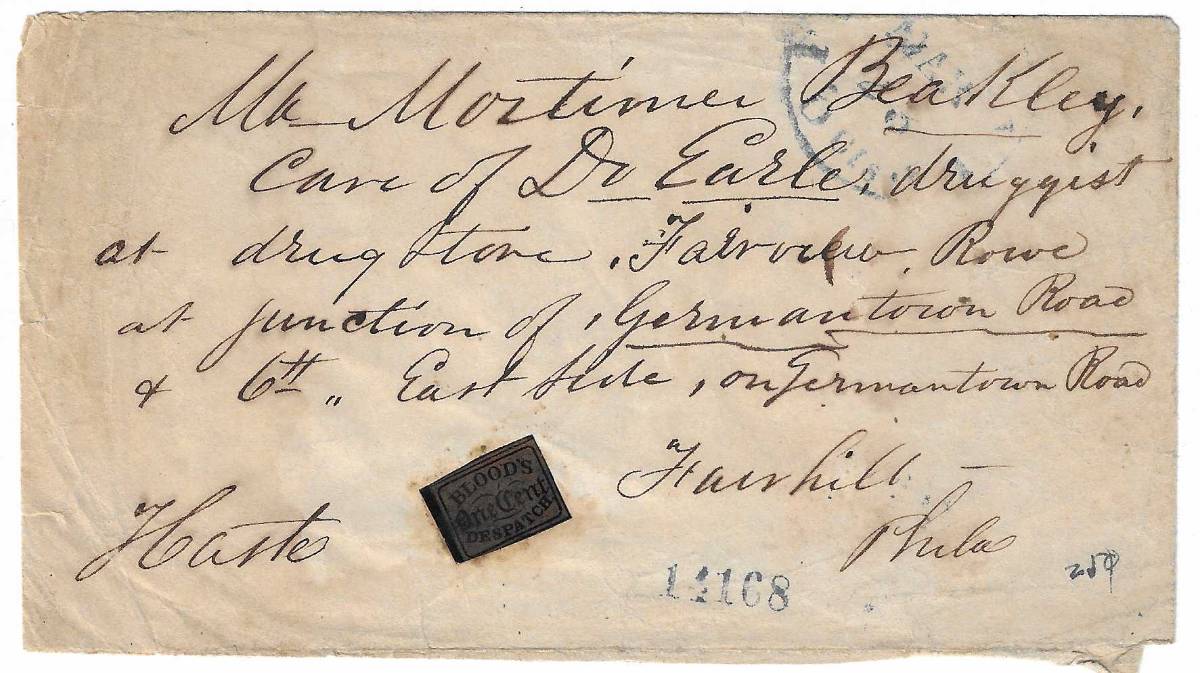
From 1850's......check out this address.....the sender sure wanted the delivery man to get this letter to its destination!!


Send note to Staff  Go to Top of Page
Edited by Rick2 - 04/05/2023 10:44 pm
Pillar Of The Community
Learn More...
United States
938 Posts
Posted 04/06/2023   10:34 am  Show Profile Bookmark this reply Add mml1942 to your friends list  Get a Link to this Reply
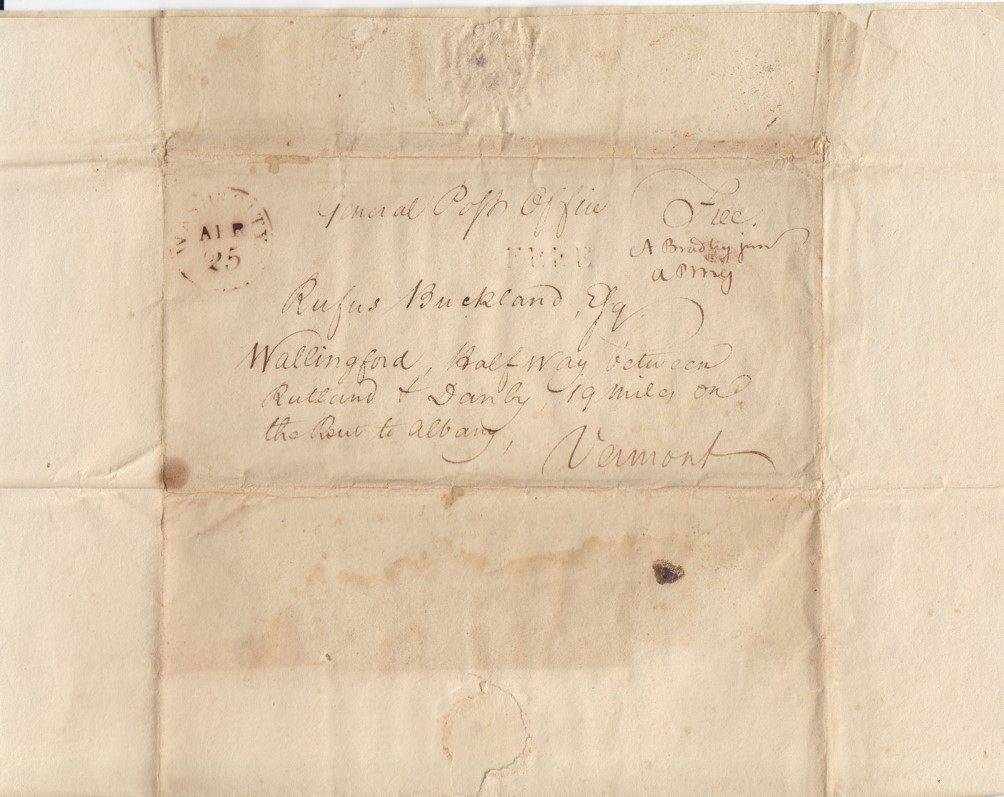
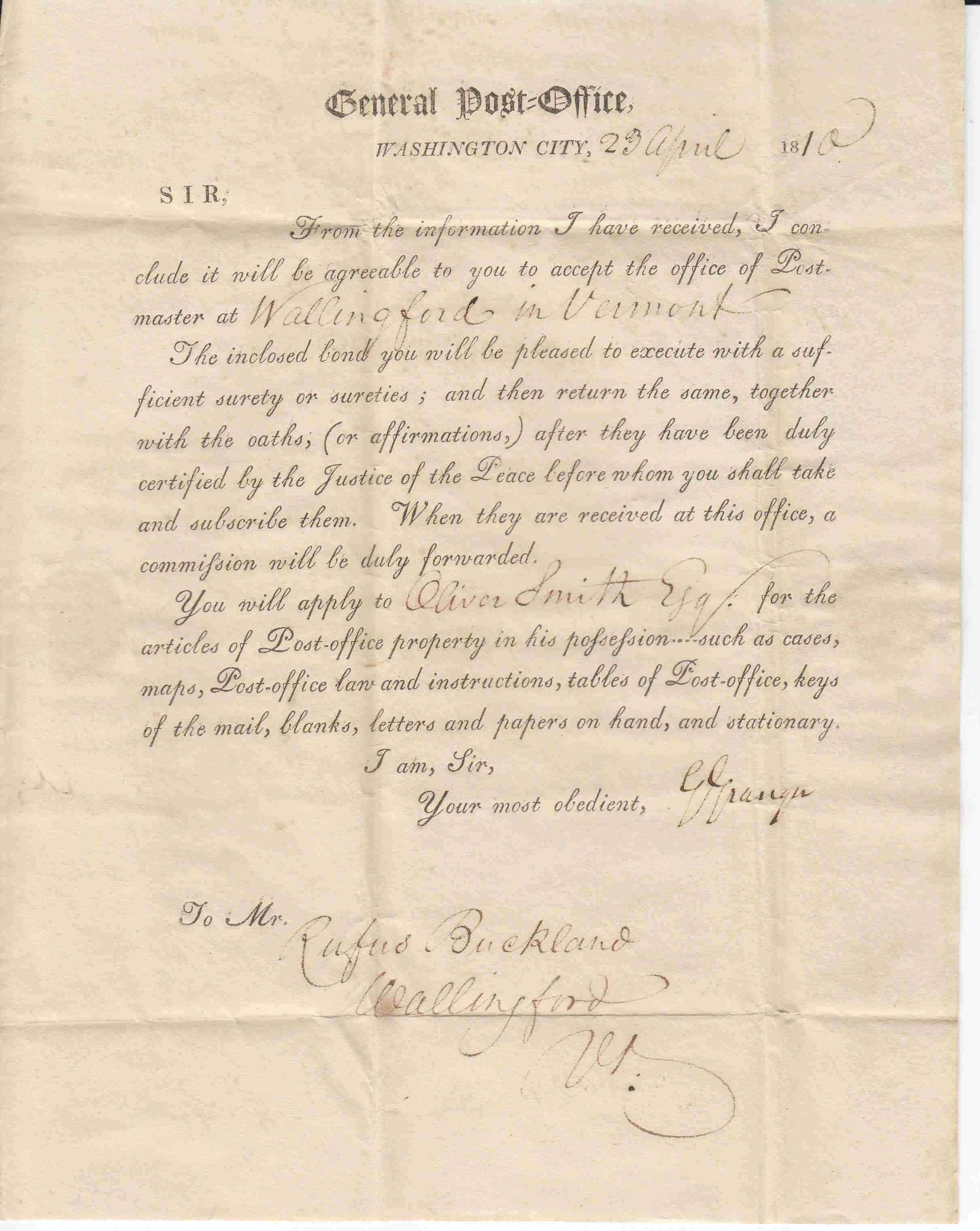
Here is a 1810 folded letter from Post Office headquarters in Washington, DC with a similar descriptive address.


The enclosed letter was an offer of a postmaster position to Rufus Buckland, for the post office at Wallingford VT.


No record has been located to verify that Buckland ever was a postmaster at Wallingford (or elsewhere) Either the letter was not delivered, or perhaps he decided to decline the opportunity.

According to Postmasters & Postoffices of the United States, 1782-1811 by Robert Stets, a man named Lent Ives became postmaster effective 11/07/1810 (date his bond received at PO HQ), replacing a previous postmaster named Oliver Smith (mentioned in the letter).
Send note to Staff  Go to Top of Page
Valued Member
United States
264 Posts
Posted 04/09/2023   5:09 pm  Show Profile Bookmark this reply Add Rick2 to your friends list  Get a Link to this Reply
Nice!!!
Send note to Staff  Go to Top of Page
Moderator
Learn More...
United States
12330 Posts
Posted 04/09/2023   5:45 pm  Show Profile Bookmark this reply Add 51studebaker to your friends list  Get a Link to this Reply
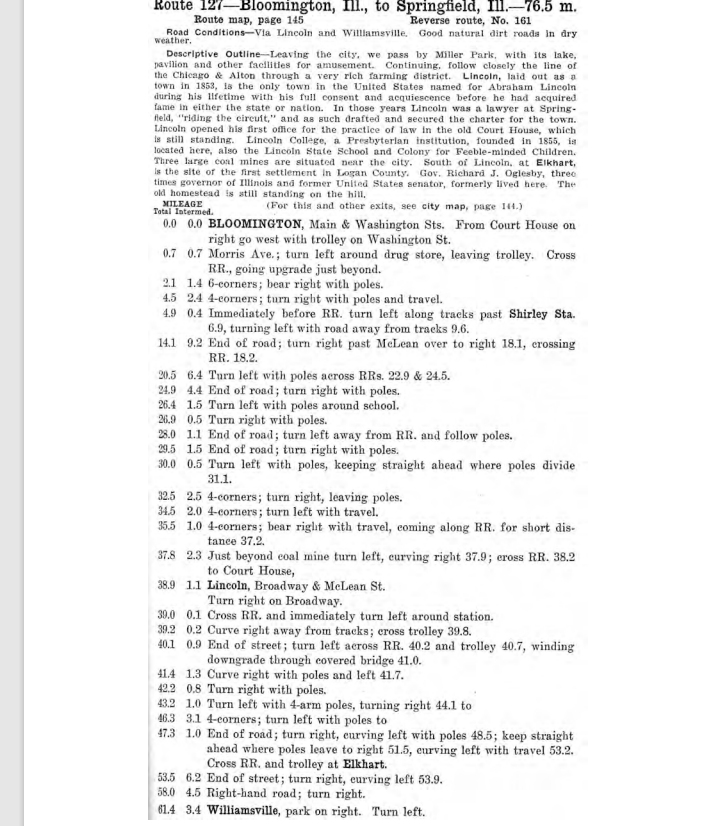
Early (1906 thru 1920) US "Automobile Blue Books" (the only real maps in the earliest years) were also very descriptive. Paved rural roads were rare and drivers at the time were literally on an adventure when traveling on unfamiliar roads.

The Blue Books fit well inside an automobile but reading them today provides insight into the state of road navigation in this time period. Without a lot of signage, navigation instructions often sounded like, "turn at large oak tree" or "turn left after passing a sheep pasture". The more rural the area, the more descriptive the navigation instruction became. Here is an example of a page from a Blue Book

Don
Send note to Staff  Go to Top of Page
Valued Member
Learn More...
United States
348 Posts
Posted 04/11/2023   11:10 am  Show Profile Bookmark this reply Add Chipshot to your friends list  Get a Link to this Reply
My mother was a school teacher and taught the Palmer method which Wiki has as

The Palmer Method of penmanship instruction was developed and promoted by Austin Palmer in the late 19th and early 20th centuries. It was largely created as a simplified style of the "Spencerian Method", which had been the major standardized system of handwriting since the 1840s.[1] The Palmer Method soon became the most popular handwriting system in the United States.[2]

Under the method, students were taught to adopt a uniform system of cursive writing with rhythmic motions.

History

Alphabet and numerals from The Palmer Method of Business Writing
The method developed around 1888 and was introduced in the book Palmer's Guide to Business Writing (1894).[3] Palmer's method involved "muscle motion" in which the more proximal muscles of the arm were used for movement, rather than allowing the fingers to move in writing. In spite of opposition from the major publishers, this textbook enjoyed great success: in 1912, one million copies were sold throughout the United States. The method won awards, including the Gold Medal at the Panama Pacific Exposition in San Francisco, in 1915, and the Gold Medal at the Sesquicentennial Exposition in Philadelphia, in 1926.[4]

Proponents of the Palmer Method emphasized its plainness and speed, that it was much faster than the laborious Spencerian Method, and that it allowed the writer to compete effectively with the typewriter.[5] To educators, the method's advocates emphasized regimentation, and that the method would thus be useful in schools to increase discipline and character, and could even reform delinquents.[6]

The Palmer Method began to fall out of popularity in the 1950s and was eventually supplanted by the Zaner-Bloser Method, which sought to teach children print writing (also called "manuscript printing") before teaching them cursive, in order to provide them with a means of written expression as soon as possible, and thus develop writing skills.[7] The D'Nealian Method, introduced in 1978, sought to address problems raised by the Zaner-Bloser Method, returning to a more cursive style of print writing. The Palmer company stopped publishing in the 1980s.
Send note to Staff  Go to Top of Page
Page: of 2 Previous TopicReplies: 20 / Views: 1,547Next Topic  
Previous Page
 
To participate in the forum you must log in or register.

Go to Top of Page

Disclaimer: While a tremendous amount of effort goes into ensuring the accuracy of the information contained in this site, Stamp Community assumes no liability for errors. Copyright 2005 - 2026 Stamp Community Family - All rights reserved worldwide. Use of any images or content on this website without prior written permission of Stamp Community or the original lender is strictly prohibited.
Privacy Policy / Terms of Use    Advertise Here
Stamp Community Forum © 2007 - 2026 Stamp Community Forums
It took 0.14 seconds to lick this stamp. Powered By: Snitz Forums 2000 Version 3.4.05