| Author |
 Replies: 34 / Views: 3,222 Replies: 34 / Views: 3,222 |
|
|
|
Bedrock Of The Community
12796 Posts |
|
|
The most comprehensive writing on the topic of counterfeit Kansas-Nebraska overprints: http://pascackstampclub.weebly.com/...erprints.pdfOne takeaway: Quote:
The most important thing to remember is that when
these stamps were overprinted, they were not yet
gummed. The manufacture of the stamps occurred in
this order: The stamps were printed, then overprinted,
then gummed, and then perforated. Had the stamps
been overprinted after gumming, they would have had
an indentation in the gum leaving an "embossed"
affect, but the genuine stamps do not have that condition. |
Send note to Staff 
|
|
|
Pillar Of The Community
United States
4189 Posts |
|
|
Genuine overprints have gum with only one gum breaker and striated ridges. OR two widely spaced gum breaker ridges near the very top and bottom of the stamp |
|
Send note to Staff
|
|
|
Pillar Of The Community
United States
1170 Posts |
|
|
So scott 669b is for the stamp that shows no ink where the period is to be but can have an impression? or is there another type of missing period where the plate was defective? Or does scott 669b include both scenarios in that listing? |
|
Send note to Staff
|
Michael Darabaris |
|
|
Moderator

United States
12330 Posts |
|
|
Bedrock Of The Community
United States
10876 Posts |
|
|
Again, these overprints were surface printed, just like pre-cancels. There is no "impression". |
|
Send note to Staff
|
|
|
Pillar Of The Community
United States
4470 Posts |
|
|
Quote:
OR two widely spaced gum breaker ridges near the very top and bottom of the stamp Painting with a broad brush. Details of some exceptions was not include by design. So if you are going to add details, do just stop there, add all the details for the differences between the correct base stamp to be overprinted. There are many such as no straight edge and only certain plate numbers were used and, and..... As to indentation on mint stamps with full gum, there will be no indication in the gum as the gum was applied after the overprint but some pressure was applied to the paper when the overprint was added. No you are not going to see paper dents as found with engraved stamps. Frankly anyone buying a K-N OP needs a cert to be sure of their purchase, but that is nonsensical due to the price for some of the stamps, less so for used. This is becoming true for almost any overprinted stamp today for example there is a huge number of so-called Darrah Shanghai Overprints regularly coming out of Romania. |
|
Send note to Staff
|
|
|
Bedrock Of The Community
United States
10876 Posts |
|
|
And the shades of the K-S overprinted stamps are generally paler and less bright then those issued later. BTW, the remains of the gum breakers can often be seen on used stamps by holding them reversed at an oblique angle to a light. They did mark the paper, and those shadows can often be seen. |
|
Send note to Staff
|
|
|
Bedrock Of The Community
12796 Posts |
|
|
Valued Member
United States
191 Posts |
|
|
Very interesting discussion here. You can have a have a blockage that would prevent an impression. In this case I would think an underinking is more the cause of this missing period. If a damaged plate I would think a crack line or something would be present. It may have never been there if the transfer was not completed on that stamp impression. I do not think a press team member would have noticed a missing dot. If so it was so small of an imperfection it was let threw. In any case it let the hobby a nice error to add to your collection. |
|
Send note to Staff
|
|
|
Pillar Of The Community
United States
1170 Posts |
|
|
Hi thanks for your reply. This stamp is listed in Scotts and all I am trying to find is what do they attribute the missing period error to? damaged plate? under inking? plate blockage? or all of the above? |
|
Send note to Staff
|
Michael Darabaris |
|
|
Pillar Of The Community

United States
948 Posts |
|
|
Pillar Of The Community
United States
3532 Posts |
|
|
Pillar Of The Community
United States
1170 Posts |
|
|
S0 I see my answer to my block of four is the plate got damaged and the periods weren't printed. on the others:
The random missing period examples shown here are different from a damaged plate variety. These indicate the problem was an ink rejection in which the surface tension (dryness) of the overprint was greater than the printed stamp surface. Some examples show a purple dot as op posed to the gloss black of the overprint. The electroplate also collected ink from the printed stamp and kept the black from adhering. With such a small area, being just a dot, both inks might have been dried and not printed any period at all. So it is possible that all values with overprints could have a missing period based on that explanation. |
|
Send note to Staff
|
Michael Darabaris |
|
|
Pillar Of The Community
United States
1162 Posts |
|
|
Yes, great exhibit, thanks for posting the link. I have a one cent Nebraska with a partially missing period that I always thought was a transition between the fully missing period, but now I am leaning towards an inking dryness issue rather than the damaged plate. 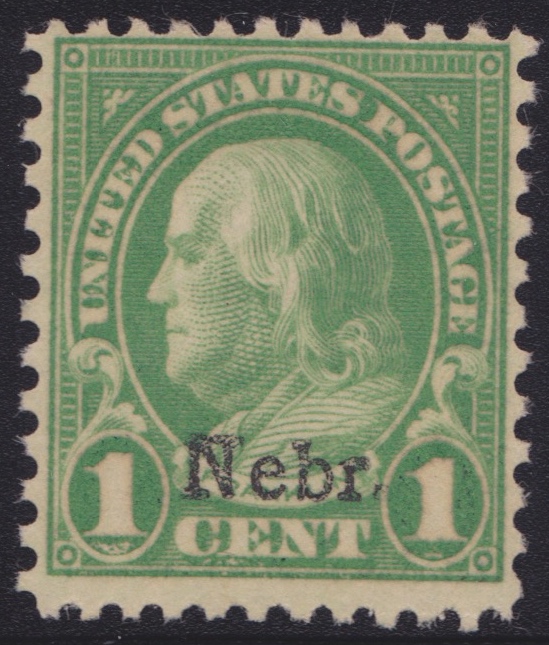 Unrelated, has anyone ever understood why the catalog value of the 8 cent Kansas is so high (mint or used) compared to the rest of the set? This exhibit says the 9 cent Nebraska was printed in the smallest quantity (about triple the number of 8c Kans were issued compared with the 9c Nebr and yet the 8 cent Kansas is more than twice the value of the 9c Nebr, mint or used). |
|
Send note to Staff
|
|
|
Valued Member
United States
158 Posts |
|
|
"The genuine overprints were surface printed, so they had no indentations. "
For those harping on "why not found on other values," keep in mind the letterpress printing was exactly the same as Bureau printed precancels on rotary press, and the "Hawaii" and "Molly Pitcher" commemorative overprints. There as not "one" set of press-mounted plates in many (most?) cases, so any production of a given set of overprint plates could result in 'one' missing period "once". A study of the ample Bureau precanceling literature will shed light on this. Even amongst 'one' plate, there can be what are called "setting varieties," noticeable spacing differences and so on. The Precancel society's journal, and the United States Specialist journal, carried copious listings of such specialist varieties found, in their editions of the first decades of Bureau precancels into at least the 1970s.
(For fun: the Bureau actually inverted "OHIO" for a few spots on precancel mats in the late 1950s on Liberty series regular precancel stamps. A quick search of online auctions will let you see these interesting critters. "Missing dot" pales in significance! -- that was a joke.) |
|
Send note to Staff
|
|
|
Replies: 34 / Views: 3,222 |
|




 Posted 05/14/2023 6:47 pm


